Instillators
Historical document, translated for reference. It reflects medical knowledge of the 1920s–30s and is not medical advice.
Summary
Instillators are instruments used in urology for the instillation of medicinal solutions into the urethra or bladder. This technique, first proposed by Guyon in 1867, allows for selective treatment of affected areas with controlled medication application.
Encyclopedia article (1928–1936)
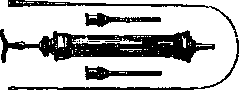
INSTILLATORS, instillation (from Latin instillare - to drip). In urology, instillation refers to the introduction of a strong solution of one or another medication into the urethra or bladder. The instruments used for this purpose are called instillators. The method was first proposed by Guyon in 1867. Introduction into the canal consists of slowly allowing the solution to drip drop by drop into a specific location in the urethra. In this way, one can act selectively on affected areas with a specific amount of medication. The effect of instillation depends not only on the strength of the solution, the number of drops, and the speed of instillation, but also on the method of application. For instillation, the following are necessary: a Guyon syringe (see illustration) and a thin elastic catheter (instillator) fitted with an olive. The Guyon syringe, with a capacity of 4 cm3, is distinguished by the fact that its piston moves by rotating the handle, with each half-turn of the handle expelling one drop of solution from the syringe. A cannula is fitted to the tip of the syringe, which is tightly inserted into the olive-shaped catheter. Instillation can, however, be performed with any syringe of 5-10 cm3 capacity with a pointed end. The Guyon instillator is fitted with olives of various calibers: olives from size 12 to size 16 on the Charrière scale are usually used. Catheters of Tuffier with an opening between two olives and a catheter for instillation with a stream directed backward are less convenient for instillation. The hard catheter of Ulzmann is no longer used. For instillation into the neck of the bladder, Albarran proposed a catheter with a large olive pierced with many openings, while Deno uses a curved silk catheter for the same purpose, the beak of which is also pierced with small openings. The patient is first made to urinate; the external opening of the canal, instruments, and the surgeon's hands are disinfected and prepared in the same way as before any catheterization. Instillation is best performed with the patient lying down. For instillation into the bladder, it must first be completely emptied of urine. The medication is instilled either directly into the bladder - in which case the olive of the catheter is inserted past the internal sphincter, and the contents of the syringe are emptied by pressing on the piston - or instilled into the bladder through the posterior part of the urethra. In this case, the olive is positioned in the membranous part, as for instillation into the posterior urethra; the drops follow one after another without interruption. This "indirect" instillation is of great importance because inflammation of the bladder is usually accompanied by inflammation of the posterior part of the canal. For instillation into the anterior part, the catheter is advanced to the so-called external sphincter, and the solution is introduced drop by drop as the instrument is slowly withdrawn. The patient compresses the external opening, thereby retaining the solution in the canal for 2-3 minutes. The first urination is usually not permitted until at least 1/2 - 1 hour later. In women, the technique of instillation is simpler: the catheter is inserted directly into the neck of the bladder. For instillation, solutions of silver salts are used, mainly silver nitrate, in concentrations from 1/2% to 2%, zinc sulfate, etc., sometimes, to avoid pain, after preliminary anesthesia. In the West, numerous protein compounds of silver are readily used - Protargol, Largin, Argonin, Ichthargan, Reargon, etc., which have no particular advantages. When choosing a preparation, it is necessary to consider the nature of the infection; for example, in tuberculous cystitis, silver nitrate is not tolerated, and the best results are obtained with methylene blue (1%), rivanol (1:5,000), sublimate (1:20,000), etc. Instillations into the urethra are indicated for chronic inflammations of it, mainly of a gonorrheal nature. Instillation is begun with weaker solutions, gradually increasing the concentration to cause a tissue reaction, i.e., discharge from the canal, which increases several hours after instillation. Further development of the principle of instillation as a limited effect only on the focus of the disease is endourethral therapy.
Instillation into the urethra is indicated for chronic inflammations, mainly of gonorrheal origin. Treatment begins with weaker solutions, gradually increasing concentration to provoke tissue reaction (discharge from the urethra occurring several hours after instillation). Further advancement of the instillation principle as a localized treatment is endourethral therapy.
Related articles
Cite this page
“Instillators.” Soviet Medical Encyclopedia. English translation of Bolshaya Meditsinskaya Entsiklopediya, 1st ed. (Moscow, 1928–1936), ed. N. A. Semashko. https://sovietmedicalencyclopedia.pages.dev/article/instillators/