Piston Recorder
Historical document, translated for reference. It reflects medical knowledge of the 1920s–30s and is not medical advice.
Summary
The piston recorder is an apparatus for the graphical registration of volume oscillations. Introduced into physiological practice by Roy and later modified by Tigerstedt, it consists of a glass cylinder with a precisely fitted rubber piston connected to a writing lever, used primarily with plethysmograph or oncometer devices.
Encyclopedia article (1928–1936)
PISTON-RECORDER, an apparatus for the graphical registration of volume oscillations. Introduced into physiological practice by Roy, it subsequently underwent changes in its construction. Among the most widely used types, the recorder of the Tigerstedt system should be mentioned. It consists of a glass cylinder g, 4 cm in height with a diameter of 1 cm (see figure), in which moves a carefully ground piston b made of hard rubber, hollow inside. An aluminum rod s is connected by means of movable joints to the piston and the writing lever h, and the point of application to the lever can be moved along the lever, which allows for changing the ratio of its arms. A movable weight d allows for balancing the lever.
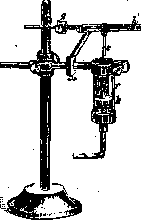
The lower part of the cylinder is closed by a metal cover, through the center of which passes a glass tube bent at a right angle on the outside, the end of which is connected by means of a rubber tube to the receiving apparatus. The transmission of oscillations from the receiving apparatus to the recorder occurs either through the column of air in the rubber tube or through the liquid with which the entire system is filled—the rubber and glass tube, as well as the cylinder itself up to the piston. Taken separately, the recorder is a recording apparatus similar to Marey's capsule, differing from the latter in that the recorder gives graph heights directly proportional to the volume, whereas in Marey's capsule these heights change depending on the tension of the membrane. This circumstance necessitates using the recorder primarily in those cases when the receiving apparatus is of the plethysmograph or oncometer type.
In the piston recorder, the author combined both the receiving and recording apparatuses into a single unit. He used it for registering volume oscillations of an isolated frog's heart during its activity. When using the recorder, reliable protection against sudden temperature fluctuations must be ensured, as these fluctuations will naturally affect the position of the piston.
Related articles
Cite this page
“Piston Recorder.” Soviet Medical Encyclopedia. English translation of Bolshaya Meditsinskaya Entsiklopediya, 1st ed. (Moscow, 1928–1936), ed. N. A. Semashko. https://sovietmedicalencyclopedia.pages.dev/article/piston-recorder/