Tonometry
Historical document, translated for reference. It reflects medical knowledge of the 1920s–30s and is not medical advice.
Summary
Tonometry is a method for measuring intraocular pressure, which determines the firmness or tonus of the eye. The article describes various tonometry techniques, including finger palpation and specialized instruments like the Maklakov tonometer, which was considered the most accurate and simple method at the time.
Encyclopedia article (1928–1936)
TONOMETRY (from Greek tonos-tension and metron-measure), a method for investigating intraocular pressure, which determines the known firmness of the eye to the touch or its tonus. The most accurate and objective method for investigating intraocular pressure without doubt is its direct measurement with a manometer, however this method is applicable only under experimental conditions on animals or on human eyes, which are doomed to destruction and removal due to some incurable suffering, and therefore for clinical purposes it of course cannot serve. The only method for determining intraocular pressure on a living eye, suitable for scientific-experimental and clinical purposes, is
Figure 1. Finger tonometry.
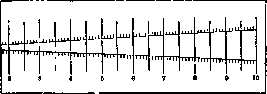
the method of T., which in its essence comes down to determining the tension of the walls of the eye, but since the latter depends not only on the hydrostatic pressure on them from liquids inside, but also on a whole series of other factors in the form of thickness, density and elasticity of the shells themselves, then obviously the results obtained from T. must be accepted only with a certain approximation. The simplest variety of T. is the so-called finger palpation of the eye, which is performed as follows. While the patient looks down, the researcher places the tips of the index fingers on the upper eyelid, closer to the edge of the orbit, i.e., above the cartilage, and alternately with both fingers applies light pressure on the eye, as if to determine the fluctuation of an abscess (fig. 1). Judgments about the state of hardness of the eye are made based on assessing the force that must be applied to overcome the resistance of the eye capsule and obtain a clearly perceptible depression of the latter. The results obtained from palpation are inaccurate and approximate, which depends on many reasons, among which one can note the individual abilities of each researcher to assess their impressions, the different structure of the eyelids of the subjects, etc. To characterize the results obtained, Bowman proposed the following conventional notations: T or simply T-normal pressure, T+1-moderate elevation, T+2-sharp elevation and T+3-maximum pressure, resembling the hardness of stone. Conversely, T-1, T-2 and T-3 denote various degrees of reduced pressure. Despite all the imperfection of this method, it undoubtedly represents a certain practical value for quick orientation regarding the state of tonus of the eye, as it requires no special apparatus and in any case with sharp deviations from normal gives sufficiently accurate indications. For scientific-research and clinical purposes, special instruments are used, which are called tonometers. The first tonometer was constructed as early as 1863 by Graefe (A. v. Graefe), and then followed a whole series of models proposed by various authors (Hammer, Weber, Dor, Donders, Snellen, Landolt, etc.). However, all these tonometers proved unsuitable for practical purposes, as they were built on the incorrect principle of indentation of the sclera. They determined not so much intraocular pressure as the extensibility of the sclera. Subsequently, the principle based on flattening or applanation of the walls of the eye was adopted as the basis for T. Here the hardness of the eye is determined either by the size of the diameter of the flattened surface or, conversely, by the magnitude of the force required to obtain a certain diameter of the flattened area. True, even with this method, the change in the shape of the eye occurs depending not only on the degree of its hardness or applied force, but also on other factors, such as: thickness, density and elasticity of the walls of the eye, as well as the resistance of the orbital fat tissue. But still, if the measurement is carried out under the same conditions and with the same instrument, the size of the errors will be approximately the same, and therefore the difference in the results obtained with successive measurements will depend exclusively on intraocular pressure. The instruments built on the principle of flattening include first of all the tonometer proposed in 1884 by Prof. of Moscow University A. N. Maklakov, which remains to this day classical and unsurpassed in its simplicity and accuracy. Maklakov's tonometer, with a constant weight of 100g, is a hollow metal cylinder, 4 cm high, with small thickenings at the ends in the form of hemispheres, facing their bases outward, into which round plates of milk glass with a diameter of 1 cm are inserted (fig. 2). In the cavity of the cylinder, a piece of lead moves freely, intended to constantly move the center of gravity of the instrument downward. During use, the instrument is suspended on a special handle in the form of a steel plate with an elongated hole cut in it, narrowing toward its end; the cylinder is passed through the wide part of the hole and is moved to the narrower part of it, where it can no longer slip through and is held in this position by a special latch. The research itself is carried out as follows: the eye is anesthetized best with a 2% solution of holocaine; the patient lies on his back, the eyelids of the eye being examined are spread by an assistant so as not to exert any pressure on the eye; the glass plates at the ends of the cylinder are evenly coated with a thin layer of glycerin solution of Bismark brown paint. While the patient looks straight ahead, the cylinder is lowered until it touches the cornea so that it can press on it with its entire weight, after which the instrument is quickly removed. At the moment when the cylinder presses with its weight on the cornea, the latter flattens, and the area of flattening is imprinted on the colored surface in the form of a round white spot, since the paint dissolves from contact with the cornea and is retained on it. To obtain an imprint of the resulting spot, or "tonogram," the plate of the tonometer is applied like a seal to writing paper slightly moistened with alcohol, as a result of which an imprint in the form of an colored circle with a white spot in the middle, corresponding to the area of flattening of the cornea, remains on the paper (fig. 3). Obviously, the size of the white spot will be the smaller, the harder the eye and vice versa. Thus, the objective expression of intraocular pressure in this case is the diameter of the white circle. To measure it, Maklakov proposed a special scale, built on the type of proportional compass and representing a transparent plate with an image of an isosceles triangle with a base of 1 cm and a height of 10 cm, divided by lines parallel to the base into millimeters (fig. 4). The plate is placed on the circle of flattening so that it fits exactly
Figure 2. Maklakov's tonometer.
between the diverging lines of the scale, and thus its diameter is determined in tenths of mm. To convert the found values into the generally accepted expression of any pressure in terms of the height of a mercury column, Lakhovich and Prof. Golovin compiled a special table, based on which is the formula of Fick P = --j- . where H is the height of the mercury column, 10,000 is the weight of the instrument in mg, d is the specific gravity of mercury (13.5), R is the radius (half the diameter) of the given circle of flattening and π = 3.14. Among the advantages of Maklakov's tonometer is the simplicity of the mechanism due to the absence of any devices, but a certain disadvantage is the painstaking nature of the research, the influence of corneal moisture on the clarity of the imprint, the impossibility of measurement in the sitting position of the patient and the impossibility of sterilization by boiling. In 1928 V. V. Pasechnik proposed a modification of Maklakov's tonometer made of silver with one 58£
Figure 3. Tonograms for Maklakov's tonometer.
between the diverging lines of the scale, and thus its diameter is determined in tenths of mm. To convert the found values into the generally accepted expression of any pressure in terms of the height of a mercury column, Lakhovich and Prof. Golovin compiled a special table, based on which is the formula of Fick P = --j- . where H is the height of the mercury column, 10,000 is the weight of the instrument in mg, d is the specific gravity of mercury (13.5), R is the radius (half the diameter) of the given circle of flattening and π = 3.14. Among the advantages of Maklakov's tonometer is the simplicity of the mechanism due to the absence of any devices, but a certain disadvantage is the painstaking nature of the research, the influence of corneal moisture on the clarity of the imprint, the impossibility of measurement in the sitting position of the patient and the impossibility of sterilization by boiling. In 1928 V. V. Pasechnik proposed a modification of Maklakov's tonometer made of silver with one 58£
Figure 4. Scale for measuring Maklakov's tonograms.
between the diverging lines of the scale, and thus its diameter is determined in tenths of mm. To convert the found values into the generally accepted expression of any pressure in terms of the height of a mercury column, Lakhovich and Prof. Golovin compiled a special table, based on which is the formula of Fick P = --j- . where H is the height of the mercury column, 10,000 is the weight of the instrument in mg, d is the specific gravity of mercury (13.5), R is the radius (half the diameter) of the given circle of flattening and π = 3.14. Among the advantages of Maklakov's tonometer is the simplicity of the mechanism due to the absence of any devices, but a certain disadvantage is the painstaking nature of the research, the influence of corneal moisture on the clarity of the imprint, the impossibility of measurement in the sitting position of the patient and the impossibility of sterilization by boiling. In 1928 V. V. Pasechnik proposed a modification of Maklakov's tonometer made of silver with one 58£
Figure 5. Fick's tonometer.



metallic stamp and without glass plates, allowing therefore for sterilization by boiling; among its disadvantages is the presence of a single stamp. On the same principle of flattening is built the Fick tonometer (1888). The fundamental difference between it and the Maklakov tonometer is that in the former a constant force is provided in the form of its weight of 10 g and the area of flattening is determined, whereas in the latter there is a specific surface area and the force required to flatten the eye over an area equal to this surface is sought. The instrument consists of a tip in the form of a round plate, 6.3 mm in diameter, connected by means of a rod to a thin steel spring, the other end of which is fixed in a frame, which at the same time serves as a handle for the instrument; to the latter is fitted a special scale with divisions. When the plate is pressed against the eye, the pressure is transmitted to the spring, and the latter bends with a certain resistance and moves along the indicated scale, each division of which corresponds to 2 mm of mercury (fig. 5). The main advantage of the instrument lies in the ease of manipulation, allowing its use on the move; one of its significant disadvantages is the difficulty of establishing the moment of correct, uniform contact of the plate with the cornea. To eliminate this disadvantage, Livshits in 1904 proposed replacing the plate in the Fick tonometer with a glass prism, the side of the square of which is 7 mm, designed for total internal reflection. Due to this property, the point of contact of the prism with the cornea will appear as a dark spot on a bright background; as pressure is applied, this spot will increase in size until it becomes a perfect circle, exactly inscribed in the square of the prism; then the divisions to which the spring has moved along the scale are read, multiplying the obtained figure by 2 to convert it to the height of a mercury column. Livshits' modification introduced a significant improvement in the design of the Fick tonometer, and consequently the instrument itself received the name of the Fick-Livshits tonometer. The model is quite suitable for ordinary outpatient use, but in terms of accuracy of results it is significantly inferior to the Maklakov tonometer. The tonometer of L. I. Sergievsky (1913) represents an attempt to combine the principles of Livshits and Maklakov, i.e., optical determination of the area of flattening with a constant weight. The instrument consists of a small cast iron horseshoe with an eye for suspension, between the legs of which is inserted a glass prism of the same type as in the Livshits tonometer, with the only difference that on its face, intended for contact with the cornea, three rings are applied, the diameters of which (6 mm, 5 mm, 4 mm) correspond to the diameters of the flattening circles obtained with the Maklakov tonometer when examining eyes with corresponding

Figure 6. Sergievsky's tonometer.
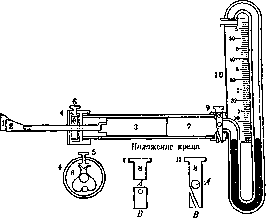
intraocular pressure (fig. 6). Among the disadvantages of the instrument is the limitation of the number of possible pressure measurements to the number 6—corresponding to the three rings and the intervals between them. The recently proposed (1929) tonometer of A. L. Kankrov and the tonomanometer of A. N. Golovin have not yet come into widespread use (fig. 7). -Щ The Schiötz tonometer, first proposed in 1905, is actually based on the discarded principle of 'indentation' of the cornea by a rod, however,
View of the spring from the front
Figure 7. A. N. Golovin's tonomanometer: 1-triangular glass prism; 2-frame for the prism; 3-glass piston; 4-metal sleeve; 5-wedge-shaped rod; 6-lyre-shaped spring; 7-glass cylinder; 8-air cock with two holes A and B; 9-sleeve for the cock; 10-manometer; 11-cock to it. the resulting change in the shape of the eye is so insignificant that it can without special error be equated to 'flattening' (fig. 8). The initial model of the instrument consists of a metal hollow cylinder, about 3.5 cm long and approximately 0.75 cm in diameter, the lower end of which has a concave surface adapted to the convexity of the cornea, on which it should be placed; on the upper end of the cylinder is fixed an elongated metal ring, bearing on it a T-shaped plate, on the horizontal part of which is placed a scale, divided into mm. In the opening of the cylinder moves freely a thin pin, the lower, cut-off end of which during use of the instrument comes into contact with the cornea, while the upper, pointed end, as the pin moves upward, presses against a short lever arm; the long arm of the latter in the form of an aluminum arrow serves as an indicator, moving along the scale. The described cylinder passes through a second, shorter and also movable one, with lateral, upward-bent bows, intended to serve as a handle for the entire instrument. The upper tip of the said pin has a
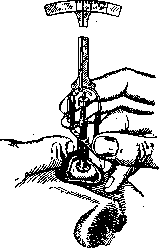
Figure 8. Schiötz tonometer (model 1905). 19 groove, on which as needed is screwed the necessary for measuring pressure weight of 5.5 g, 7.5 g, 10 g and 15 g. To the tonometer is attached a special device for checking the correctness of its adjustment in the form of a metal stand with a convex surface corresponding to the curvature of the cornea, on which before use the instrument is placed with its concave surface; in the normal state of the apparatus the indicator should stand at the zero division of the scale. In later designs, of 1920 and 1924, the author introduced improvements into this model (fig. 9). When examining the patient, they are laid on their back and looks straight ahead. Grasping the instrument with the thumb and index finger by the side bows of the handle, it is lowered vertically onto the anesthetized cornea of the patient until there is complete contact with its lower concave surface of the instrument, at the same time noting the deviation of the indicator along the scale. The results of the research, obtained in the form of the deviation of the indicator by a certain number of divisions of the instrument's scale, are converted into mm of mercury pressure by means of a special diagram, provided with the instrument (fig. 10). At the present time, the Schiötz tonometer is the most widely used both abroad and in our Union, mainly due to the simplicity of handling it, although in terms of the accuracy of the results obtained it is to a large degree inferior to the Maklakov tonometer. After the Schiötz tonometer, a whole series of similar instruments appeared, representing more or less complex variations and modifications of the impression and applanation tonometers proposed by Wessely, Wendt, Romer and others, but all of them have not received wide recognition and distribution or are still in the period of examination and verification.
Related articles
Cite this page
“Tonometry.” Soviet Medical Encyclopedia. English translation of Bolshaya Meditsinskaya Entsiklopediya, 1st ed. (Moscow, 1928–1936), ed. N. A. Semashko. https://sovietmedicalencyclopedia.pages.dev/article/tonometry/