Valhera Hanging Position
Historical document, translated for reference. It reflects medical knowledge of the 1920s–30s and is not medical advice.
Summary
The Valhera hanging position is a birthing posture where the woman lies on her back at the edge of the bed with her legs hanging down and her pelvis slightly elevated. This position can increase the true conjugate of the pelvis by 0.5-1.0 cm on average, which may be helpful when there is a slight mismatch between pelvic dimensions and fetal head size.
Encyclopedia article (1928–1936)
VALHERA HANGING POSITION (Valhera), a position of the parturient woman on her back, at the edge of the bed, with legs hanging down and the pelvis slightly elevated (for which a tightly folded pillow is placed under the lower back) (see Fig. 1). In 1889, Valhera showed that the true conjugate of a pregnant woman changes depending on body position. The cause of this change is the physiological mobility of the pelvic bones at the sacroiliac joint, which becomes particularly significant by the end of pregnancy (due to the loosening of the joint ligaments associated with it). Since the point of rotation in the sacroiliac joints does not coincide with the promontory but is located below and behind it, the true conjugate decreases when the anterior arch of the pelvis (symphysis) is raised upward, and increases when it is lowered downward. In other words, in the first case the symphysis approaches the promontory, and in the last case it moves away (see Figure 2). The maximum increase is achieved in the V. h. p. This position gives an increase in the true conjugate, on average, of 0.5-1.0 cm. In individual cases, the increase in the true conjugate may be extremely minimal - up to 0.1 cm (Bartoshevich), in others - somewhat greater - up to 1.4 cm (Kuttner). The V. h. p. is used in cases of relative disproportion between the pelvis and the head. Where an increase in the true conjugate of a few millimeters is necessary for the head to pass through the pelvic inlet, the V. h. position gives good results. Since such a position with legs hanging down is tiring for the parturient woman, it
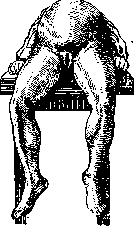
Figure 1.
is applied for a short time - no longer than 3/4 hours. With an insufficiently molded head and with an imperfectly
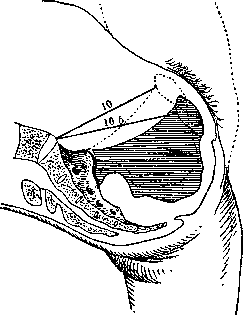
Figure 2 (according to Bumm).
dilated cervix, the Valhera hanging position is a useless procedure that only causes suffering to the parturient woman.
Related articles
Mentioned in
Cite this page
“Valhera Hanging Position.” Soviet Medical Encyclopedia. English translation of Bolshaya Meditsinskaya Entsiklopediya, 1st ed. (Moscow, 1928–1936), ed. N. A. Semashko. https://sovietmedicalencyclopedia.pages.dev/article/valhera-hanging-position/