Agglutination
Historical document, translated for reference. It reflects medical knowledge of the 1920s–30s and is not medical advice.
Summary
Agglutination is the clumping of bacteria or other cellular elements when exposed to serum from an immune animal. This reaction, first studied in 1896, involves specific substances called agglutinins that bind to antigens, causing visible clumping and precipitation.
Encyclopedia article (1928–1936)
Agglutination, the precipitation of bacteria or other cellular elements when acted upon by serum from an animal that is not susceptible (immune) to them. The property of serum to cause agglutination is explained by Ehrlich's theory (see Immunity) as the accumulation in it during immunization of special substances called 'agglutinins.' The reaction of A. was first studied by Gruber and Durham (1896). In the blood serum of a healthy person, normal agglutinins are sometimes also found with respect to certain types of bacteria, for example, typhoid, dysentery, etc. In early childhood (Landsteiner), there are no normal agglutinins. Apparently, they are formed at a more mature age as a result of unnoticed immunization of the body by corresponding bacteria through the intestinal wall or by other means. The stimulus for the accumulation of agglutinins is either infection of the animal, or the artificial introduction of live and killed cultures of microbes (resp. foreign cells), or finally, the same introduction of microbial proteins. Substances that, when introduced parenterally, can cause the formation and accumulation of agglutinins in the body are called agglutinogens (see Antigens). The protein molecule of an agglutinogen has a small size and can pass through a colloidal filter. Agglutinogen is contained in bacterial cultures in a dissolved state, and in old cultures it is more abundant than in young ones. Agglutinogen is not destroyed by treatment with formalin or by boiling. Bacteria are killed in this process but retain the ability to agglutinate and to cause the formation of agglutinins in the bodies of animals. Sera have larger particles than agglutinogens and do not pass through the colloidal filter. Agglutinins are mainly associated with the euglobulin fraction of blood serum, to a lesser extent with the pseudo-globulin fraction. They are destroyed when heated to 60-65°; alkalis easily destroy them; acids harm them to a lesser extent. Alexin or complement (see Alexin) does not play a significant role in the reaction of A. The bacterial cell represents a complex conglomerate of proteins. Some of these proteins may be common to bacteria belonging to the same phylogenetic group. It is therefore understandable that an agglutinating serum specific to one type of bacteria will also agglutinate, although more weakly, other types of bacteria that are related, belonging to the same group as the first. Such related A. is called group agglutination. Finally, some bacterial cultures have the ability to spontaneous A. in physiological solution (autoagglutination) without any immune or normal serum. According to Ehrlich's terminology, agglutinins have a haptophoric group that fixes them to bacteria, and a toxo- phoric or ergophoric group, which causes the phenomenon of clumping-agglomeration and precipitation-agglutination. Degeneration of the toxophoric group of agglutinin leads to the formation of agglutinoïds. Inactivation of agglutinins and their transformation into agglutinoïds occurs when heated to 58-70°. Various chemical substances, such as salts, alkalis, acids, formalin, and uric acid, also destroy the ergophoric group of agglutinins. Bacteria saturated with the corresponding agglutinoïd lose their ability to A. The essence of A., from the point of view of physical chemistry, is as follows. Bacteria are uniformly distributed in the liquid due to active, or Brownian molecular motion, because their bodies carry a uniform electric charge. In an electric current, bacteria move toward the anode, therefore, they are negatively charged. At the same time, bacteria have a force of mutual attraction, depending on surface tension. Obviously, with uniform distribution in the liquid, the repulsive force is greater than the force of attraction. Agglutination occurs at the moment when the uniform electric charge weakens to such an extent that the force of attraction gains the upper hand. An increase in the force of attraction can also be accompanied by A. Bacteria agglutinate at the moment when the potential difference drops below 15 millivolts (Northrop and De Kruif) provided the force of attraction of the bacteria remains constant. In the case where the force of attraction is reduced or becomes very small, A. does not occur even when the potential drops to zero. The origin of the potential can be explained on the basis of Donnan's theory, according to which in protein liquids separated by a colloidal membrane permeable to all ions of one liquid and part of the ions of another, a potential difference arises, the magnitude of which depends on the concentration and charge of the constituent parts of the liquid. Bordet (1899) attributes A. to the phenomenon of precipitation of colloidal particles from a suspension (dispersion) in a liquid under the influence of electrolytes. Bacteria and agglutinating serum, freed from salts by dialysis, do not give the phenomenon of A. even after prolonged standing. The addition to such a mixture of traces of electrolyte-NaCl immediately causes A. of bacteria. The binding of agglutinin by bacteria also occurs in the absence of salt: bacteria loaded with agglutinins can be centrifuged, washed from serum, and suspended in distilled water. The addition to such a suspension of bacteria of traces of salt immediately causes agglutination of the bacteria. Agglutination occurs not only in the presence of NaCl, but also of many other salts, as well as organic crystalloids (Friedberger). The reaction of A, upon subsequent addition of electrolyte, also proceeds as in a mixture of two colloids carrying electric charges of opposite nature, with one of the colloids present in smaller quantities and unable to completely neutralize the charge of the other. In this case, the addition of an electrolyte, which dissociates in solution into salt ions, contributes to the complete neutralization of the electric charge of the predominant colloid. The neutral particles of colloids, due to surface tension and mutual attraction, precipitate in flakes. The agglomeration of suspensions, which bacteria are, is also possible by the joint action of a colloid and an electrolyte. A suspension of mastic, in the presence of a small amount of gelatin or protein-containing liquids, is precipitated by the addition of traces of salt (Neisser and Friedemann). Such experiments undoubtedly prove the physicochemical (colloidal) nature of the reaction of A. To neutralize one colloid with another, a certain quantitative ratio of their electric charges is necessary. In excess of one of them, a predominance of a charge of the opposite nature arises, therefore, recharging of the colloid and, in connection with this, stabilization of its dispersed state. In this way, 'zones of inhibition' of the reaction arise. They often occur in A. of bacteria by fresh sera that do not contain agglutinoïds. In this case, the agglutinating serum in concentrated dilutions sometimes does not agglutinate or gives a weak reaction, while with large dilutions the reaction is clearly expressed. The explanation of the essence of the reaction of A. by the neutralization of electric charges of colloids met with objections from Michaelis and Davidson, who found that the reaction of A. can occur with large fluctuations in the concentration of H-ions. The optimum of the reaction does not coincide with the isoelectric point of the antigen and agglutinin. Therefore, Dean proposed another theory, according to which in the process of A. of bacteria, they adsorb particles of the colloid agglutinin, which are deposited on their surface. In this process, proteins of the antigen that have come out into the surrounding fluid and bind the globulins of the immune serum also participate. Due to the change in surface tension, A. of bacteria occurs, which in bunches become visible to the eye and then, due to gravity, settle to the bottom. The enzymatic theory of A. was first expressed by Mansfield (1918), who interpreted the reaction as follows: bacteria remain in suspension due to protective colloids (agglutinin contains an enzyme that destroys this shell and the antigen itself). As a result, bacteria not protected by a shell positively or negatively charge the ions of the salt solution, lose their uniform electric charge, mutually attract, gather in bunches and precipitate. Zdravomyslov (1924) represents the participation of the enzyme in the process of formation of agglutinin differently: under the conditions of the experiment, agglutinins are obtained by mixing the antigen with trypsin. As a result of the digestion of bacterial proteins, trypsinate is obtained, in which agglutinins are contained, which should be considered as an enzyme bound to the products of cleavage of bacterial proteins. Physicochemical theories have not yet given an explanation for the specificity of immune reactions. An analogy with the specificity of serum agglutination is the acid agglutination of bacteria (Michaelis), based on the fact that the concentration of H-ions, at which a protein precipitates, is specific for each of them. Therefore, A. of bacteria by acids occurs at a specific concentration of H-ions for each type of microorganism. This reaction is still not as specific as immune reactions (Gouwens, 1923). The role of agglutinins in immunity is unclear.
Agglutinated bacteria do not lose viability and continue to multiply at the bottom of a vessel with a nutrient medium. Typhoid bacteria in agglutinating serum grow in the form of flakes consisting of threads (Mandelbaum). Laboratory application of agglutinins is possible in two directions: 1) for establishing a diagnosis, the blood serum of the patient is used, which is mixed in certain dilutions with a culture of known bacteria--the diagnosis of the disease is made based on the presence of corresponding agglutinins in the blood (see Widal reaction); 2) a specific agglutinating serum is mixed with a culture of an unknown microorganism--based on the presence of A., the species of the microorganism is identified. Practical application of the A. reaction has in the recognition of typhoid fever, paratyphoid infections, bacillary dysentery, Malta fever, meningitis, and some other infections. In such cases, the A. reaction is considered conclusive if the specific immune serum agglutinates the given culture in dilutions close to its titer. The titer of a serum is defined as the smallest amount of it that still possesses agglutinating action. The result of the A. reaction can be determined with the naked eye in the case of a strongly pronounced reaction, or better, with a magnifying glass; most clearly--with an agglutinoscope (Kuhn and Woithe), which allows determining the size of the flakes. Group agglutinins can be distinguished from the main ones by means of the Castellani test, based on the fact that bacteria bind all agglutinins of the immune serum for a given species. Group agglutinins are also bound in this process. If, however, the serum is brought into contact with a species of bacteria other than the one with which it was produced in the animal's body, the main agglutinins remain free. Solutions of NaCl of increased concentration (2.9-5.8%) in the Widal reaction suppress group A.
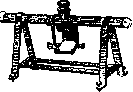
M. Shutsers. Agglutinoscope, an apparatus for observing the phenomenon of agglutination. The most convenient model is that of Kuhn-Woithe. As can be seen from the drawing, a test tube with liquid is inserted into a metal tube having an opening opposite the magnifying glass. Rays of light reflected from the mirror, passing through the test tube, are deflected by the formed accumulations and make it possible to see the smallest flakes, invisible to the naked eye. At present, the agglutinoscope is also partially used for reading sedimentation reactions (Meinicke, Sachs-Georgi, etc.).
Related articles
Mentioned in
- Active Immunization
- Agglutinating Sera
- Aggravation
- Antibodies
- Antigens
- Belonovsky, Georgy Dmitrievich
- Bizzozero's Plaques
- Coagglutination
- Cross Immunization
- Dental Drill (a steel drill with fine sharp grooves, used for)
- Erythrocyte Sedimentation
- False Agglutination
- Gruber
- Hanging Drop
- Hemagglutination
- Hyponoic Mechanisms
- Immunobiological Reactions
- Infectious Abortion
- Isoreactions
- Maltese Fever
Cite this page
“Agglutination.” Soviet Medical Encyclopedia. English translation of Bolshaya Meditsinskaya Entsiklopediya, 1st ed. (Moscow, 1928–1936), ed. N. A. Semashko. https://sovietmedicalencyclopedia.pages.dev/article/agglutination/