Atypical Growth and Structure
Historical document, translated for reference. It reflects medical knowledge of the 1920s–30s and is not medical advice.
Summary
This article from the 1928–1936 Great Medical Encyclopedia explores atypical tissue growth and structure, distinguishing between benign reactive processes—such as chronic inflammation and ulcer regeneration where tissue topography is altered—and malignant tumors, which exhibit both topographical disruption and profound cellular atypia.
Encyclopedia article (1928–1936)
ATYPICAL GROWTH AND STRUCTURE, tissue proliferation differing to a greater or lesser extent from its normal, typical growth. Every tissue of a formed organism has a characteristic type of structure both in the sense of the arrangement and interrelation of its cells and in the sense of its relation to neighboring tissue. During various proliferative processes, for example, in physiological and pathological regeneration (see), typical structure and tissue arrangement as a rule are preserved; however, in some cases atypical growth takes place, consisting in the fact that a given tissue goes beyond the limits of its normal position and penetrates into neighboring tissue. Atypical tissue growth is sometimes observed in inflammation, tuberculosis, and the regeneration of ulcers in integuments. For example, in lupus (see Tuberculosis of the skin) and other chronic ulcerative skin processes, one can observe what appears to be overproduction of the regenerating covering epithelium and its atypical growth, manifested by epithelial cords growing deep into the underlying connective tissue (see figure); likewise, during prolonged healing of intestinal ulcers, e.g., in dysentery, atypical growth of glandular epithelium may occur, penetrating into the submucosa beyond the muscularis mucosae. In the above examples, atypical growth is manifested by a disturbance of tissue topography, whereas the structure of the proliferating tissue in terms of the type and interrelation of its cells remains typical.-Atypical growth is expressed much more sharply in tumors (see), in which, alongside atypical tissue growth in the sense of a disturbance of its topography, there is also an atypical structure of the growing tissue, expressed by the fact that the structure of this tissue differs to one degree or another from the structure of normal tissue of the given type. This is most clearly manifested in malignant tumors (e.g., in cancers, sarcomas), in which the growing tissue, exhibiting atypical growth in the sense of extending far beyond the normal position of the given tissue, is also always atypically structured. Atypical structure in connective tissue and muscular tumors is expressed in the abnormal appearance of their cells in terms of size and shape, and in the irregular arrangement of their bundles; in epithelial tumors, it is also expressed in the appearance of the cells and their nuclei differing from the norm, the unusual relationship between the epithelial complexes and the connective tissue stroma, and the arrangement of cells in these epithelial complexes not coinciding with the norm. Many of the pictures of atypical tumor structure relate to manifestations of the immaturity of their tissue (for details, see Tumors).
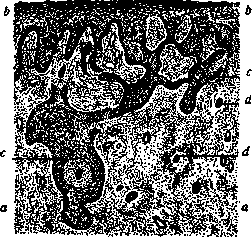
Lupus of the knee skin with atypical proliferation of the epithelium: a—corium, turning into granulation tissue containing tubercles; b—epidermis; c—epithelial cords grown deep; d—tubercles (after Ziegler).
Many of the pictures of atypical tumor structure relate to manifestations of the immaturity of their tissue (for details, see Tumors).
Related articles
Mentioned in
Cite this page
“Atypical Growth and Structure.” Soviet Medical Encyclopedia. English translation of Bolshaya Meditsinskaya Entsiklopediya, 1st ed. (Moscow, 1928–1936), ed. N. A. Semashko. https://sovietmedicalencyclopedia.pages.dev/article/atypical-growth-and-structure/