Carcinosarcoma
Historical document, translated for reference. It reflects medical knowledge of the 1920s–30s and is not medical advice.
Summary
Carcinosarcoma is a tumor that combines histological features of both carcinoma and sarcoma. The article discusses various theories about its origin, including whether it represents a combination of two independent tumors or a transformation from one type to another, emphasizing the need for comprehensive study from histological, anatomical, and clinical perspectives.
Encyclopedia article (1928–1936)
CARCINOSARCOMA (carcino-sarcoma), a tumor that combines in its histological structure the characteristic features of both cancer and sarcoma. Depending on whether one accepts the isolation of epithelial and connective tissue primordia according to the views of His and Virchow or takes the standpoint of the non-specificity of germ layers, judgments regarding the origin of such tumors will differ. Borst allows for three possible interpretations. 1. Carcinoma and sarcoma each arise independently at the same site, mutually penetrating each other (combined tumors). 2. First, cancer develops, the stroma of which gradually transforms into sarcoma (more rarely—sarcoma with cancerous transformation of epithelial appendages); Borst considers this type as true C.-s. (mutational tumors according to Schopper); such tumors are found in the uterus, thyroid gland, breast, gastrointestinal tract, gallbladder, nasal cavity, and esophagus. 3. Finally, part of the primary carcinoma develops into strands and networks, while another part receives diffuse sarcoma-like spread. Borst considers the latter as false C.-s. and prefers the name carcinoma sarcomatodes for them. According to Erlich and Apolant, in the transplantation of mouse carcinomas, a direct transformation of cancer into sarcoma was observed, which, in connection with the doctrine of the non-specificity of germ layers, makes it possible to interpret all tumors of this kind as carcinomas that directly transform into sarcomas (Krompecher). It should be borne in mind that the term C.-s. combines very different neoplasms, which, to determine their essence in individual cases, must be studied not only from a histological but also from an anatomical and clinical point of view. They should also be distinguished from the group of so-called "mixed tumors" (Mischtumoren of German authors), which have a benign character.
G. Koritsky.
CASCARILLA (Cortex Cascarillae, Ph VII), the bark of Croton eluteria Bennet, a shrub about 6 m high, family Euphorbiaceae-Crotoneae; native to—the Bahamas, Cuba. Brittle tubes or grooves 0.5 to 1 cm wide; bark thickness 0.5-2 mm; the outside of the bark is covered with whitish to light gray cork; the inside is dark, with longitudinal wrinkles; often white lichens on the bark. The smell of the bark is aromatic, taste bitter-spicy. Characteristic absence of sclereids. Constituent parts: 1) essential oil (about 1.5-3%); consists of sesquiterpene C15H24, boiling at 173°, and an oxygen compound with a higher boiling point; 2) bitter substance cascarillin C16H24O5 (not a glycoside); 3) resin up to 15%; 4) tannin; 5) starch; ash from 9% to 15%. Used as a remedy that stimulates the activity of digestive organs.
Large doses of C. cause vomiting, loss of strength, and headaches; small doses are added to tobacco, liqueurs, etc. The preparation is Extractum Cascarae Pa. C. was used in Germany as early as the 17th century against fever under the name China nova, but the producing plant became known only in 1860. CASPER Leopold (Leopold Casper, born in 1859), a famous German urologist. After graduating from the Berlin University, he studied urology in London with Thomson and in Paris; he was one of the hot pioneers of cystoscopy, and the latter is much indebted to him for its spread and popularization. He succeeded in improving the cystoscope by adapting it for catheterization of the ureters. Casper is the initiator of the method of endoscopic operations, as well as the method of indigo carmine test for kidney function. He is the founder and honorary member of the German and Berlin Urological Societies, the founder and editor-in-chief of the most popular urological journal (Zeitschrift f. Urologie). Among his numerous printed works, one should note his textbooks on cystoscopy and urology, which went through several editions. The most important works of C.: "Die diagnostische Bedeutung des Ureterkateterismus" (B., 1896); "Handbuch der Cystoskopie" (1st ed., Lpz., 1898; 5th ed., Leipzig, 1923); "Lehrbuch der Urologie" (1st ed., B.-Wien, 1903; 3rd ed., B.-Wien, 1923; Russian ed.-SPB, 1905).
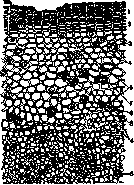
Cascarilla Bark (cross-section): 1-cork; 2-cortex; 3-cells with monocrystals; 4-cells with brownish contents; 5-milk vessels; 6-groups of bast fibers; 7-groups of wood fibers.
Casper was one of the hot pioneers of cystoscopy, and the latter is much indebted to him for its spread and popularization. He succeeded in improving the cystoscope by adapting it for catheterization of the ureters. Casper is the initiator of the method of endoscopic operations, as well as the method of indigo carmine test for kidney function. He is the founder and honorary member of the German and Berlin Urological Societies, the founder and editor-in-chief of the most popular urological journal (Zeitschrift f. Urologie). Among his numerous printed works, one should note his textbooks on cystoscopy and urology, which went through several editions. The most important works of C.: "Die diagnostische Bedeutung des Ureterkateterismus" (B., 1896); "Handbuch der Cystoskopie" (1st ed., Lpz., 1898; 5th ed., Leipzig, 1923); "Lehrbuch der Urologie" (1st ed., B.-Wien, 1903; 3rd ed., B.-Wien, 1923; Russian ed.-SPB, 1905).
Related articles
Mentioned in
Cite this page
“Carcinosarcoma.” Soviet Medical Encyclopedia. English translation of Bolshaya Meditsinskaya Entsiklopediya, 1st ed. (Moscow, 1928–1936), ed. N. A. Semashko. https://sovietmedicalencyclopedia.pages.dev/article/carcinosarcoma/