Chickenpox
Historical document, translated for reference. It reflects medical knowledge of the 1920s–30s and is not medical advice.
Summary
This article from the 1928–1936 Soviet Medical Encyclopedia discusses chickenpox (varicella), detailing its history, disputed relationship with smallpox, clinical symptoms, and course in children.
Encyclopedia article (1928–1936)
CHICKENPOX, varicella, is an acute infectious disease accompanied by a maculopapular-vesicular rash. It is contagious and often takes on an epidemic course. This disease is inherent to childhood up to the age of 10; in older children it is less common and is only occasionally observed in adults, as susceptibility to it decreases with age. Chickenpox was first described in the 16th century by Italian physicians Vidus Vidius and Ingranus (Vidus Vidius, Ingramis) under the name cristalli. The name "varicelle" was first introduced by Vogel (Vogel) in 1772, and he also isolated chickenpox as a completely separate disease independent of variola. The name chickenpox displaced all others that indicated a close clinical relationship between chickenpox and true smallpox. In the history of medicine, the question of the etiological identity of variola and varicella was controversial for a long time. It reached a particular acuteness in the 18th century after variolation began to be used. Here two trends clearly manifested themselves. Dualists, headed by Heberden and Willan (Heberden—1767, Willan—1806) in England, Heim and Hesse (Heim—1809, Hesse—1825) in Germany, considered chickenpox, despite clinical and morphological similarities with variola, to be an etiologically independent disease. This school prevailed in Germany. In England and France, unitarians gained the upper hand, represented by Thomson (Thomson), who considered variola, varicella, and varioloid to be three degrees of the same disease. This unitary view was supported in the middle of the 19th century by Hebra (Hebra) in Germany. The great smallpox pandemic (1868–1874) in Europe forced a re-examination of this issue. At present, the unitary theory has been completely rejected due to a number of experimental works, and the specificity of both diseases, variola and varicella, has been established. The causative agent of chickenpox is still unknown. Experimental work by Bókay (Bokay), as well as other authors, indicated an etiological relationship between herpes zoster and chickenpox. Thus, for example, inoculation of contents from a varicella vesicle and a herpes zoster blister gave a similar local reaction. Children who had suffered from chickenpox gave a negative reaction to the inoculation of contents from a herpes zoster blister, and conversely, children who had suffered from herpes zoster were placed in the same bed with chickenpox patients and were not infected by the latter. Jacoby, Feer, and Frey described chickenpox epidemics originating from children arriving with herpes zoster. The latter, after discharge from the hospital, without contracting chickenpox themselves, served as a source of the chickenpox epidemic. Serological studies also confirm the identity of the etiology of herpes zoster and chickenpox. The varicella antigen gives a positive complement fixation reaction with the blood of patients with herpes zoster and varicella, and vice versa. However, despite numerous experimental works, immuno-biological and serological data, the view on the identity of the etiology of herpes zoster and chickenpox cannot be considered firmly established (Scheer et al.). A number of authors managed to provoke a local reaction, and sometimes a general rash, by inoculating a healthy child with clear varicellar lymph. After 8–10 days, vesicles with clear contents and an umbilicated depression were obtained, which did not differ in any way from the vesicles in chickenpox. Serological data confirmed the presence of the virus in those vaccinated with varicella. This established the possibility of transmitting chickenpox by inoculation. Whether immunity is achieved in this way has not yet been clarified. The mode of entry of the infectious agent into the body is unknown. The chickenpox virus is very volatile and apparently easily transmitted through the air. A very short stay near a chickenpox patient is enough to become infected. Direct contact is obviously not necessary. Infection occurs mainly through the respiratory tract. The possibility of transmission through a third party who remains healthy, or through a bacillus carrier, is admitted. The literature also describes cases of intrauterine infection. The susceptibility of children to chickenpox is very great and is noted from the first months of life. Places where children stay together—nurseries, kindergartens, and schools—contribute to the development of a chickenpox epidemic. No connection with a specific time of year is noted. Regarding the period of contagiousness of chickenpox, there are two views: some authors, such as Filatov, Heubner, and others, consider the contagious period to be from the last days of incubation to the shedding of crusts, equal to approximately 2–3 weeks; while others, such as Nathan (Natan), consider the contagious period of chickenpox to be 7 days, i.e., the last days of incubation and the rash period. The infectious agent does not differ in great stability with respect to atmospheric influences and disinfectants. Once contracted, chickenpox confers immunity. Twice or thrice-repeated disease is observed extremely rarely. Bohn (Bohn) admits the possibility of relapses with intervals of 2–3 weeks, true, as a rare phenomenon. Symptoms and course. The incubation period is 2–3 weeks. At this time, usually no clinical symptoms can be noted. Before the appearance of the rash, children often present nothing abnormal. In some cases, the disease is preceded by mild prodromal phenomena: fever, chills, general lethargy, loss of appetite, vomiting, restless sleep. Occasionally, more severe phenomena are observed: uneven breathing, weakened pulse, severe headaches, even convulsions and deep sopor. It is often possible to note 1–2 days before the rash or simultaneously with it the appearance of a prodromal rash, the so-called rash, which is caused by paralysis of the skin capillaries and has the character of scarlatiniform, morbilliform, or hemorrhagic purpura (purpura haemorrhagica). Scarlatiniform rash frequently gives reason to assume a mixed infection, but the absence of other symptoms characteristic of scarlet fever speaks against it. The appearance a few days before the chickenpox rash of intercostal herpes zoster, the so-called herpes zoster varicellosa, is also described. The varicella rash most often begins on the face and scalp, sometimes in other places on the body: on the shoulders, chest, and abdomen, in the form of pink, sharply demarcated spots or papules of various sizes, from a pinhead to a pea, round or oval in shape. During the first day, often after a few hours, very small vesicles form in the center of some of them, which increase toward the periphery of the initial spots and papules and sometimes reach the size of a pea. These vesicles are usually located in the deep layers of the epidermis, under the stratum corneum of the skin; they are multilocular and contain a clear serous fluid. The appearance of these clear vesicles, sitting either on normal skin or on a papule, with an inflammatory rim, is typical of chickenpox (see separate plate). Between the spots and vesicles, larger or smaller areas of unchanged skin remain. On the soles of the feet and palms there are usually no rashes, and in those cases when they do occur, they rarely pass into the vesicular stage, but usually remain in the form of spots and papules. The development of a vesicle from a spot occurs within a few hours. The fluid in the vesicles very quickly turns yellow and becomes cloudy from an admixture of leukocytes, and an umbilicated depression forms at the top of the vesicle. For 2–3 days the vesicles retain their original shape, then dry into a superficial brown crust, upon the shedding of which pigmentation remains for some time. With scratching or secondary infection, the papillary and subpapillary layers of the skin are involved in the process, and scars then form. The rash itself occurs in several stages, and not all spots undergo all stages of development; sometimes they remain in the form of spots, papules, or very small vesicles. The appearance of the skin with a rash of various sizes and in different stages of development and its uneven distribution are very characteristic of chickenpox and create a picture that Heubner aptly compares to a star map on which stars of various sizes are plotted. The patient's back, which is usually affected very severely, is particularly striking. The rash is mostly accompanied by a rise in temperature reaching 38°, less often up to 39° and higher. On the second or third day, the temperature drops, unless new rashes appear, which are accompanied each time by a new rise in temperature. Rashes rarely last longer than the 5th day. Simultaneously with skin phenomena, sometimes somewhat earlier, an enanthema appears. Vesicles erupt in the mouth and pharynx, which very soon burst under the influence of mechanical irritation, the skin of the vesicles macerates, and as a result yellowish fibrinous exudates form, resembling aphthous stomatitis. Vesicles also appear in the larynx, trachea, and on the vocal cords, which is accompanied by a croupous cough, hoarseness, difficulty breathing, and attacks of suffocation, which can simulate croup if they occur before the appearance of the exanthema. The appearance of a rash on the mucous membrane of the eyelids and in the external auditory canal causes short-term and minor disorders. One often has to see rashes on the prepuce
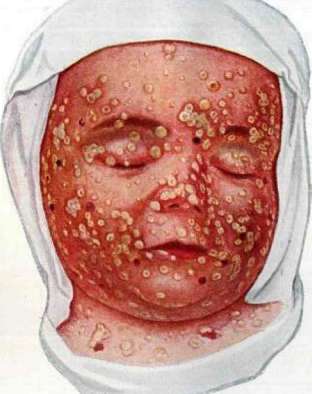

Rash.
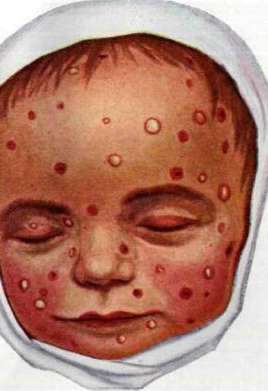
mucosa of the mouth, at the opening of the urethra, or on the external female genitalia. The blood picture in chickenpox is also characteristic: 1-3 days before the eruption and for 5-8 days during the eruption, leukocytosis, lymphocytosis, neutropenia, and the absence or decrease of eosinophilia are observed. By the end of the second week or the beginning of the third, the blood picture returns to normal. Deviations from the normal course of the disease and complications. The eruption in chickenpox is subject to large variations: from a few vesicles scattered over the entire body to a huge number of them. Forms of chickenpox without exanthema are also encountered, and then the diagnosis can be made only on the basis of serological studies. Among the anomalies of the rash, v. miliaria is described, consisting of very small vesicles (Henoch, Thomas), and roseola varicellosa (Thomas), in which the rash is limited to the formation of small red spots that do not turn into vesicles. Another deviation is represented by v. bullosa (bullous), when the initial blisters begin to rapidly increase at the periphery and form thin-walled, flaccid blisters, 2-3 cm wide, with turbid contents, resembling pemphigus. The rash sometimes takes on a confluent character, making it look like smallpox. This form is accompanied by a high temperature and a severe general condition. Unlike natural smallpox, the blisters in v. bullosa dry up in 1-2 days, no fusion of vesicles or skin swelling is noted on the hands and feet, the temperature drops simultaneously with the drying up; the total duration of the disease does not exceed that of the usual form of chickenpox. The hemorrhagic form of chickenpox is frequently encountered, with either a favorable or a very severe outcome. Usually, 2-3 days after the eruption, hemorrhages appear in the very blisters or generally on the skin, and bleedings occur from the nose, mouth, and intestines. The causes of this form are diverse. Sometimes the hemorrhagic form is a manifestation of sepsis, sometimes it is connected with Werlhof's disease, thromboasthenia, or mixed infection. Gangrenous forms of chickenpox are also described, which begin with the usual eruption, but after a few days, gangrenous rims appear around some vesicles, spreading along the periphery. After the formation and falling off of the crust at the site of the vesicles, funnel-shaped tissue defects are formed, 5 cm or more in diameter, having a dirty-purulent bottom lying at various depths. These flabby abscesses involve the surrounding tissue in the process, destroying it over a large extent. Gangrenous forms apparently do not depend on the special virulence of the chickenpox virus, but are related to the child's constitution, tuberculosis, rickets, lues, chronic nutritional disorders, or preceding acute infectious diseases. Some authors see in the gangrenous form a special idiosyncrasy to the chickenpox virus. The literature describes cases complicated, due to secondary staphylococcal and streptococcal infection, by abscesses, phlegmons, lymphangitis, gangrene of the extremities, pleural empyema, kidney infections, serous and purulent joint inflammations. Cases of skin infection in chickenpox with tuberculosis bacilli are also described. Henoch was the first to point out nephritis as a complication; the latter usually proceeds well, rarely takes a chronic course or the character of cyclic albuminuria. Hemorrhagic nephritis is very rare. In infants, toxicosis is sometimes observed during the eruption. The worst complication is sepsis. Of the nervous system, polioencephalitis (chorea minor), multiple sclerosis, unstable peripheral paralysis, etc., are noted. The diagnosis usually presents no difficulties, even if chickenpox appears in a mildly expressed form. Serious difficulties arise when smallpox is suspected, but the following circumstances must be taken into account here: in chickenpox, prodromal phenomena are rare, whereas in smallpox, the rash is always preceded by prodromal disorders such as vomiting, convulsions, high temperature, etc. In chickenpox, the rash appears almost simultaneously on the face, scalp, torso, and extremities, giving preference to no part of the body. In smallpox, the rash appears gradually, earlier on the face, then on the torso, sparing the abdomen, and then already on the extremities. The face and extremities are the most affected. Very typical for chickenpox is the polymorphism of the rash and eruption in several waves. The temperature in chickenpox rises at the onset of the eruption and drops with its end; in smallpox, a rise in temperature is observed in the prodromal period, and it drops with the appearance of the rash. Serological studies also help diagnosis: the chickenpox antigen gives a positive complement fixation reaction with the blood of chickenpox patients, but not smallpox. The prognosis is generally favorable. Complications in chickenpox are usually rare. The prognosis worsens in children with a weakened constitution whose resistance is reduced: tuberculous, syphilitic, rachitic, as well as in infants suffering from nutritional disorders and, finally, in children with mixed infection (scarlet fever, measles, pertussis, bronchopneumonia, etc.). In these cases, complications (sepsis, gangrene) are more often noted, often leading to a fatal outcome. Mortality from uncomplicated chickenpox is a very rare phenomenon. According to data by Pfaundler and Schlossmann, in London in 1904, the following mortality figures from chickenpox were registered per 1,000 births: Age in months: 0-3 (0.01), 3-6 (0.01), 6-12 (0.04). Age in years: 1-2 (0.03), 2-3 (0.01), 3-4 (0.01), 3-4 [sic] (0). The treatment of chickenpox usually requires no intervention. The task is reduced to preventing secondary infections. During the febrile period, patients should stay in bed. Against severe itching, cooling mixtures are used: pastes containing 1% menthol, appropriate shaking mixtures, etc. For keeping the oral cavity clean, appropriate gargles and lubrication of the mouth with a 20% solution of borax in glycerin are recommended. Bathing is not recommended during the eruption; after the formation of crusts, baths are indicated. Prophylaxis. In view of the contagiousness of chickenpox already in the last days of incubation and in view of the volatility of its virus, the isolation of healthy children usually does not achieve its purpose. As for the contact of the latter with other healthy children, according to Mettenheim, it is permissible within 10 days from the date of detection of the infection, since (as already indicated above) only in the last days of incubation is a chickenpox patient considered contagious. The question of the practical application of varicella lymph requires further research. The diet in chickenpox does not require special instructions, since in most children the appetite is not reduced and digestion proceeds correctly.
Related articles
Mentioned in
Cite this page
“Chickenpox.” Soviet Medical Encyclopedia. English translation of Bolshaya Meditsinskaya Entsiklopediya, 1st ed. (Moscow, 1928–1936), ed. N. A. Semashko. https://sovietmedicalencyclopedia.pages.dev/article/chickenpox/