Glyciphagus
Historical document, translated for reference. It reflects medical knowledge of the 1920s–30s and is not medical advice.
Summary
An article from the 1928-1936 Soviet Great Medical Encyclopedia describing the mite genus Glyciphagus, its species, habitats in household dust and organic debris, and its role in causing skin dermatitis and pseudoparasitism in humans and animals.
Encyclopedia article (1928–1936)
GLYCIPHAGUS, a genus of mites of the family Tyroglyphidae, 0.5 mm in length. They live in household dust,
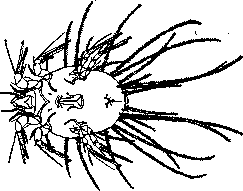
Glyciphagus cadaverorum.
on decomposing organic matter, corpses (see illustration), skeletons, etc. Main species: G. domesticus (de Geer), found in flour and sugar products. It can transfer to humans and cause skin itching, particularly in people dealing with sugar. This form of dermatitis is called "grocer's itch" or "gale des épiciers". It has been found in the ear of the rabbit, guinea pig, and on sheep skin, where it caused mange. G. cadaverorum Schrank and G. ornatus Kramer are also found in hay and on the skin of horses. Like other Tyroglyphidae, G. is sometimes found in human urine and faeces. It can enter the urine from the outside as well (with dust, hay used for sealing glassware, etc.). The actual presence of G. in the urinary bladder can be confirmed only by examining urine obtained by a catheter and collected in clean glassware. G. are often ingested by humans with food and can be detected during the microscopic examination of faeces. With significant contamination by these mites, feed can be very harmful to domestic animals. The presence of G. in humans or animals pertains to phenomena of pseudoparasitism.
Related articles
Mentioned in
Cite this page
“Glyciphagus.” Soviet Medical Encyclopedia. English translation of Bolshaya Meditsinskaya Entsiklopediya, 1st ed. (Moscow, 1928–1936), ed. N. A. Semashko. https://sovietmedicalencyclopedia.pages.dev/article/glyciphagus/