Bodonidae
Historical document, translated for reference. It reflects medical knowledge of the 1920s–30s and is not medical advice.
Summary
The Bodonidae family is a group of flagellated protozoa characterized by two flagella, one directed forward and the other backward. These organisms are found in stagnant waters and human excretions, with two species identified in humans that appear to be saprophytes rather than parasites.
Encyclopedia article (1928–1936)
Bodonidae, bodonids (Doflein, 1901), family of flagellates (class Mastigophora, s. Flagellata, order Protomonadida, suborder Eumonadea). Its representatives are characterized by the presence of two flagella, one of which is directed forward, while the other is directed backward and, during movement, trails behind the body.
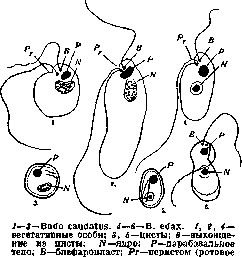
opening). Magnification about 1,500.
The family B. contains the genus Bodo (Ehrenberg) Stein, 1875 (syn.: Prowazekia Hartmann et Chagas, 1910), whose representatives are found in stagnant waters, as well as in human feces and urine; from there they were isolated in culture. In humans, two species are described: B. caudatus Dujardin, 1841 (main syn.: B. urinarius, B. asiaticus, Prowazekia cruzi and others, Amphimonas caudata, Diplomastix caudata) and B. edax Klebs, 1892. Both of these species are apparently not parasites, but only saprophytes in human excreta, reaching them from the outside in the form of cysts. There are, however, isolated reports of their possible development in the urinary bladder, as well as in the oral cavity. Bodonidae apparently have no pathogenic significance.
Related articles
Cite this page
“Bodonidae.” Soviet Medical Encyclopedia. English translation of Bolshaya Meditsinskaya Entsiklopediya, 1st ed. (Moscow, 1928–1936), ed. N. A. Semashko. https://sovietmedicalencyclopedia.pages.dev/article/bodonidae/