Rhabditis
Historical document, translated for reference. It reflects medical knowledge of the 1920s–30s and is not medical advice.
Summary
This article describes the genus Rhabditis, a group of free-living nematodes that are occasionally found in humans. It details their morphological characteristics and lists several species identified in clinical cases, noting that their presence is often accidental and typically lacks a clear pathological connection.
Encyclopedia article (1928–1936)
RHABDITIS, a genus of nematodes from the family Rhabditidae. Characteristics of the genus: a cylindrical oral cavity without armature, an esophagus with two swellings (bulbs), and a masticatory apparatus in the posterior bulb. Males are 0.8–1.05 mm in length, females from 0.9 to 2 mm. At the tail end
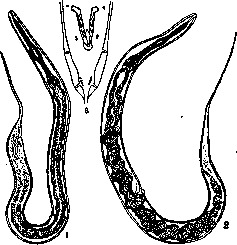
Rhabditis gracilis: 1—male; 2—female; 3—tail end of the male.
of the male, there are wings with caudal papillae, two short spicules, the distal ends of which are either free or fused, and a gubernaculum. The genital tubes in females are paired; the vulva is located almost in the middle of the body or closer to the posterior end. The eggs are oval, with a thin transparent shell containing a larva; the size of the eggs is 0.06 x 0.03 mm. They are oviparous or viviparous. The genus Rhabditis includes a large number of species of free-living nematodes, widely distributed in nature: in soil, water, in decaying refuse, and on plants. Some species have been described as parasites of animals and plants; however, their parasitic nature cannot be considered established. There is reason to consider these species as transitional from free-living nematodes to parasitic ones. The following 9 species of the genus Rhabditis have been described in humans: 1. R. pellio Schneider, 1866—from the vagina of a woman and from the bladder of a nephritic patient. 2. R. Niellyi R. Blanchard, 1885—from a papular rash of a patient in Brest. 3. R. species—discovered by O. Frese in fluid after gastric lavage of a female patient. 4. R. hominis Kobayashi, 1914, confirmed repeatedly in Japan during helminth-coprological examination of children. 5. R. faecalis Wattanabe, 1922.—On the territory of the USSR, the following species of Rhabditis have been confirmed in humans:
6. R. shachtiella Skrjabin et Schulz, 1926, in the Donbas—in the feces of a coal miner. 7. R. donbass Skrjabin, Schulz et Serbinoff, 1926, 6 times in the Donbas (the authors) and once in Saratov (German). 8. R. species—found once in the gallbladder of a woman being treated for liver disease in Moscow (Prof. Steriopulo and Dr. Wagner), and once in human feces in the North Dvina Governorate (Prof. K. I. Skrjabin and V. P. Baskakov). 9. R. gracilis Schingarewa, Demidowa et Kudriawzew, 1928, discovered in 7 cases in children and adults (0.07% of the total number examined) in Leningrad. Almost all the named authors point to the rapid disappearance of Rhabditis without treatment, to the rare detection of Rhabditis during repeated examinations, and to the absence of a sufficiently definite connection with clinical phenomena. Significance of Rhabditis for the physician: to consider the possibility of finding it during examination as a result of accidental entry into the human body with water, food, and mainly vegetables, or due to contamination of the material being examined.
Z. Vasilkova
Related articles
Mentioned in
Cite this page
“Rhabditis.” Soviet Medical Encyclopedia. English translation of Bolshaya Meditsinskaya Entsiklopediya, 1st ed. (Moscow, 1928–1936), ed. N. A. Semashko. https://sovietmedicalencyclopedia.pages.dev/article/rhabditis/