Habenula
Historical document, translated for reference. It reflects medical knowledge of the 1920s–30s and is not medical advice.
Summary
This article describes the anatomy of the habenula, a small structure at the posterior end of the thalamus, and its connections to the pineal gland and olfactory system. It details the trigonum habenulae, the habenular commissure, and the fasciculus retroflexus Meynerti.
Encyclopedia article (1928–1936)
HABENULA (Latin: habena, leash), realinculus conarii, is located at the posterior end of the thalamus opticus, behind the III ventricle; formed by white stripes, as if
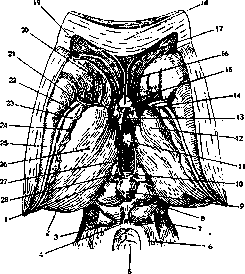
1-habenula; 2- pulvinar; 3-п. trochlearis; 4-frenulum veil medullaris ant.; S-lingula ce-rebelli; в-brachium conjunctivum; 7-collicu-lus inf.; S- colliculus sup.; 9- corpus pineale; 10-commissura post.; 11-massa intermedia; 12-tuberc. ant. thalami; 13-commissura ant.; 14-recessus triangularis; 15-columna fornlcis; 16-lamina dextra septi pellucidi; 77-cavum septi pellucidi; is-genu corpor. callosi; 19- cornu ant.; 20-caput nuclei caudatl; 21-vena terminalis; 22-stria terminalis; 2 3-lamina aflixa; 24-taenia chorioidea; 25-cauda nuclei caudati; 26-thalamus; 27-stria medullaris; 28-trigonum habenulae (no Bauber'y).
emanating from the glandula pinealis; both these stripes are connected by commissura habenularum (see figure). At the place where the habenula approaches the thalamus opticus, it expands, forming trigonum habenulae, in which lies gangl. habenulae, consisting of two nuclei differing in the size of their cells. In these nuclei! the striae medullares terminate. There are several opinions regarding the origin of the striae medullares: the cortex of the temporal lobe, nucleus ansae peduncularis, septum pellucidum; there is a hypothesis that they are formed by collaterals and terminal branches of radiationis olfactoriae profundae; in general, one can say that the striae medul-lares are closely connected with the olfactory system; they go first along the anterior surface, and then along the inner edge of the upper surface of the thalamus opticus; part of them terminates in the gangl. habenulae on their side, and the other part passes to the opposite side and there also terminates in the gangl. habenulae. The centrifugal conductor is the fasciculus retroflexus Meynerti, which terminates in substan-tia perforate posterior Hahenula, thanks to the connection through striae medul lares with the olfactory system, the habenula has a relation to the olfactory reflex.
V. Kononova. HABITUS (Latin: habitus, physique, external appearance), a term denoting in clinical medicine the aggregate of external signs characterizing the structure of the body and the external appearance of a person. The concept of H. includes: body dimensions in length, width and depth, body weight, development of the skeleton, musculature and subcutaneous adipose tissue, features of the structure of the head, face, trunk and limbs, properties of the skin and hair covering, posture of the body, etc. H. has significance 1) for recognizing individual diseases and the state of the patient at a given moment by certain signs and 2) for the assessment and understanding of a given individual in general by the aggregate of all signs and the general picture of H. In antiquity, H. was given very great importance from the point of view of general medical assessment of the patient, and even then certain more characteristic and typical H. were distinguished. Subsequently, as the doctrine of diseases developed more and more, H. as a whole receded into the background. In recent times, in connection with the revival and development of the doctrine of constitution, habitus as such again attracts the attention of physicians. The basic method for determining H. is inspection (see Diagnosis); the assessment of H. is made on the general impression. At present, with the penetration of anthropometric methods of research into clinical practice, one also willingly resorts to various measurements and indicators (see Indices of physical development and Constitution) by means of which it is possible to obtain objective criteria for comparative assessment and determination of a certain group of persons. Thus, for example, the average values (from 10 to 30) of the most common and most clinically justified indicator of Pignet - indicate a medium physique, and persons with an indicator in these limits can be referred to the medium constitutional type. An indicator of less than 10 speaks of a strong physique (hypersthenic type). Finally, an indicator of more than 30 indicates a weak physique and asthenic type (see below). Indeed, if one calculates the Pignet indicator from the average anthropometric data of Kretschmer characterizing the constitutional types of men, the following values are obtained, which coincide completely with the limits just indicated: for the picnic (= hyper-sthenic) type 5.3, for the athletic (=average) 15.4 and for the asthenic 33.8. The physique of a person is greatly influenced by sex, age, development of the skeleton and musculature, state of nutrition and internal secretion. Therefore, conversely, the sex of a person is almost always correctly recognized by habitus, his age is determined quite accurately, with a certain confidence one can judge his physical. development and state of nutrition and with considerable probability assume certain deviations on the part of the endocrine system. Some features of H., as well as the general character of it, often indicate the prevailing but not yet leaving physiological limits influence of hypo-, hyper- or dysfunction of individual endocrine glands. Thus, relatively low growth with significant development of the body in width (stockiness), thick and dry skin and a tendency to obesity indicate hypofunction of the thyroid gland. On the contrary, relatively high growth with little development in width, thin and moist skin and a tendency to leanness speak of hyperfunction of the thyroid gland. The same features of H. as in hypothyroidism, but more pronounced obesity with distribution of fat in the female type, scanty hair covering on the genital parts, small size of the hands and feet indicate hypofunction of the pituitary gland, etc. (see Internal secretion). Finally, H. has great constitutional significance, since the appearance of a person is the boundary of his inner world with the surrounding external environment; here as it were collide and mutually balance the influences of these two forces. H. is laid as the basis of most constitutional classifications (see Constitution), which is quite reasonable and justified by the fact that the external structure is closely connected and is in certain relations with the internal structure of the body and its func. properties, since form and function are only two sides of the same phenomenon. Among the huge variety of external appearance of people, one can distinguish a small number of characteristic types of H., corresponding. to certain constitutional types of people, with two mutually opposite H. clearly standing out, long distinguished in clinic under the names: H. apoplecticus and H. phthisicus. Apoplexies are people of hypersthenic constitutional type (see Constitution) with signs of fullness-red color of the skin, especially on uncovered parts of the body, with tortuous protruding blood vessels. Their name hi.bitus apoplecticus received from the expressed tendency of people of this H. to hemorrhages in the brain. For habitus phthisicus, sharply expressed, as if emphasized features of the asthenic constitutional type and a special predisposition of the carriers of this H. to tuberculosis are characteristic. The following brief description can serve as a general characteristic of habitus of the two main and mutually opposite constitutional types: 1. Hypersthenic type. Large and wide skeleton, relatively low growth, excess body weight, short and thick limbs, short and thick neck, wide and straight shoulders; wide, short and deep chest cavity, obtuse epigastric angle, large belly; round or square head, wide and soft face; well developed, voluminous, but little relief musculature; thick, elastic, pink and poor in pigment skin; rich hair covering on the body, abundant subcutaneous adipose tissue, especially on the trunk; in general, the most characteristic in this H. is strong development of the body in width and depth (development of the cavities of the head, chest and abdomen) and a tendency to deposit fat. Pignet indicator.< 10. 2. Asthenic type. Thin skeleton, relatively high growth, insufficient in relation to growth body weight, long and thin limbs, long and thin neck (with clearly protruding Adam's apple); narrow and sloping shoulders; narrow, long and flat chest cavity; acute epigastric angle, small belly; elongated head, long, narrow, sharply contoured face; poorly developed, thin and flaccid musculature; thin, flaccid, pale and noticeably pig-mergtrated skin; relatively poor hair covering on the body, scanty fat pad; in general, the most characteristic is: small development of the body in width with unchanged growth in length, small chest circumference and lagging body weight compared to growth. Pignet indicator>30. (H. hyste-ricus, see Hysteria.)
Related articles
Mentioned in
Cite this page
“Habenula.” Soviet Medical Encyclopedia. English translation of Bolshaya Meditsinskaya Entsiklopediya, 1st ed. (Moscow, 1928–1936), ed. N. A. Semashko. https://sovietmedicalencyclopedia.pages.dev/article/habenula/