Lighting Fixtures
Historical document, translated for reference. It reflects medical knowledge of the 1920s–30s and is not medical advice.
Summary
This article from the 1928–1936 Soviet Great Medical Encyclopedia defines lighting fixtures as devices used to improve illumination and rationalize light distribution. It details various types of fixtures, including direct, semi-indirect, and indirect lighting, emphasizing their role in preventing glare and ensuring proper light quality for different environments.
Encyclopedia article (1928–1936)
LIGHTING FIXTURES, devices for lighting appliances serving for decoration (various types of chandeliers, sconces, etc.) and, what is especially important, for improving illumination and for the rational use of the light provided by the lamp. The use of uncovered incandescent lamps for lighting purposes cannot be recommended in any way, as they produce a blinding effect on the eyes and provide a distribution of the luminous flux that is irrational from the point of view of lighting engineering. To obtain rational lighting, the lamp is placed in one or another lighting device, usually called a lighting fixture, which has the task of: a) the redistribution of the luminous flux required for a given purpose; b) reducing the brightness of the luminous body and eliminating the harmful blinding effect of this brightness on the eyes (glare); c) achieving sufficient light diffusion to obtain a soft light that is pleasant to the eye, without sharp shadows. There are an extremely large number of types of lighting fixtures. In accordance with accepted systems of light distribution, lighting fixtures are divided into those for a) direct, b) semi-indirect, and c) indirect light. Lighting fixtures for direct light consist of reflectors of various shapes that give a specific direction to the luminous flux and are used primarily for local lighting. Frequently encountered flat reflectors in the form of small plates for electric
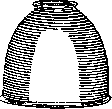
FIG. 1.
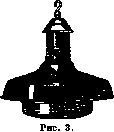
lighting do not achieve the indicated goals and should not be used. The most satisfactory type of direct light fixture is the deep "Alpha" reflector, designed in such a way that the light bulb placed inside it is hidden from the eye (see Figure 1). This lighting device can be recommended in cases where it is necessary to obtain greater illumination directly at the workplace than from a lamp illuminating the entire room. Among the types of desk fixtures, the most appropriate is the horizontal reflector, which can be set at various heights thanks to a rotating stand (see Figure 2). For kerosene and kerosene-incandescent lamps, there are also lampshades that prevent the light of the lamp from directly hitting the eyes. For general lighting, among direct light fixtures, one can recommend lighting devices of the "Universal" type (see Figure 3); in addition to the reflector, they are equipped with a frosted glass shade, which reduces the brightness of the light source and, thus, eliminates the danger of blinding the eye. The most widespread application is found in semi-indirect light fixtures, used for the general lighting of rooms. It is designed in such a way that a small part of the luminous flux (from 1/5 to 1/3) is directed directly downward into the illuminated space, and the remaining, larger part is reflected by a milk glass shade onto the ceiling, which diffuses the luminous flux that falls upon it. Thus,

Figure 2.
a soft light that is pleasant to the eye and does not produce sharp shadows is achieved. A necessary condition for the use of this type of fixture is a white, clean ceiling. Thanks to the indicated properties, semi-indirect light fixtures can be recommended for the lighting of a) rooms where very fine and precise work is carried out, b) drafting and drawing offices, c) office
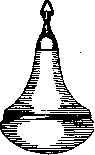
Figure 5.
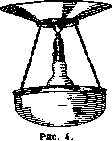
premises and typing bureaus, d) reading rooms and schools. Among the numerous semi-indirect light fixtures, one can note those manufactured in our country: a) fixtures of the so-called clerical type (see Figure 4) and b) the "Lucette" lighting device (see Figure 5). All these types of lighting fixtures are manufactured in the USSR by the State Electrical Trust (GET). Lighting fixtures for indirect light are distinguished by the fact that with them, the luminous flux is completely reflected onto the ceiling or walls. This type is used rarely, as it requires large expenditures of electrical energy and its operation is expensive. Recently, so-called daylight fixtures have begun to be used quite widely (in particular, for lighting operating rooms), in which the luminous flux emitted by an incandescent lamp passes through a special blue filter, after which the light in its composition approaches daylight.
Related articles
Mentioned in
Cite this page
“Lighting Fixtures.” Soviet Medical Encyclopedia. English translation of Bolshaya Meditsinskaya Entsiklopediya, 1st ed. (Moscow, 1928–1936), ed. N. A. Semashko. https://sovietmedicalencyclopedia.pages.dev/article/lighting-fixtures/