Marsupialization
Historical document, translated for reference. It reflects medical knowledge of the 1920s–30s and is not medical advice.
Summary
Marsupialization is a surgical technique used for treating abdominal or thoracic cysts when complete removal is not feasible. The procedure involves suturing the opened cyst wall to an external wound to create a permanent opening.
Encyclopedia article (1928–1936)
MARSUPIALIZATION, a procedure used in the surgical treatment of cysts of the abdominal or thoracic cavities, and sometimes of organs, in cases where the cyst is not removed, and which consists of the fact that the opened wall of the cyst is sutured into the external wound. M. is performed depending on the contents of the cyst (serous, parasitic, purulent). In the first case, the cyst, previously protected by tampons from the outflow of its contents into the free abdominal or thoracic cavity, is punctured, and its contents are emptied. After this, the wall of the cyst is incised, the excess part is removed, and the remaining part, fused with surrounding organs, is sutured into the wound of the abdominal or thoracic wall, as hermetically as possible isolating the free cavity from infection during subsequent open treatment. In the second case, the cyst is not emptied, but its wall is sutured into the external wound, and only after 7-10 days, when firm adhesion has occurred, is the cyst emptied and tamponed. Since the cavity of the cyst is sometimes very large and heals extremely slowly under the tampons, and sometimes fistulas remain, at present M. is resorted to less and less frequently. Previously, M. was widely used for cysts of the ovary, ligaments of the uterus, and also for hydatid cysts. The latter are now operated on exclusively by the closed method (see Echinococcus). M. is now performed only in cases where the cyst, due to its position, presents great difficulties and dangers for removal, or, being fused with neighboring organs, cannot be removed without damaging the latter. This applies to cysts of both the abdominal and thoracic cavities and even of the brain. In the latter cases, the wall of the cyst is sutured to the dura mater.
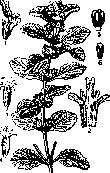
vulgar: 2-flower with bract; 2-corolla with stamens attached to it at one or two points; 3-calyx depending on the contents of the cyst (serous, parasitic, purulent). In the first case, the cyst, previously protected by tampons from the outflow of its contents into the free abdominal or thoracic cavity, is punctured, and its contents are emptied. The wall of the cyst after this is incised, the excess part is removed, and the remaining part, fused with surrounding organs, is sutured into the wound of the abdominal or thoracic wall, as hermetically as possible isolating the free cavity from infection during subsequent open treatment. In the second case, the cyst is not emptied, but its wall is sutured into the external wound, and only after 7-10 days, when firm adhesion has occurred, is the cyst emptied and tamponed. Since the cavity of the cyst is sometimes very large and heals extremely slowly under the tampons, and sometimes fistulas remain, at present M. is resorted to less and less frequently. Previously, M. was widely used for cysts of the ovary, ligaments of the uterus, and also for hydatid cysts. The latter are now operated on exclusively by the closed method (see Echinococcus). M. is now performed only in cases where the cyst, due to its position, presents great difficulties and dangers for removal, or, being fused with neighboring organs, cannot be removed without damaging the latter. This applies to cysts of both the abdominal and thoracic cavities and even of the brain. In the latter cases, the wall of the cyst is sutured to the dura mater.
Related articles
Mentioned in
Cite this page
“Marsupialization.” Soviet Medical Encyclopedia. English translation of Bolshaya Meditsinskaya Entsiklopediya, 1st ed. (Moscow, 1928–1936), ed. N. A. Semashko. https://sovietmedicalencyclopedia.pages.dev/article/marsupialization/