Toxocara
Historical document, translated for reference. It reflects medical knowledge of the 1920s–30s and is not medical advice.
Summary
This article from the 1928–1936 Great Medical Encyclopedia describes the nematode genus Toxocara, detailing its morphological characteristics, species, and occasional parasitism in humans, particularly Toxocara mystax and Toxocara canis.
Encyclopedia article (1928–1936)
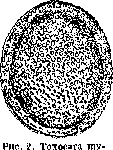
TOXOCARA Stiles, 1905, a genus of nematodes of the subfamily Ascaridinae, family Ascarididae, order Ascaridata. The head end (Fig. 1) is equipped with 3 lips. The pulp of the dorsal lip forms two distinct lateral lobes, separated by a saddle-shaped depression, and one unpaired median lobe. The tips of the median unpaired lobe cover the posterior half of the saddle-shaped depression. Cervical wings are powerfully developed. The tail end of the male is equipped with a conical appendage. Tail wings are absent. Spicules are nearly equal, equipped with wings. The vulva of the female is in the anterior quarter of the body. Eggs are nearly spherical with a thin shell (Figure 2), covered with cellular depressions resembling a thimble. Intestinal parasites of carnivores and optionally of man. The genus Toxocara includes six species. Toxocara mystax (Zeder, 1800), an obligate parasite of cats, has been recorded in humans. The length of the male Toxocara mystax is 30–60 mm, spicules 1.7–1.9 mm, length of the female 40–100 mm. The vulva is at the level of the anterior quarter of the body, eggs 0.065–0.075 mm in diameter. Cosmopolitan. Recorded in humans (according to Skryabin and Schulz, 1931) 10 times, of which 4 times in the USSR.
In experiments with the species Toxocara canis from the dog, Fülleborn
easily managed to obtain intrauterine invasion.

Related articles
Mentioned in
Cite this page
“Toxocara.” Soviet Medical Encyclopedia. English translation of Bolshaya Meditsinskaya Entsiklopediya, 1st ed. (Moscow, 1928–1936), ed. N. A. Semashko. https://sovietmedicalencyclopedia.pages.dev/article/toxocara/