Adenomyoma
Historical document, translated for reference. It reflects medical knowledge of the 1920s–30s and is not medical advice.
Summary
Adenomyoma is a benign tumor composed mainly of glandular epithelium and smooth muscle tissue, most commonly found in the uterus. The article discusses various theories about its histogenesis and notes that it rarely becomes malignant.
Encyclopedia article (1928–1936)
ADENYOMA (from Greek aden- gland, mys- muscle and oma- suffix denoting tumor), a tumor whose main constituent elements are glandular epithelium and smooth muscle tissue; the latter usually predominates, and sometimes one can only speak of glandular inclusions in a leiomyoma. A. is observed, mainly, in the uterus, especially on the posterior wall of its body, in the tubal angles, in the broad and round ligaments, in the vagina; much less frequently in the ovaries, along the gastrointestinal tract, in the gallbladder.-A. is pathogenetically and histogenetically not uniform. With regard to A. of the female genital sphere, reference is made to their development from the remains of the Wolffian (Gartner's) duct and the Wolffian body (epoophoral and paroophoral A.), which, however, has been proven only in individual cases; the main mass of uterine A. is associated with the proliferation of the uterine epithelium itself, sometimes, perhaps, with an anomaly in the development of the Müllerian duct in the sense of its epithelial detachment. A. of the duodenum and generally of the small intestine may develop as a result of the detachment of an anlage of the pancreas or of the intestinal mucosa itself, or from the ductus omphalomesentericus. In a number of cases, the glandular elements in adenomyomas are a product of the proliferation of the serous epithelium of the peritoneum. With respect to seroepithelial and other adenomyomas, especially so-called diffuse adenomyomas of the uterus, it is often possible to microscopically prove
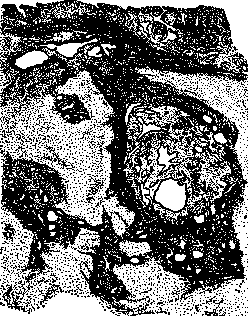
Adenomyometritis (adenomyosis); glandular
channels penetrate to the serous covering of the uterus (Aschoff, Pathologische Anatomie). the inflammatory nature of the disease, from which the terms: adenomyometritis, adenomyosalpingitis, adenomyositis; however, some authors here also deny the primarily inflammatory nature, preferring to speak of adenomyosis, for example, adenomyosis uteri (see Endometrioma).-A., a benign tumor, very rarely turns into cancer or sarcoma. In individual cases of seroepithelial A. of the intestine, due to the deep penetration of the process into the wall, phenomena of narrowing of the lumen were observed; this includes cases of so-called adenomyosis recto-uterina or vaginalis, with stenosis of the rectum.
Related articles
Mentioned in
Cite this page
“Adenomyoma.” Soviet Medical Encyclopedia. English translation of Bolshaya Meditsinskaya Entsiklopediya, 1st ed. (Moscow, 1928–1936), ed. N. A. Semashko. https://sovietmedicalencyclopedia.pages.dev/article/adenomyoma/