Equilibrium of the Body
Historical document, translated for reference. It reflects medical knowledge of the 1920s–30s and is not medical advice.
Summary
This article defines the mechanical and biomechanical principles of equilibrium, explaining the conditions required for a rigid or variable body to remain at rest. It details how gravitational forces and muscular moments interact to maintain posture and movement in the human body.
Encyclopedia article (1928–1936)
EQUILIBRIUM OF THE BODY. I. Mechanical equilibrium, a state in which a body experiences no acceleration. In a narrower, practically applied sense, equilibrium of the body is a state of its immobility relative to the surrounding environment. For an invariable (rigid) body to be in equilibrium, it is necessary and sufficient: a) that the geometric (i.e., obtained by sequential application of the parallelogram rule) sum of all forces acting on the points of this body be equal to zero, and b) that the geometric sum of all moments of forces acting on the body also be equal to zero. If a body cannot be considered invariable, the conditions for equilibrium of the body become more complex. Such a body must be mentally divided into elements small enough to be considered invariable bodies in relation to the given task; for equilibrium of the body, it is necessary in this case that conditions (a) and (b) be fulfilled for each element separately. Thus, if the number of elements is n, then for equilibrium of the body, it is necessary that 2n conditions independent of each other be fulfilled.
If the sum of forces acting on an invariable body is not equal to zero, we can always make it zero by applying to the body one more force equal and opposite to the aforementioned sum of forces. Such a force, which brings the body into equilibrium, is called a balancing force. To bring a complex system of n elements into equilibrium, it is necessary to have at one's disposal n balancing forces and as many balancing moments. In practice, cases are very frequent where the forces and moments acting on a body depend in a certain way on the position occupied by the body in space. For example, when moving a piece of iron in the force field of a magnet, the attractive force of the latter is greater the closer the iron is to the pole of the magnet. When giving a suspended pendulum various inclinations, the moment of the force of gravity acting on the pendulum is greater the closer the pendulum string is to the horizontal position, and smaller the closer it is to the vertical. In these cases, among numerous other positions, there may exist such positions at which the sums of forces and the sums of moments acting on the body become zero. Such positions are called positions of equilibrium. Depending on how the forces and moments act on the body in the immediate vicinity of the equilibrium position, three varieties of positions of equilibrium of the body are distinguished: positions of indifferent, stable, and unstable equilibrium of the body. In the first case, all positions in the immediate vicinity of the given position of equilibrium are themselves exactly the same positions of equilibrium. In the second case, in any proximity to the given position of equilibrium, there are positions devoid of equilibrium, but only such from which the forces and moments drive the body toward the position of equilibrium. Finally, in the third case, in any proximity to the given position of equilibrium, there are unbalanced positions not connected by the limiting condition of the second case. The behavior of a body near the equilibrium positions of these three types is known from elementary physics. Of particularly great importance for applied mechanics and for biomechanics is the case where all forces acting on the points of a body remain always constant in magnitude and parallel to each other: such are, first of all, the forces of gravity. In this case, the force balancing all such parallel and constant forces always passes through one and the same point of the invariable body, called the center of gravity of the body, in whatever position the body itself may be. For variable bodies, the balancing force for forces of the gravity type is likewise constant in magnitude and direction, but can pass through different points of the variable body, depending only on its deformations, and not on its positions in space: in variable bodies, the position of the center of gravity is not constant.
If an invariable body is suspended by any point, its state of equilibrium or non-equilibrium under the action of gravity will be entirely determined by what position its center of gravity will occupy in relation to the point of suspension: 1) the body will be in equilibrium if the center of gravity lies on the same vertical as the point of suspension, and will not be in equilibrium in any other case; 2) the equilibrium will be stable if the center of gravity is located below the point of suspension, unstable if it is above, and indifferent if it coincides with the point of suspension, i.e., if the body is suspended by the very center of gravity.
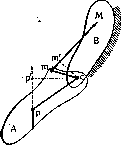
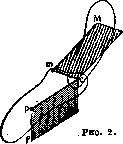
II. Biomechanical equilibrium. 1. Equilibrium in a joint. Link A (Fig. 1) can rotate relative to link B in the joint c connecting them. If one of the links, e.g., B, is fixed immovably, then for the equilibrium of link A, it is necessary and sufficient that the moments of all forces acting on the various points of link A, calculated in relation to the center of the joint c, be equal to zero in sum. Let us assume for simplicity that 2 forces act on link A: the force of gravity P and the force of muscular tension M (Fig. 1). The first force is applied at the center of gravity of the link p and represents the resultant (i.e., the geometric sum) of all forces of gravity acting on the individual points of the link. The second force represents the resultant of all forces developed by the individual fibers of a given muscle and passes through a certain point of the link m, lying on the area of attachment of the muscle tendon to the bone. The moment of force P relative to point c is equal to the product of the force and the arm of its action, i.e., the length of the perpendicular cp dropped from the center of the joint onto the line of action of force P. It is easy to verify that if one depicts force P with an arrow at a certain scale, its moment relative to c will be numerically equal to the area of the parallelogram constructed on the straight segments P and cp (Fig. 2). Reasoning in the same way, one determines the moment of force M as the product of M and cm, i.e., as a value numerically equal to the area of the parallelogram constructed on M and cm.
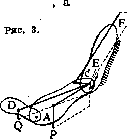
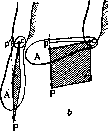
For link A to be in equilibrium, it is necessary that the moments P · cp and M · cm be equal and oppositely directed, in other words, that the two aforementioned parallelograms be equal in area and located on both sides of link A. If not two, but several forces act on link A, the course of reasoning and calculation remains the same, only one has to sum (geometrically) not two, but several moments calculated in the manner described above. In Fig. 3, link A is depicted, on which 4 independent forces act: P—the force of gravity of the link, Q—the force of gravity of the distal link D, F—the force of the flexor muscle, and E—the force of the extensor muscle. The link will be in equilibrium if the sum of the moments of all these 4 forces relative to point c is equal to zero. It is necessary to emphasize that in all examples of this kind, equilibrium of the body is determined not by the weights of the links, which are long-term constants, but by the moments of these weights, which change depending on the position of the link within very wide limits. Thus, in Fig. 4a, the moment of link A is small, because the arm cp is small; if one turns link A, as depicted in Fig. 4b, then the arm cp will increase, and with it, the moment P · cp will also increase. For long links of the body (forearm, arm, lower leg, thigh), it can be assumed that the moment of their gravity has its greatest value when their longitudinal axes are horizontal, and is close to zero when they are vertical. Thus, although the weights of the links are constant, their moments, P · cp, are variable just like the moments of muscular forces, M · cm. Therefore, to balance these moments against each other, the organism can resort to changing both the former and the latter. If, for example, in Fig. 3, the geometric sum (i.e., in this example, the difference) of the moments of the antagonist muscles F and E is greater than the largest value that the total moment of the forces of gravity P and Q can take (with horizontally extended links), then equilibrium is impossible, and the system of links A and D must begin to move in the direction of flexion. If, however, this sum of muscular moments takes any smaller values lying between the aforementioned maximum of the moment of gravity and zero, then for each of these values, there will be such arrangements of links A and D at which the system will be in equilibrium. In the vast majority of cases, the system itself will come to this position as soon as the sum of muscular moments has taken a known value. Likewise, it can be asserted that for each position of the system of links A and D, there exists such a value of the sum of muscular moments that balances the system in the given position.
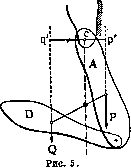
The movements of a system of links to an equilibrium position, determined by a specific muscular moment, as described above, are of enormous, if not predominant, importance in the biomechanics of movement. These movements are assigned the names static-dynamic, or fixational, or fixed, and the states of equilibrium that occur as a result of them are called static positions, states of static work, or fixations. Purely dynamic movements of links, i.e., those in which a limb moves with acceleration without passing through an equilibrium position and without stopping until it encounters some external obstacle (impact), are comparatively rare in practice. Much more common are cases of fixational movements, to which the overwhelming majority of professional movements belong. As a special case of the law discussed, it should be pointed out that if the sum of muscular moments is equal to zero, then for the equilibrium of the system of links A, D, etc., it is necessary that the sum of the moments of their gravitational forces, i.e., P. cp', Q. cq', etc. (Fig. 5), also be equal to zero. This latter condition is fulfilled when the common center of gravity of the system of links A, D... lies on the same vertical as the point of suspension of the system (in this case, the center of the joint c); the equilibrium of the system will be stable or unstable depending on whether the common center of gravity of the system is located below or above the point of support of the system c. From this special case, it follows that when the muscles of joint c are inactive (their total moment = 0), the center of gravity of the system suspended from c will necessarily be positioned on the same vertical as point c, i.e., it will bring the system into a state of stable equilibrium, and no contractions of the muscles of the system that do not cross over point c (so-called internal muscles of the system) will be able to move it from this vertical, even if the system itself undergoes the most diverse deformations due to these contractions. In its most general form, this rule, which is extremely important for the study of movements, is expressed as follows: the internal muscles of a system can displace the center of gravity of the system only along a straight line connecting its position with the point of support or suspension. 2. Equilibrium of the entire human body. The equilibrium of the body of a standing person can be considered from exactly the same points of view as the equilibrium of individual systems of links was considered above. In this case, the system of links will be the entire body, but instead of a point of support c, we will be dealing with a support area C (Fig. 6), consisting of the contours of the support of both feet and the area enclosed between them. Since no tensions, similar to muscles, are stretched between the body and the support surface when standing, it is obvious that equilibrium when standing can proceed exclusively according to the pattern of the last special case discussed. For the equilibrium of the body when standing, it is necessary that the moment of the common center of gravity of the entire body in relation to the support area C be equal to zero, i.e., that the vertical dropped from the common center of gravity of the entire body pass through the support area.
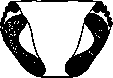
Figure 6.
The most important consequences of this basic principle are as follows: 1) no internal forces of the system (i.e., no muscle contractions) can, according to what was said above, shift the center of gravity of the body from the vertical on which it is located, i.e., disturb the equilibrium of the body if it already exists. However, since this center of gravity lies above the surface of support, i.e., the equilibrium belongs to an unstable type, a very small external force is sufficient to disturb this equilibrium. If the support were not a platform C, but a point c, then from the slightest external influence (a gust of wind) the equilibrium of the body would be irreparably disturbed, i.e., no muscle contractions could fight this disturbance. In the presence of a support area C of finite dimensions, the same irreparable disturbance of the equilibrium of the body occurs if an external force moves the vertical of the general center of gravity beyond the limits of this area. In this case, a person cannot help but fall, unless they timely change the contours of their support area, e.g., move a leg. 2) If a person is holding a heavy load, the previous statement remains valid in relation to the general center of gravity of the body and the load. The center of gravity of the body alone or the center of gravity of the load alone may in this case turn out not to be over the support area. 3) If the standing support area is replaced by a support line (tightrope walker, cyclist) or a support point (a dancer on pointe, a cyclist riding on one wheel), then no prolonged static equilibrium of the body is conceivable. In these cases, it is replaced by dynamic equilibrium, or balancing, the fundamental biomechanical mechanism of which is the same in all cases. As already emphasized, no muscle contractions can shift the center of gravity of the body from the vertical or return it to this vertical. Therefore, the muscle contractions of balancing always pursue a completely different goal: they strive not to place the center of gravity over the point of support, which is impossible, but to bring the point of support under the center of gravity, which is sometimes possible. A dancer on pointe cannot balance, because the point of support of her toe is immovable, but on a rope possessing transverse mobility, one can balance. That is why a seemingly paradoxical thing occurs: that one can walk on a rope 3 mm thick and relatively safely, while it is extremely dangerous, if not impossible, on a beam 30 mm wide. Balancing while riding a bicycle or ice skating boils down to the same timely bringing of the support line under the center of gravity. If the bicycle begins to lean to the right, i.e., the center of gravity turns out to be to the right of the support line, the rider turns the handlebars to the right as well, in order to roll the bicycle under the center of gravity that has deviated in that direction. It is impossible to balance on a stationary bicycle, because in this case its points of support become immovable. 4) Equilibrium while walking also belongs to the type of dynamic equilibrium, or balancing. At the beginning of each step, the vertical of the center of gravity goes beyond the limits of the support surface of the rear leg, and the body begins to fall forward. The task of balancing here boils down to catching this vertical with the other leg, which timely creates a new support area in front. Figure 7 shows how the vertical projection of the center of gravity moves between the support areas when walking. 3. Mechanisms of static equilibrium of the body and balancing. The innervation mechanisms of both named functions are generally diverse and, moreover, are essentially different for cases of static and dynamic equilibrium of the body. For static equilibrium of the body, the nervous mechanisms of muscle tone are primarily essential, in particular such phenomena as the fixation or plastic tone of Uexküll (Sperrtonus, Uexküll), which apparently lies at the basis of many fixations. Then one should mention the "static tone" of Brondgeest (Ruhetonus, Brondgeest), which represents a very complex reflex, or rather a collection of reflexes, supporting the muscles of the whole body in a state of those tonic tensions which are required for maintaining the equilibrium of the body in one posture or another. Numerous authors assert that this tonic effect proceeds without action currents, under the influence of vegetative innervation. (For the central localization of these tonic reflexes, see Tone.) The second, and undoubtedly the main, group of innervations determining both static equilibrium of the body and balancing consists of proprioceptive innervations and proprioceptive reflexes. The latter consist of changes in muscle tension under the influence of irritations of peripheral elements embedded in the tendons of muscles, in the membranes of articular capsules, and around the muscle fibers themselves. These terminal apparatuses perceive, on the one hand, changes in position in space (more precisely, changes in the mutual arrangement) of the limbs of the body; on the other hand, they react to force changes in muscles and tendons, to changes in tension in both. Disorders of the normal activity of the proprioceptive apparatus (ataxia in lesions of the posterior columns) entail such significant disorders of the equilibrium of the body (Romberg's symptom) that this alone forces one to recognize its leading role in maintaining the equilibrium of the body. It is undoubted that the proprioceptive apparatus participates both in the realization of the simplest tonic reflexes and in complex dynamic acts of balancing. A very important role in the physiology of equilibrium is played by the vestibular apparatus, which perceives changes in the position of the head in the gravitational field and displacements or accelerations experienced by it in space. Being connected to only the head, the vestibular apparatus by itself would be powerless to assist in maintaining the equilibrium of the body as a whole; therefore, its activity is closely connected with the activity of the entire proprioceptive system, and especially with the tonic reflexes of the cervical musculature. In this combination, the main role in maintaining the equilibrium of the body falls to the vestibular apparatus, especially during complex acts of balancing, which makes the flawlessness of its functioning an indispensable condition for such professions as, for example, the profession of a pilot. Finally, one should also mention the role of the cerebellum, which possesses a huge number of nerve connections and takes the closest part in all kinds of acts of maintaining the equilibrium of the body. There is every reason to believe that it is the cerebellum that is the highest regulatory center to which all proprioceptive and vestibular impulses flow and which, through the system of cells of the anterior horns, as well as probably through the system of the red nucleus (n. rubri) and the sympathetic trunk, influences the state of the muscles, assisting in the maintenance of the equilibrium of the body. For pathology of the equilibrium of the body, see Vestibular nerve, Vestibular system, Cerebellum, Ataxia.
Related articles
Mentioned in
Cite this page
“Equilibrium of the Body.” Soviet Medical Encyclopedia. English translation of Bolshaya Meditsinskaya Entsiklopediya, 1st ed. (Moscow, 1928–1936), ed. N. A. Semashko. https://sovietmedicalencyclopedia.pages.dev/article/equilibrium-of-the-body/