Pirogov Amputation
Historical document, translated for reference. It reflects medical knowledge of the 1920s–30s and is not medical advice.
Summary
Pirogov amputation is a historic osteoplastic method of ankle-level amputation that uses a calcaneal bone graft to create a weight-bearing stump. Developed by N. I. Pirogov in 1852, it served as the foundation for subsequent osteoplastic surgical techniques.
Encyclopedia article (1928–1936)
PIROGOV AMPUTATION, an osteoplastic method of removing the lower leg at the level of the malleoli. The idea of the method consists in covering the cross-section of the lower leg bones with a cross-section of the calcaneus, thereby creating a good weight-bearing stump. The operation is indicated in cases of traumatic injuries, tumors, osteomyelitis, tuberculosis, gangrene of the foot, etc. The historical premise for this operation is the Syme operation. In the Syme operation, the skin incisions are the same as in the Pirogov amputation. A flap is cut from the skin of the heel of the foot being removed, with which the cross-section of the lower leg bones is covered. N. I. Pirogov proposed this osteoplastic amputation in 1852. The skin-bone flap, containing the calcaneal tuberosity, is applied to the cross-section of the lower leg bones and fixed either with a periosteal suture, wire, or a nail through the heel. It is recommended to fix the flap well over the skin sutures with a long strip of adhesive plaster. The accompanying figure shows the relationships resulting from the Pirogov amputation (Fig. 1). The Pirogov amputation was a great discovery in its time and served as the progenitor of all osteoplastic methods: Gritti, Sabaneev, and Bier. Long-term results of the Pirogov amputation itself revealed both its shortcomings and its merits. Although the Achilles tendon is not shown in the figure, it is clear that it is stretched during this operation. N. I. Pirogov himself warned about this in the following terms: "The tension (of the Achilles tendon), which I always avoid as the main obstacle to success, depends on two causes: it occurs either when one saws off too little of the malleoli and the articular surface of the tibia, or when one leaves too much of the calcaneus in the posterior flap." The second defect is that the point of support in the stump obtained after the Pirogov amputation does not fall on the area of skin that we are accustomed to using usually. The skin here is thinner, therefore in some cases it may ulcerate. Günther introduced a change to the Pirogov method. The skin incision is made somewhat more anteriorly (Fig. 2). The sawing of the calcaneal tuberosity and the bones of the lower leg is performed obliquely from above and behind, downwards and forwards. Thanks to this, the patient rests on skin accustomed to pressure. Le Fort and Esmarch move the skin incision even further anteriorly.
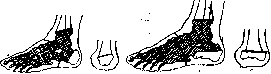
Figure 2. Günther operation.
Figure 3. Le Fort and Esmarch operation. (Fig. 3). The sawing of the bones of the lower leg and the calcaneus is performed horizontally. Figures 2 and 3 illustrate both of these methods. Finally, the modification by the English surgeon Quemby deserves attention. The latter, in adolescents and children, places the calcaneal tuberosity, sawn according to Pirogov, between the untouched malleoli. This does not disturb the line of the epiphyseal cartilage of the lower leg bones. This modification gave impetus to the creation of the Samfirescu operation—placing the horizontally sawn calcaneus (Le Fort) into a somewhat deepened space between the condyles. Modern orthopedics, when performing the Pirogov amputation and its modifications, requires that the stump be several centimeters shorter than the healthy limb. Only in this way are favorable conditions created for prosthetics. The Pirogov amputation, which gave impetus to the development of osteoplastic methods, has world historical significance. Pirogov himself defines it with the following words: "My operation has no need to fear rivalry. Its merit is not in the method of amputation, but in the osteoplasty. The principle proven by it is undoubtedly important: that a piece of one bone, while in connection with soft parts, grows to another and serves to lengthen and to the function of the limb."
Related articles
Mentioned in
Cite this page
“Pirogov Amputation.” Soviet Medical Encyclopedia. English translation of Bolshaya Meditsinskaya Entsiklopediya, 1st ed. (Moscow, 1928–1936), ed. N. A. Semashko. https://sovietmedicalencyclopedia.pages.dev/article/pirogov-amputation/