Sabaneev Operation
Historical document, translated for reference. It reflects medical knowledge of the 1920s–30s and is not medical advice.
Summary
The Sabaneev Operation is an amputation technique involving the removal of the lower leg at the knee joint using an osteoplastic principle. It is considered a refinement of the Gritti operation and produces a more durable stump.
Encyclopedia article (1928–1936)
SABANEEV OPERATION, the removal of the lower leg at the knee joint with the application of the osteoplastic principle. It is more correctly designated as an osteoplastic amputation of the thigh (amputatio femoris inter-condyloidea osteoplastica). Like the Gritti operation, of which it is essentially a further refinement, the S. o. should be considered a derivative operation of Pirogov. The skin incision is made symmetrically on both sides of the thigh (Fig. 1), starting from the upper edge of both condyles downward onto the leg, and ends 3-4 cm below the tuberosity tibiae. The lateral incision on the leg passes in front of the head of the fibula, while the median incision is 1 cm behind the edge of the tibia. The ends of both incisions are connected by a transverse incision. The incisions are carried down to the bone immediately. Then, 2-3 cm above this incision, a similar transverse incision is made from behind. Along the edge of the retracted skin behind, all muscles are cut through to the bone. The leg is raised upward, the posterior flap is separated from the bone, a knife is inserted from behind into the knee joint, the ligaments are cut, and the leg is bent forward so that the anterior surface of the leg comes into contact with the anterior surface of the thigh. The cartilage of the upper surface of the tibia is cut at the border of its anterior third with a frontal incision. The tibia is sawn lengthwise so that the corresponding section of bone is included in the anterior soft tissue flap. When the sawing reaches the lower edge of the skin flap, the saw is removed, the leg is brought to its normal position, and the tibia is sawn from front to back. The bone wedge from the tibia is completely sawn through and the leg is removed. In the wound, the popliteal artery and vein are ligated. The anterior skin-bone flap is turned upward. The condyles of the thigh are exposed, and they are sawn at the level of their greatest width. The sawn surfaces of the thigh and tibia are applied to each other (Fig. 2) and secured with periosteal sutures. The functional result of the S. o. is very good. The stump is much more durable than the Gritti stump. Like all other osteoplastic amputations, the S. o. should not be performed in cases of extensive damage to soft tissues, in patients with nutritional decline, with weakness of cardiac activity, and significant arteriosclerosis.
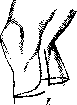
FIG. 1.
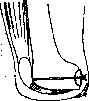
Fig. 2.
Related articles
Mentioned in
Cite this page
“Sabaneev Operation.” Soviet Medical Encyclopedia. English translation of Bolshaya Meditsinskaya Entsiklopediya, 1st ed. (Moscow, 1928–1936), ed. N. A. Semashko. https://sovietmedicalencyclopedia.pages.dev/article/sabaneev-operation/