Gritti's Amputation
Historical document, translated for reference. It reflects medical knowledge of the 1920s–30s and is not medical advice.
Summary
An article from the early Soviet medical encyclopedia describing Gritti's amputation, an osteoplastic amputation at the knee joint. It details the surgical technique, its advantages over simple disarticulation, and modifications to prevent the patella from slipping.
Encyclopedia article (1928–1936)
GRITTI'S AMPUTATION, proposed in 1857 by the Italian surgeon Gritti, is based on the concept of Pirogov's operation; instead of disarticulation, a plastic amputation is performed at the knee joint, utilizing the patella to cover the bone stump. Gritti's amputation has gone through a series of modifications and improvements. Currently, its technique is as follows: a semilunar skin flap incision is made, with the convexity of the incision reaching downward to the tuberosity of the tibia; the ends of the incision on both sides of the thigh are at the posterior margin of the condyles (see Figure 1, A); the ligamentum patellae is transected at the bone, after which the flap containing the patella within its thickness, along with the lateral ligaments of the knee and the joint capsule, is folded upward. The ligamentum patellae is firmly grasped, and, pressing the patella tightly against the bone in the intercondylar notch, the cartilaginous surface of the patella is sawed off (see Figure 2). The soft tissues of the thigh are separated upward above the condyles, and the femur is sawed through above the upper margin of the articular cartilage, at the level of the upper margin of the patella.
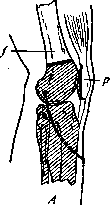

Figure 1. A—the dotted line indicates the incision line of the soft tissues; the thick line indicates the bone cut; the shaded parts are to be removed. B—the final result of the operation. f—femur; p—patella. (After Bier-Braun-Kümmell.)
After ligating the vessels (artery and vein popliteal), the flap is turned downward, the patella is fitted to the cut surface of the femur and secured with sutures to the soft tissues of the posterior surface of the thigh—to the flexor tendons and the periosteum (see Figure 1, B). Sutures are applied to the skin. Gritti's operation has
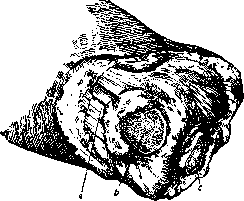
Figure 2. Gritti's amputation: a—ligamentum patellae proprius; b—sawed-off patella; c—cut of the femur. (After Bier-Braun-Kümmell.)
all the advantages over disarticulation at the knee joint, because it creates a strong, viable stump containing a good fatty cushion, capable of bearing a heavy load and convenient for wearing a prosthesis. The fitted cut of the patella does not always remain in its place: its slipping and ankylosis at an angle are not infrequently observed. In view of this, a certain modification of the operation is currently proposed: a kind of plug is made from the patella, with which the medullary canal of the femur is closed. Literature: Gritti R., Dell'amputazione del femore al terzo inferiore e della disarticolazione del ginocchio, Milano, 1857; ibid., Amputation des Oberschenkels an den Condylen mit Patellarlappen, Verhandlungen des X Internationalen med. Kongresses 1890, B. III, Abt. 7, B., 1891.
Related articles
Cite this page
“Gritti's Amputation.” Soviet Medical Encyclopedia. English translation of Bolshaya Meditsinskaya Entsiklopediya, 1st ed. (Moscow, 1928–1936), ed. N. A. Semashko. https://sovietmedicalencyclopedia.pages.dev/article/grittis-amputation/