Stegomyia
Historical document, translated for reference. It reflects medical knowledge of the 1920s–30s and is not medical advice.
Summary
Stegomyia calopus, now known as Aedes aegypti, is the mosquito that transmits yellow fever and dengue fever. This article describes its physical characteristics, habitat, life cycle, and control measures in the Soviet Union during the 1930s.
Encyclopedia article (1928–1936)
STEGOMYIA calopus Meig., in recent literature appears under the name Aedes aegypti (L.); other synonyms—Aedes argenteus Poiret and Aed. fasciatus Fabricius; carrier of yellow fever (see) and dengue fever (see Dengue fever); in our literature known as the yellow fever mosquito. Female 4-7 mm in length (figs. 1 and 2). In general a black mosquito with white spots on the forehead, occiput, thorax, on the posterior edge of the scutellum, and on the sides of segments I-VI of the abdomen. On the mesonotum, thorax a characteristic white pattern in the shape of a lyre. On the black legs white rings, on the tarsi and white knees. The maxillary palps are 5-6 times shorter than the proboscis. On the antennae white rosettes of hairs. It is a true "domestic" insect, all of whose development and life are closely connected with human dwellings. Distributed in the tropics; reaches north to 43° N. lat. Within the USSR it is found in Batum (where it was discovered by E. I. Martynovsky), Poti, Sukhumi. Imported specimens are encountered in Tiflis, Gagra, Tuapse, but here S. calopus does not establish itself. Easily transported over long distances. Easily bred in laboratory conditions.
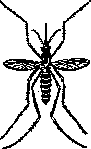
Bites humans both day and night, but at temperatures not below 16°. At 28° can drink blood every 2-2½ days. In the laboratory females survived up to 100-150 days. Mating occurs at temperatures not below 18-19°; at optimal temperature it occurs 2-3 days after emergence. Egg laying usually occurs after every 2-3 blood meals. The female lays on average 40-120 eggs; the ability of females to lay up to 750 eggs has been noted. Laying occurs in the most diverse bodies of water with clean and dirty water—from barrels of drinking water to rusty tin cans and fragments of broken pottery in which water has collected. Eggs of regular oval shape with pointed poles—fig. 1. Yellow fever mosquito; surface of the eggs is reticulate. Color black. They are laid singly; very resistant to drying (over half a year). Larvae hatch in several batches from the same clutch. The minimum temperature for development is 17°, and the optimum is about 28° (fig. 3). At optimal temperature a new generation of S. calopus can be obtained in the laboratory at any time of the year, on average every three weeks (A. Gusevich). At 27-30° and other favorable conditions eggs give larvae already in two days; the entire larval period lasts 6 days, the pupa lives 1½ days, and in 9¼ days, counting from the moment of egg laying, an emerged mosquito already flies out (Martini). The larva has a barrel-shaped respiratory siphon with a narrower apex. The tracheal gills are long and wide. Characteristic are the spiny bristles on the sides of segments VIII-XII (fig. 2. Posterior end of the body of a Stegomyia calopus larva: 1-siphon; 2-gills; 3-caudal hairs; 4-spines; 5-bristles, greatly enlarged; can devour larvae of other mosquitoes and live in water with 4% salt. The pupa is dark with two lateral whitish spots on the "thorax" and a striped abdomen. In the USSR there is neither yellow fever nor dengue fever, but the presence of their carrier on the eastern coast of the Black Sea must be taken into account. With S. calopus they conduct an energetic struggle, as with malaria mosquitoes (see Malaria). Depending on the finding of S. calopus in "household" water containers, it is necessary to control the water with the provision of immediate destruction of the aquatic stages of metamorphosis of S. calopus. Emerged mosquitoes are destroyed by fumigation. Sustained struggle with S. calopus leads to a significant reduction in the number of these mosquitoes. Reducing the percentage of houses infested with S. calopus from 90 to 10 and below already leads to the elimination of yellow fever (America). For the purpose of preventing the possible importation of dengue to the Black Sea coast of the Caucasus (in connection with the strong development of the dengue epidemic in 1928 in Greece) there was conducted a successful struggle with S. calopus (especially in Batum and then in Sukhumi), in particular by the use of gambusia.
Fig. 3. Temperature curve of development of the yellow fever mosquito. T-temperature in degrees C; V-duration of development in days; C-"minimum temperature for development". (According to A. V. Gusevich.)
Related articles
Mentioned in
Cite this page
“Stegomyia.” Soviet Medical Encyclopedia. English translation of Bolshaya Meditsinskaya Entsiklopediya, 1st ed. (Moscow, 1928–1936), ed. N. A. Semashko. https://sovietmedicalencyclopedia.pages.dev/article/stegomyia/