Acrania (z884)
Historical document, translated for reference. It reflects medical knowledge of the 1920s–30s and is not medical advice.
Summary
Acrania is a congenital defect characterized by partial or complete absence of the cranial vault and overlying skin. In severe cases, the brain may be exposed as a rudimentary structure or completely absent, often associated with other developmental abnormalities.
Encyclopedia article (1928–1936)
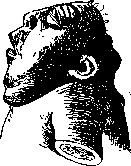
ACRANIA (from the Greek a - negative particle, and kranion - skull), a deformity characterized by complete or partial absence of the cranial vault and the corresponding skin coverings. In severe cases of acrania, the brain appears as a rudiment consisting of connective tissue with blood vessels and insignificant remnants of brain tissue, lying openly (exencephaly) on a poorly developed, deformed base of the skull; sometimes the brain is completely absent (see Anencephaly). Acrania is often combined with spina bifida (see Rachischisis) and underdevelopment of the spinal cord (see Amyelia); if the rudiment of the brain protrudes backward through the defect in the skull and spine, it is called notencephaly. The absence of most of the skull and brain and the strong protrusion of the eyes due to underdevelopment of the frontal bones gives the head a characteristic toad-like appearance; this resemblance is further enhanced by the fact that the neck in A. is usually poorly developed, and the strongly backward-tilted head seems to be directly attached to the trunk. The origin of A. is unclear; apparently, the most important and primary factor should be considered the developmental deformity of the brain, while A. is already a consequence of such a deformity; attention is drawn to hydrocephalus of the medullary tube, to the role of amniotic constrictions, to the significance of the fact of strong curvature of the embryo's body; Rabaud has put forward the theory of fetal meningitis. In mild degrees of acrania, for example, in cases of hemikrania (with hemicephaly, see), the fetus may be viable for some time, with sometimes a significant discrepancy between relatively good brain function and anatomical structure. A. is often combined with other deformities: failure to close the thoracic and abdominal cavities, ectopias, eventrations, etc. Very often, A. is combined with underdevelopment of the adrenal glands (see Anencephaly). Kaufmann observed a case of A., when the parents already had two similar fetuses. A. also occurs in some animals and birds.
ACRATOTHERMS
This term is not defined in the provided text.
Related articles
Mentioned in
Cite this page
“Acrania (z884).” Soviet Medical Encyclopedia. English translation of Bolshaya Meditsinskaya Entsiklopediya, 1st ed. (Moscow, 1928–1936), ed. N. A. Semashko. https://sovietmedicalencyclopedia.pages.dev/article/acrania-2/