Jejunostomy
Historical document, translated for reference. It reflects medical knowledge of the 1920s–30s and is not medical advice.
Summary
This article describes the surgical procedure of jejunostomy, a fistula of the jejunum used for feeding patients when a gastroenterostomy is impossible. It details the Witzel-Eiselsberg method as the preferred technique due to its simplicity and ease of closure, while also mentioning other historical methods.
Encyclopedia article (1928–1936)
JEJUNOSTOMIA, jejunostomy, a fistula of the jejunum, is performed for the purpose of feeding patients for whom it is impossible to perform a gastroenterostomy. This includes cases of extensive burns of the esophagus and stomach, and malignant tumors that have infiltrated the entire wall of the stomach; in rare cases, an inoperable gastric ulcer is an indication for jejunostomy. A necessary condition for jejunostomy is complete
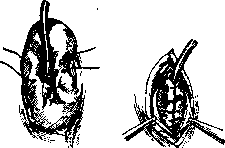
Figure 1.
Figure 2.
hermeticity, which prevents the leakage of duodenal juice, the loss of which quickly leads to exhaustion and the death of the patient. Several methods of jejunostomy have been proposed, of which the most common is the Witzel-Eiselsberg method; the Mayo-Robson and Maydl methods are sometimes used. For patients who are weakened and exhausted by prolonged starvation and who cannot withstand a lengthy surgical intervention (and such are the majority of patients subjected to this operation), the technically simple Witzel-Eiselsberg method is the most indicated. Through an incision along the midline or to the left of it, the abdominal cavity is opened by blunt dissection of the fibers of the rectus abdominis muscle. A loop of the jejunum is located 20-30 cm below the plica duodenojejunalis and is pulled into the abdominal wound. After isolating the abdominal cavity with gauze pads, a rubber tube the thickness of a pencil is inserted into the lumen of the intestine in the anal direction through a small incision in its wall. The wall is tightened with a purse-string suture
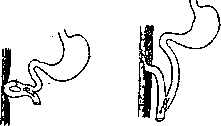
Figure 3.
Figure 4,
around the inserted tube, after which the tube is buried into the intestinal wall with separate sutures (Fig. 1), similar to the Witzel method (Fig. 2) for gastrostomy (see). The intestine is fixed to the parietal peritoneum with several sutures, followed by layered suturing of the abdominal wall wound. One should avoid a large number of sutures on the intestine so as not to cause its narrowing and the retention of duodenal contents. The Mayo-Robson, Maydl, and other methods are much more complex than the one described, as they require the creation of an entero-enteroanastomosis, as can be seen from Figures 3 and 4. A great advantage of the Witzel-Eiselsberg method is the ease of closing the fistula once it is no longer needed. Simple removal of the tube leads to its rapid closure (usually after 2-3 days). Nutrients poured into the intestine should, if possible, be warmed to body temperature and introduced slowly, in small doses of 50-100 cm3 every 1-2 hours, under low pressure—best of all through a funnel attached to the end of the rubber tube. Initially, only liquids should be introduced; when the intestine begins to gradually adapt to the new position and the nature of the food, which is not modified by gastric juice, the quantity and nutritional value of the introduced food can be gradually increased. For better assimilation of food during jejunostomy, Eiselsberg suggests the following feeding regimen: the total amount of food consists of 1,500-1,800 g of milk and 200 g of finely crushed bread. To the milk are added 10-20 g of meat juice, 8-10 eggs, 2 tablespoons of somatose, and 1-2 teaspoons of butter. This entire amount is divided into portions and introduced into the fistula in 8-10 feedings throughout the day.
Related articles
Cite this page
“Jejunostomy.” Soviet Medical Encyclopedia. English translation of Bolshaya Meditsinskaya Entsiklopediya, 1st ed. (Moscow, 1928–1936), ed. N. A. Semashko. https://sovietmedicalencyclopedia.pages.dev/article/jejunostomy/