Mechanotherapy
Historical document, translated for reference. It reflects medical knowledge of the 1920s–30s and is not medical advice.
Summary
Mechanotherapy refers to a system of therapeutic exercises performed by patients using specialized apparatus. This 1930s article describes various mechanotherapy systems developed by Zander, Krukenberg, Herz, Thilo, and others, explaining their mechanical principles and applications in treating muscle atrophy, joint stiffness, and other conditions.
Encyclopedia article (1928–1936)
MECHANOTHERAPY, in the narrow sense, a system of methodical exercises which the patient performs with therapeutic purpose on apparatus or with the help of apparatus. The idea of replacing the hand of a gymnast in therapeutic exercises with mechanical force appeared very long ago. However, systematic applications of mechanized manual techniques belong only to the middle of the 19th century. In 1857, the first mechanotherapy apparatus appeared, invented by the Swedish physician Zander. The design of this apparatus corresponds to the physiological laws of muscular work. Starting from this time, in a relatively short period, numerous different systems and varieties of individual apparatus emerged, of which the apparatus of Zander, Krukenberg, and Herz developed most extensively. Principles of construction of the main systems in M. The system of Zander apparatus is built on the principle of a double-arm lever. The lever device serves two purposes: 1) to change the resistance for the exercising muscle, 2) to dose this resistance by moving a weight on the lever. The basis for constructing an apparatus on the lever principle were the following physiological laws: 1) the strength of a muscle decreases as it contracts (Schwann's law); 2) the strength of a muscle increases as the angle formed by the muscle with the corresponding bone lever approaches a straight line. When a muscle acts on a bone lever in an oblique direction, the strength of the muscle cannot be manifested in full and is lost during movement. Formulating this in mathematical expressions, we obtain: the magnitude of resistance increases and decreases proportionally to the cosine of the angle of inclination of the lever with the weight. - Zander apparatus are divided into the following groups: 1) apparatus for active movements, more precisely dual movements (Figure 1); this also includes apparatus for progressive or balancing movements; 2) apparatus for passive movements, massage manipulations and finally 3) orthopedic apparatus for treating various curvatures (of the spine, etc.). The apparatus are set in motion by a mechanical motor or external manual force. Zander apparatus, built on the principle of a double-arm lever, are applicable only for those joints in which muscular work obeys the laws of leverage (for example, the elbow joint); in other movements, these principles do not agree with the physiological movements of the joint (Bum). If we add to this that, in addition to the complex automatic configuration of joint surfaces, the mechanism of movement depends to a large extent on muscular play, it becomes understandable that the Zander system by no means solves the problem of developing movements, especially in violation of muscular equilibrium, and therefore leaves much to be desired. Krukenberg apparatus are built on the principle of a balancing pendulum. In the apparatus, a pendulum with a weight hangs perpendicular to the axis of movement, which sums up the individual impulses produced by the patient and thereby increases the range of motion. The magnitude of resistance in the apparatus does not correspond to the curve of muscle work capacity in individual phases of movement, as is observed in Zander. However, the force of resistance, the increase and decrease of counter-resistance in this system change due to the balancing of the pendulum itself, as well as the movement of the weight, which can be moved along the pendulum. The difference of the Krukenberg system from Zander apparatus lies primarily in the magnitude of movement excursions. While in the Zander apparatus the magnitude of excursions is determined each time by the initial position of the lever, the corresponding setting of the apparatus, in Krukenberg apparatus this excursion magnitude, due to pendulum movements, can be increased or decreased at will. Krukenberg apparatus serve mainly for treating muscle atrophy, strengthening paralyzed muscles, and combating joint stiffness on the basis of muscle atrophy. In order to be able to produce movement even when the muscles are capable only of minimal contraction, Krukenberg apparatus are equipped with devices that balance even the weight of the body parts. The rhythmic, semi-automatic movements obtained on the Krukenberg apparatus give a very beneficial effect in treating internal diseases and diseases of the nervous system. According to Herz, the shortcomings of this system are as follows: 1) the volume of movements is strictly limited by the volume of pendulum movements; 2) the speed of oscillation depends on the length of the pendulum, which is why long pendulums are necessary for slow movements. - To the system of Krukenberg apparatus belong also the apparatus of the Caro system, consisting of one main stand, to which individual parts for different joints are attached. Despite the apparent great convenience of such a system (saving space), these apparatus have one significant drawback: they consume a lot of time for the doctor and the patient in rearranging and securing the parts. Where it is necessary to treat a large number of patients, it is better to abandon this system of apparatus. Herz's system of apparatus is based on the principle of an eccentric. Herz proceeded from the fact that the increase and decrease of counter-resistance occurs according to special curves, which are determined on the one hand by the anatomical-architectural features of the joints, and on the other by changes in muscle strength in different phases of movement. By calculating with the help of a dynamometer specially designed by him the tension of muscle strength during movement, Herz plotted the values he obtained on the periphery of a circle along radii corresponding to the phases of movement. Then connecting these points at the places of the plotted values, he obtained a curve,
showing the changes in tension of the muscle of a given joint during movement. Herz called these curves joint-muscle diagrams. - Herz gives five groups of apparatus for the following types of movements: active movements with resistance, swinging movements, self-braking movements, passive movements, apparatus for massage techniques (vibration, patting, etc.).
The system of Thilo apparatus is built on the principle of a block. The design of this primitive mechanotherapeutic apparatus is as follows: through one or more blocks a rope is passed, on one end of which different weights are suspended, on the other - the segment of the exercising limb. By increasing or decreasing the weight of the load, as well as changing the position of the blocks and setting them at different angles, Thilo achieves dosing of force and changing tension in different phases of movement. A classic example of an apparatus of the Thilo system is the apparatus for exercising fingers: a small frame on which blocks are attached on all four sides; the arm rests in the middle on a crossbar. The tip of the finger is threaded through a loop, and thus the muscles of the fingers are exercised-in all four directions? /e, producing flexion, extension, abduction and adduction (Fig. 2). To the type of Thilo apparatus belongs the universal apparatus Werde-gesund. System of elastic traction. The apparatus of this system can be divided into several groups. The first group includes a device where resistance is produced by stretching a rubber tube. An example of such an apparatus is the Goodyear restorer, the second group of apparatus combines a rubber cord and a block. An example of such an apparatus is the block apparatus. The common drawback of these two groups of apparatus is that 1) elastic traction constantly increasing resistance to the muscles; the strongest resistance falls at the end of muscle contraction, i.e., at the period when the muscles develop the least strength, which contradicts the basic physiological principles of muscle work; 2) the g stretchability of rubber decreases very quickly, and thus the concept of resistance is lost. System of spring traction. This group of apparatus is based on the application of a spring. An example can be the apparatus for flexion and extension of the forearm and lower leg (Figs. 3 and 4). In conclusion, mention should be made of very simple but convenient, especially in a home setting, apparatus for exercising the ankle and wrist joints of the Heermann system. They are built on the principle of sled-like rockers. As an example, the foot rocker is shown (Figure 5). For treating joint stiffness-* of the fingers, the Alsbberg apparatus is used
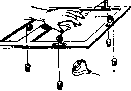
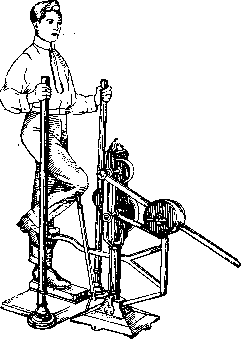
Figure 1. Zander apparatus for active movements with resistance.
Figure 2. Thilo apparatus for exercising the fingers in all four directions. Figure 3. Apparatus for flexion and extension of the forearm. Figure 4. Apparatus for flexion and extension of the lower leg. Figure 5. Heermann foot rocker.
berg) (fig. 6). Between two swinging wheels are fixed in the middle by means of a strap the fingers. The swinging of these wheels produces flexion and extension. Finally, mention should be made of the treatment of stiffness of the jaw joints, in which Heister's rotators are widely used, cork and wooden wedges inserted between the dental row, etc. Technique of M. When exercising on apparatus (development of muscles or movements in joints) regardless of what type of apparatus it is or to what system it belongs, it is necessary to observe: 1. Correct placement of the moving segment-limb on the apparatus, namely-the axis of the apparatus must strictly coincide with the axis of the joint which is moving. The requirement for coincidence of axes is not achievable for all joints. For example, as easy as it is to apply this requirement in flexion of the knee foot, ankle, elbow, raising of the arm forward and to the side, so difficult is it to observe this rule in rotation of the shoulder and hip and in lateral movements of the leg in the hip joint. This is explained by the anatomical complexity of these joints. 2. Correct initial position of the free parts of the exercising limb outside the apparatus, as well as correct posture of the body. 3. Correct fixation of the exercising segment of the limb on the apparatus. Fixation of the limb on the apparatus aims to ensure the direct transfer of movement from the apparatus to the exercising part of the body. The degree of fixation in some cases determines the effectiveness of the apparatus. As a rule, fixation should not restrict freedom of movement in the joints and should not impair blood circulation in the tissues of the moving limb. Strong fixation of the limb adversely affects the elasticity of the muscle. A direct indication for fixation of the limb on the apparatus is also the need to eliminate associated movements. Thus, in stiffness of the hip joint, it is necessary to pay close attention to isolating the associated movement of the pelvis when exercising stiffness of the shoulder joint-to exclude the combined movement of the scapula, etc. Isolating the movement of the pelvis from the hip in stiffness of the hip joint is to this day a problem in M. that has not been finally resolved. 4. Correct dosage (load). Dosing exercises is the most important and at the same time the most difficult question in mechanotherapy. As a general rule, muscle exercise should preferably be started without any load. Transition to load should be gradual and imperceptible. The load should be increased as muscle strength increases, and it is necessary to observe the requirement that the increasing resistance is always in strict accordance with the muscles' ability to work. Indications and contraindications. Indications for referring patients for gymnastics on apparatus are essentially the same as for medical gymnastics. It is only necessary to keep in mind that the choice of exercises in M., as well as indications for use, are significantly more limited than is the case with gymnastics. This is because, while in medical gymnastics we have the possibility at any moment to change manual methods of impact in any direction, in M., with the standardization of mechanotherapeutic apparatus (system of axial movements-a mandatory condition for coincidence of joint axes with the axis of the apparatus), this is not always possible to do. This very moment is the reason why M., which had a flourishing development in the 19th century, soon had to stop, limiting itself in the future to introducing only various changes and improvements within what had already been achieved.
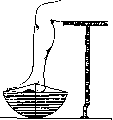
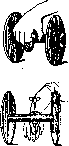
Fig. 5.
FIG. 6. Fig. 5. Heermann's apparatus for exercising the ankle joint. 6. Alsberg's apparatus for exercising the fingers.
Related articles
Mentioned in
Cite this page
“Mechanotherapy.” Soviet Medical Encyclopedia. English translation of Bolshaya Meditsinskaya Entsiklopediya, 1st ed. (Moscow, 1928–1936), ed. N. A. Semashko. https://sovietmedicalencyclopedia.pages.dev/article/mechanotherapy/