Ocular
Historical document, translated for reference. It reflects medical knowledge of the 1920s–30s and is not medical advice.
Summary
The ocular is a system of lenses in optical instruments like microscopes and telescopes that faces the observer's eye and functions as a magnifying glass. Its purpose is to enlarge the real image produced by the objective, with various types designed to correct optical aberrations and provide different magnification capabilities.
Encyclopedia article (1928–1936)
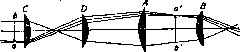
OCULAR, a system of lenses in optical instruments (microscope, telescope, etc.), turned toward the observer's eye and serving the role of a magnifying glass. The purpose of the O. is to enlarge the real image given by the objective (see). The image from the objective must be at a distance less than the principal focal length of the O., and to obtain maximum magnification, this image should lie as close as possible to the principal focus of the O. Viewing the image through the O. as through a magnifying glass (see), we obtain a virtual image located at the distance of best vision from the eye. A good O. should give a colorless image, and for this it is necessary that the red and blue rays passing through the O. would give virtual images of the same angular magnitude. For this, the focal length of the O. must be the same for both types of rays. This problem is solved in a complex achromatic O., consisting of two lenses (of the same material), removed from each other by a distance equal to half the sum of their focal lengths. The main types of Huygens and Ramsden oculars, used in microscopes (for detailed description see Microscope) and in telescopes, satisfy this condition. Usually, the O. is calculated and corrected separately from the objective with respect to the main optical errors. Therefore, the O. can be changed in optical instruments, selecting the focal length according to the required magnification. However, O.'s with a focal length less than 5 mm are not used, since for such short-focus O.'s the brightness of the image becomes too small, and diffraction affects its distinctness. In a terrestrial telescope, the O. consists of two parts—one, like all O.'s, being a magnifying glass, and the other, located between the first part of the O. and the objective, usually consisting of two converging lenses and serving to invert the inverted image given by the objective to an upright one. The O. of a terrestrial telescope can be considered as a microscope through which the real image ab given by the telescope's objective is viewed. The diagram of the O. of a terrestrial telescope is shown in Fig. 1, where lenses A and B are the Huygens ocular, and C and D are the objective (the inverting system of the telescope). In telescopes of spectroscopes, cathetometers, etc., the Ramsden ocular is usually used. The problem with the O. in the Galilean telescope (binocular) is solved very originally: here the ocular consists of a diverging lens (one or a system of lenses), placed behind the objective at a distance less than the focal length of the latter, and equal to the difference of the focal lengths of the objective and ocular. Rays from the object MN, refracted by the objective B, enter the ocular before they converge at the focus, and are transformed into a divergent beam. As a result, a virtual, enlarged, and upright image of the object mn is obtained for the eye.
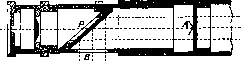
FIG. 1. -(Fig. 2). In O.'s used for measurements, a crosshair reticle A (spider web) or a transparent scale (graduation) is placed at the location of the image of the object given by the objective. The observer's eye in this case sees the image of the object superimposed on the scale. This device is called an ocular micrometer. To better illuminate the scale or crosshairs, an opening B (Gauss eyepiece) is made in the mount of the O. (Fig. 3), through which light from the source L, reflecting either from a mirror plate P or from a prism with total internal reflection, falls on the crosshairs or scale.-If
Figure 2.
in the microscope the O. is moved further than the focal length of the image given by the objective, then the system will give a real enlarged image of the object, which can be projected onto a photographic plate (see Photomicrography) or onto a screen. In the latter case, we turn the O. into a projection lens. Zeiss has produced a series of special O.'s ("Homal" and others) for microprojection. (Special oculars used in microscopes—see Microscope.) Among simple O.'s, there is also the orthoscopic ocular of Kellner. It consists of two identical plano-convex
Figure 3.
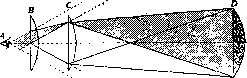
lenses B and C, with the convex sides facing the objective D, having the same focal lengths and removed from each other by a distance also equal to their focal length. The O. is installed in such a way (Fig. 4) that the image given by the objective coincides with the first lens of the O. The first lens of the O. will not produce magnification, but will deflect the rays toward the principal optical axis. The second lens B gives a virtual and enlarged image. To avoid the effect of chromatic aberration, the second lens is made achromatic. The advantage of the orthoscopic ocular is a very large field of view. It is used in simple microscopes, for example, for examining wood sections, coarse tissue structures, etc. The main disadvantages of this O. are strong spherical aberration (the edge parts of the image are disproportionately enlarged) and distortion of the image due to the fact that the image of the surface of the first ocular lens, covered with dust and dirt, is superimposed on it.
Figure 4.
a. iris.

Related articles
Mentioned in
Cite this page
“Ocular.” Soviet Medical Encyclopedia. English translation of Bolshaya Meditsinskaya Entsiklopediya, 1st ed. (Moscow, 1928–1936), ed. N. A. Semashko. https://sovietmedicalencyclopedia.pages.dev/article/ocular/