Birds
Historical document, translated for reference. It reflects medical knowledge of the 1920s–30s and is not medical advice.
Summary
Birds are a highly organized and specialized class of vertebrates that use the air for movement with perfection. They are characterized by feathers, a four-chambered heart, and reproduce by laying eggs rich in yolk.
Encyclopedia article (1928–1936)
BIRDS (Aves), a highly organized and specialized class of vertebrates, representatives of which with perfection use the air medium for movement. For birds, appendages of the integument in the form of feathers, which are horny formations, are characteristic. Large contour feathers and small downy feathers are distinguished. Feathers and the air between them are poor conductors of heat, contributing to the maintenance of the bird's own body temperature, which, along with mammals, belong to warm-blooded animals. Old feathers are replaced by new ones (molting). The skin of birds is dry, as it lacks glands, if we do not count the uropygial gland, located above the cloacal opening. This gland gives a fatty secretion for lubricating feathers, which is of great importance for birds swimming on water (feathers do not get wet with water, which allows birds to passively stay on its surface). Under the skin lies a fatty layer; when fattening, fat is deposited in different parts of the body. The bird's head is lightened in weight due to the delicacy of the skull bones. The neck is generally elongated; the body is compact, the tail is reduced. There are two pairs of limbs - the anterior pair is transformed into flight organs called wings; the hind limbs are the only support when moving on land. The skeleton in birds is bony, characterized by the thinness of the bones, their tendency to completely or partially fuse in groups into complex bones or also to merge in groups without any trace into a single whole. The bird skeleton is pneumatic, i.e., filled with air due to the penetration of air sacs into the cavity of the bones. Teeth in living birds have disappeared without a trace even in embryonic life. For grasping or tearing prey, there is a beak - a horny sheath covering the upper and lower jaws. For the digestive organs, the crop, muscular stomach, glandular stomach, great length of the intestine, and the presence of a cloaca are characteristic, into which in young birds the Fabrician bursa opens. The heart is four-chambered with a right aortic arch. The lungs form thin-walled sac-like outgrowths - air sacs. In addition to the upper larynx, birds have a lower, or singing larynx at the place of branching of the trachea into bronchi. In most female birds, only the left half of the reproductive organs (ovary and functional oviduct opening into the cloaca) has been preserved. In males, the sexual apparatus is paired. The organs of vision are well developed. In addition to the inner and middle ear, there is a short external auditory canal. In the brain, the cerebral hemispheres and cerebellum are very strongly developed. - Birds reproduce by laying eggs, very rich in yolk, which is covered with a thick protein shell and a strong calcareous shell. The development of the embryo occurs only when the eggs are warmed (incubation or warming in an incubator). Birds are remarkable for their instincts (building nests, caring for offspring, migrations, flights, etc.). Phylogenetically, birds originated from reptiles. Some birds feed on plant food, others on various invertebrate and vertebrate animals, using live prey or carrion. The number of bird species is about 20,000. Birds are of great importance to humans. Feathers, down, and skins are used in everyday life and in industry. Bird meat is used for food and for dietary nutrition. Many birds destroy various harmful animals (mice, rats, ground squirrels, snakes, etc.), other birds, on the contrary, harm humans (destruction and damage to fruits, destruction of beneficial insects, etc.). Chicken eggs have long been a classic object for embryological work. Chickens are used for genetic work and are used (like pigeons) as laboratory animals in experimental zoology and medicine. - Birds are rich in various parasites, which in most cases have no relation to humans. However, some species of external parasites of birds attack humans and vice versa - for example, ticks Argas persicus, Dermanyssus gallinae, bed bug, etc. - Birds are divided into subclasses Ratitae - ratites (African ostriches and rheas, cassowaries, kiwis) and Carinatae - carinates. Orders of carinates: loons, penguins, petrels, storks, pelicans, herons, storks, flamingos, waterfowl, birds of prey, gallinaceous birds, cranes, shorebirds (gulls, pigeons, etc.), cuckoos, parrots, rollers, passerines.
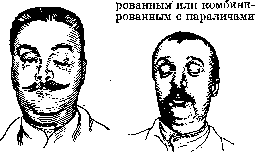
Figure 1. Ptosis of the left
Figure 2. Bilateral
eyelids, of the oculomotor muscles (one or more). In complete ptosis, the upper eyelid completely covers the eyeball; when ptosis is not pronounced, the upper segment of the pupil is covered by the lower edge of the upper eyelid; between these two positions of the upper eyelid, various degrees of its descent are observed. The patient cannot voluntarily raise the eyelid despite all efforts; he tries to help raise the eyelid by contracting the forehead muscles, thanks to which in ptosis one can note the presence of numerous folds on the forehead and high position of the eyebrows, which is especially demonstrative in unilateral ptosis. Ptosis can be acquired or congenital; congenital ptosis depends on a deficiency in the development of the corresponding nuclei of the oculomotorius (in the brainstem), while acquired ptosis can be observed with lesions of the oculomotorius at various levels, from its nuclei to peripheral branches. Some authors admit a cortical origin of ptosis with lesions of the gyri angularis (Landouzy), gyri centralis ant. (Dejerine). The etiology and course are the same as in complete paralysis of the oculomotor muscles (see Ophthalmoplegia, Polioencephalitis). Isolated paralysis of Müller's muscle is accompanied not by ptosis, but by narrowing of the palpebral fissure. Treatment is surgical (see Hesse's operation).
Related articles
Cite this page
“Birds.” Soviet Medical Encyclopedia. English translation of Bolshaya Meditsinskaya Entsiklopediya, 1st ed. (Moscow, 1928–1936), ed. N. A. Semashko. https://sovietmedicalencyclopedia.pages.dev/article/birds/