Mohrenheim's Fossa
Historical document, translated for reference. It reflects medical knowledge of the 1920s–30s and is not medical advice.
Summary
Mohrenheim's Fossa is a triangular depression located beneath the clavicle, formed by the deltoid and pectoral muscles. It is clinically significant for palpating the coracoid process and the axillary artery and vein, and it serves as a key approach to these vessels.
Encyclopedia article (1928–1936)
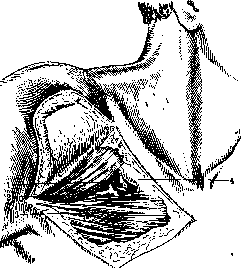
MOHRENHEIM'S FOSSA (Mohrenheim), an indentation named after the surgeon-gynecologist Mohrenheim, who first drew attention to it at the end of the 18th century; it is located under the clavicle at the boundary of its middle and outer thirds and is also known as the infraclavicular fossa or the deltopectoral triangle (fossa infra-clavicularis, s. trigonum deltoideo-pectorale)
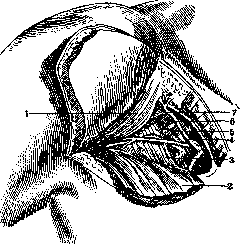
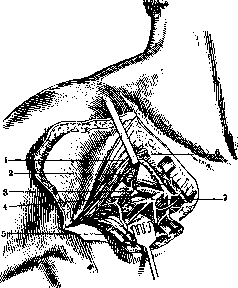
(Fig. 1). Being a continuation of the sulcus deltoideo-pectoralis between the deltoid and pectoral muscles diverging at the clavicle, M. fossa has the shape of a triangle, the sides of which are formed by the named muscles, and the base is the clavicle (Fig. 2). This fossa is more clearly expressed in thin subjects, especially at the moment of pulling the arms forward. Within it, the coracoid process and the clavico-coracoid ligament (Batuiev, Brosike, and others) can be palpated (more easily in individuals with weakly developed musculature), as well as the pulsation of the a. axillaris. In some cases, the latter can be pressed against the second rib (Testut et Jacob), for which Mohrenheim proposed a special pelote, which, however, no one uses to this day. The skin of the described area is very mobile and devoid of hair. The subcutaneous fat consists of two layers: the superficial, more or less rich in fat, and the deep, laminated, representing the true fascia superficialis. Between the two laminae of the latter are the fibers of the lower part of the platysma, which contributes to the gaping of transverse wounds in this place. In this same layer, sensory nerves of the area, the nn. supraclaviculares, descend from the cervical plexus. Under the superficial pectoral fascia and the fat tissue filling M. fossa, lies the deep pectoral fascia (f. pectoralis profunda, s. coraco-clavicularis Richet), in the layering of which the m. pectoralis minor is enclosed behind the m. pectoralis major. Directly behind the upper part of this deep fascia (f. clavi-pectoralis Gruberi), lying above the latter muscle, is the v. axillaris and, laterally to it, the a. axillaris with a bundle of the brachial plexus (Fig. 3). In the depths of the deltopectoral groove runs the v. cephalica. Reaching Mohrenheim's triangle, it goes together with the lymphatic vessels away from the chest muscles into the depths, pierces the clavico-pectoral fascia, and empties into the v. axillaris. Sometimes the v. cephalica divides into two branches, one of which crosses the clavicle and empties above it into the subclavian vein, while the other retains the usual position of the v. cephalicae. In other cases, the v. cephalica does not empty into the v. axillaris at all, but, crossing the clavicle, gives blood to the v. jugularis externa. Cases are noted where it forms a ring around the clavicle. Within M. fossa, the v. cephalica meets the branches of the a. thoraco-acromialis, which together with the nn. thoracales anteriores pierces the clavico-pectoral fascia and supplies the chest muscles (Fig. 4). Along the course of the v. cephalica and in the area of M. fossa, lymph glands (nn. infraclaviculares) are often located. Smoothing of M. fossa is one of the earliest signs of sub- and especially interpectoral abscesses. A bulge in the area of M. fossa, in the presence of other symptoms, makes it possible to recognize a subcoracoid dislocation of the shoulder. Fractures of the clavicle significantly alter the relief of this area. In M. fossa, enlarged subclavian lymph glands (breast cancer) can be palpated. Gunshot and knife wounds of M. fossa represent great danger due to the location of large blood vessels in the depths of this area. M. fossa has great importance for the approach to the subaxillary and subclavian vessels below the clavicle, during temporary or permanent ligation of them or other operations on them. Along the deltopectoral groove and triangle, the v. cephalica leads directly to the v. axillaris. This significantly facilitates the finding of the artery located outward from it.
MORIA, moria, a psychopathological syndrome characterized by an elevated good-natured-happy (euphoric) mood and a tendency to foolish antics. This term was previously used to a considerable extent, being employed to denote states observed in various mental diseases (amentia Meynerti, dementia praecox); at present, at the initiative of Jastrowitz, it is used exclusively to denote those peculiar states which sometimes develop in brain tumors and other organic lesions of the brain and which are most characterized by the patient's striving, at all costs, to joke and make witticisms, a striving that is discordant with his severe objective condition (hence the name Witze1sucht given to it by Oppenheim). In different cases, this syndrome presents quite significant differences, and while in some patients, with sharp euphoria, jestfulness is expressed to a relatively slight degree, in others, on the contrary, the urge to be witty is not accompanied by euphoria at all, but has a peculiar tense-compulsive character. The jokes of such patients are usually in no way distinguished by wit; on the contrary, they are flat and even directly absurd. The position advanced by Jastrowitz regarding the connection of M. with the localization of the pathological process in the frontal lobes remains disputed to this day: while some assert that such localization is confirmed in no more than a third of cases reaching autopsy, others continue to insist on the connection between M. and the frontal lobes, pointing out the possibility of secondary damage to the latter by processes localized in other parts of the brain. Thus, the pathogenesis of this syndrome remains unclear at present.

Related articles
Mentioned in
Cite this page
“Mohrenheim's Fossa.” Soviet Medical Encyclopedia. English translation of Bolshaya Meditsinskaya Entsiklopediya, 1st ed. (Moscow, 1928–1936), ed. N. A. Semashko. https://sovietmedicalencyclopedia.pages.dev/article/mohrenheims-fossa/