Pyuria
Historical document, translated for reference. It reflects medical knowledge of the 1920s–30s and is not medical advice.
Summary
Pyuria is the presence of pus in urine, indicating inflammation of the urinary tract or adjacent structures. It can be classified as initial, terminal, or total, with diagnostic methods including microscopic examination and three-glass test.
Encyclopedia article (1928–1936)
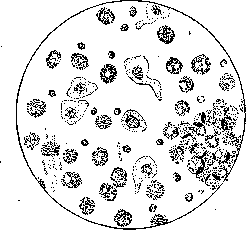
Pyuria, pyuria (from Greek pyon- pus and ouron- urine), synonym. leukocyturia, the excretion of pus with urine. The source of pus in urine may be inflammatory conditions of the urinary organs (urethra, bladder, ureter, kidney, and renal pelvis) or pus may be mixed with urine in purulent lesions of the prostate gland and seminal vesicles. In more rare cases, pyuria is caused by abscesses of the parametrium that have ruptured into the urinary bladder, salpingitis, or abscesses of appendicular origin. In the overwhelming majority of cases, the presence of pus in urine can be determined macroscopically, manifesting as diffuse cloudiness of the urine or in the form of clots, flakes, and threads, clearly visible in freshly passed, generally clear urine. The latter form of pyuria is more specifically determined by microscopic examination of the urine sediment (see figure), which must also be performed in cases of obviously turbid urine, all the more so since turbidity of urine may depend on the admixture of salts or bacteria (see Urine, Bacteriuria). The color of urine in pyuria either remains unchanged or with a high pus content becomes greenish-yellow. The milk-yellow color of urine is characteristic of pyelitis accompanied by polyuria. With an alkaline reaction, urine in pyuria acquires a dirty-brown or grayish color. Pyuria is always accompanied by simultaneous bacteriuria. Determination of the bacterial content of urine in pyuria is valuable for characterizing the inflammatory process in the urinary organs and for selecting appropriate therapy. The most accurate data in this respect are obtained not from bacterioscopic examination of the urine sediment, but from cultures of sterilely obtained urine. Absence
of growth indicates the so-called aseptic pyuria, which is a characteristic symptom of tuberculous lesions of the kidneys and renal pelves. When encountering chronic aseptic pyuria, one must always think of the possibility of tuberculosis and try to confirm it by finding Koch's bacilli through animal inoculation. Besides the tuberculous process, aseptic pyuria with acidic urine can be observed in rarely occurring gonorrheal lesions of the upper urinary tracts. Differential diagnosis is extremely difficult because the gonococcus in urine in such cases can be determined bacterioscopically only extremely rarely. Only inoculation of a guinea pig can clarify the determination of the bacterial nature of 'aseptic' pyuria. Pyuria is always accompanied by a greater or lesser content of protein in urine. Clinically, acute and chronic pyuria are distinguished. Both forms of pyuria, like hematuria, can manifest as: 1) initial pyuria (pyuria initialis), 2) terminal pyuria (pyuria terminalis), 3) complete - total pyuria (pyuria totalis). To identify one or another type of pyuria, examination of urine by the three-glass test is necessary. The patient is asked to empty all the urine contained in his bladder into three glasses in succession. In initial pyuria, the first drops or the first portion of urine flowing from the channel will be turbid with pus, the remaining urine is clear. This type is typical for inflammatory processes in the anterior urethra - urethral pyuria. In terminal pyuria, all the passed urine is clear, only the last drops of urine are milky-white and contain pus; such pyuria is observed in diseases of the prostate gland and seminal vesicles. A combination of initial and terminal pyuria is observed in acute purulent prostatitis that has ruptured into the urethra. Total pyuria is characterized by all three portions of urine being turbid with pus. Such a form is observed in diseases of the urinary bladder and renal pelves. For differential diagnosis of bladder and pyelonephritic pyuria, the test with bladder washing can be valuable. Rapid clarification of the washing fluid serves as a sign of pus descending from the renal pelves. The discharge of pus from foci located outside the bladder (renal pelves) is indicated by periodic changes of clear and turbid washing fluid, caused by the entry of new portions of pus into the bladder. However, the same picture can also be observed when emptying abscesses from organs and tissues surrounding the bladder or from its diverticula into the bladder. The most accurate data on the localization of the pyuria focus can be obtained only by cystoscopic examination of the bladder and catheterization of the ureters. All cases of prolonged total pyuria, as a rule, require CYSTOSCOPY.
Microscopy of urine in pyuria. Presence of pus cells, epithelial cells, and bacillus coli.
A. Frumkin. P.I.SHA. The continuously occurring life processes in the human organism, as well as the work performed by humans, require constant replenishment of the organism with new substances in the form of O2, necessary for oxidative processes, and in the form of nutrients. For the adult organism, food must provide everything necessary to maintain it in a viable state; for a child, in addition, everything necessary for the development of its body. Food must satisfy the following conditions: 1) it must provide the organism with the necessary amount of calories; 2) Food must contain the necessary amount. a) nitrogen-containing substances (proteins), b) fats, c) carbohydrates, including fiber, d) mineral compounds, as well as e) the required amount of water and f) necessary vitamins; 3) it must be pleasant to the taste and smell and thereby stimulate the secretion of digestive juices; 4) it must create a feeling of satiety. All these points must be strictly coordinated, as errors and irregularities in nutrition often occur because one or more of these conditions are not taken into account. By origin, food can be either animal or vegetable. Usually people eat mixed food; both of animal and vegetable origin. By the structure of their teeth and individual organs, humans are now omnivorous creatures and consume in food the meat of mammals, fish, birds, mollusks, eggs, insects, fruits, berries, mushrooms, edible roots, nuts, plant seeds, spices, beverages, etc. It should be assumed that primitive man ate only raw plants, and soft ones with a pleasant smell. At the stage of development when food was already cooked, he began to use plants that have a hard shell and are difficult to digest in their raw state, which made it possible to significantly diversify nutrition. 1v7 Food of plant origin. Grain crops that provide flour play a significant role in human food: wheat, rye, barley, oats; among non-grain crops - millet and buckwheat and finally maize, or corn; potatoes are widely distributed; to a lesser extent, leguminous plants are used for food: peas, beans, lentils, soybeans. From oil-producing plants, food is provided by sunflower, hemp, flax, soybean, olive tree, the fruits of which give vegetable oil. Further, food is provided by various vegetables, fruits, mushrooms and berries. In tropical countries, the main food grains are rice, sorghum (sorgum vulgar.- Indian millet, mainly distributed in places where rice and wheat give poor yields); on the slopes of the South American Andes, a special type of goosefoot, so-called "quinoa" (Chenopodium quinoa) is eaten; taro in Polynesia, the roots of this plant weigh up to 2 kg and are rich in starch; yam-a creeping plant with fleshy tubers up to 20 kg weight-in tropical Asia and Africa; arraruta-talia-grows in humid tropical forests, gives good flour; sweet potatoes, or sweet potato (the cultivation of this plant is beginning to develop in the Caucasus too); cassava-in humid tropical countries; the fleshy root is eaten, which contains a significant amount of starch; the root has a poisonous milky juice, which is easily removed by washing, pressing and drying; from this root flour is made, the highest grade of which is known under the name "tapioca". For residents of the tropics, banana-fig tree, date palm, coconut palm, bread tree, which yields delicious fruits, mango tree and pineapple also play a prominent role in nutrition. Among plants that give oil, the oil palm (Africa), sesame (India), peanut (South America), cotton plant, the seeds of which give oil, which is widely distributed in Central Asia, should be noted. Food of animal origin. Animal food consists of: a) various parts of animals, muscle tissue, internal organs, glands, blood, bone marrow; b) eggs and caviar; c) milk and its derivatives; butter, sour cream, cottage cheese, cheese, etc. A characteristic feature of animal food is the predominance of nitrogenous substances in it. Residents of the taiga, tundra, deserts, semi-deserts, high mountain areas, where agriculture is not developed, sparse vegetation, poor communication routes, feed mainly on meat and fish, so for example in the tundras of North America the main food is fish and marine animals; in the tundras of Europe and Asia-fish and reindeer; in deserts, semi-deserts-mutton and horse meat. Nomadic peoples feed not so much on meat as on milk of various animals (cow, mare, she-ass, camel, sheep, goat), also preparing from it various beverages (arak, kumyska from cow's milk, kumys-from mare's milk), cheeses (brine from sheep or goat's milk, kurut from goat's milk) etc. Polar residents also feed mainly on animal food, and the eating of liver is particularly widespread (with the exception of polar bear liver). The meat of reindeer, marine animals and birds, seal, whale, seagulls, penguins, loons, as well as bird eggs are preserved in large quantities for the winter. American researchers point out that glandular organs and the viscera of animals are richer in mineral salts and vitamins than meat. Therefore, savages, eating the animal whole with all the viscera, glandular organs, bone marrow and a large amount of bones, thereby provide their organism with the necessary mineral salts and vitamins; civilized peoples, preferring meat to viscera, have the opportunity to obtain mineral salts and vitamins in abundance from food of plant origin. Beverages, mineral substances, spices. Of beverages, water is the most widespread. To give water flavor, sugar, fruit juice, berry juice are often added to it, water is carbonated, etc. Special mention should be made of kvass, made from malt and bread; this beverage is widely distributed in the USSR. Among hot beverages, tea takes first place, then coffee and cocoa; in South America, mate, or Paraguayan tea (Ilex paraguaensis) is widely used. Alcoholic beverages are widely consumed among almost all peoples. Of inorganic mineral substances, the most important is table salt; in some localities, for example in central Africa, there are areas where it is difficult to obtain table salt; natives replace it with the ash of various plants. With plant food, a large amount of table salt is required, since plants are rich in potassium compounds; however, when potassium compounds are excreted from the organism, as shown by Bunge, the excretion of sodium also increases. With predominant meat and milk diet, the need for salt is felt much less and for example the Yakuts do without it almost entirely. Spices (see) have extremely widespread use everywhere. Consumption of unusual and little-used food products. Usually all representatives of the animal world are divided into: a) animals suitable for food, and b) animals not suitable for this purpose. At present, such a division is already outdated and on the basis of data from specialized literature, all representatives of the animal world can be divided into two other categories: a) little used in food and b) having wide distribution. Among most peoples of the world, beef, mutton and pork are widely distributed; but this meat is not used in food among some peoples for various reasons; thus, Egyptians did not eat pork, because it caused "abundance of juices and leprosy" (Plutarch), a considerable number of Hindus at present do not eat cow meat, because the cow is considered a sacred animal, Muslims do not eat pork. At present, it can thus be pointed out that from products of animal origin, meat of almost all zoological species goes into food. Besides the meat of animals, fish and birds, various reptiles and insects also go into food. Among a number of non-European peoples, food is provided by such species as lizards, some snakes, frogs, locusts, bees, various species of spiders, worms, etc. As for the little-used and unusual for us products of plant origin used in food, their number is infinitely large; their distribution is often also local, similar to animal products. Very often plants have poisonous principles (alkaloids, glycosides, acids, etc.) and in certain doses serve more as medicinal than food substances. The geographical position of the area and the difference in climate influence the character of human nutrition and determine the choice, mainly, of those food products which can be obtained in these localities. Where there are many plants and animals of a certain species, they are most of all used in food, for example the meat of polar bear, reindeer-by northern peoples, elephant meat-by negroes, zebra and rhinoceros meat-in Africa and India, buffalo-in the Caucasus, whale-in Japan and in the north of the USSR, kangaroo-in Australia, parrots-in Brazil, penguins-in New Zealand, monkeys-on the island of Ceylon, Borneo and Paraguay, dates-in Egypt, rice-in China and Japan, arrarut and bananas-in the tropics, etc.
On the other hand, with the development of mechanical transport in the second half of the 19th century, it became possible to transport food products from one part of the world to another, and this served, for example, as the most important factor in increasing the culture and consumption of various grains throughout the world; the use of cold, the invention of isothermal cars and refrigerated steamships allows transporting even perishable products over long distances from that part of the world where the production of the product is cheap, to major industrial centers, e.g. from Australia or South America to Europe; thus, the food regime undergoes very significant changes over time. The different temperature in one or another locality forces a person to adopt such a diet which is most suitable for these conditions. Peoples of hot countries consume more plant-based food because these areas are richest in plants; northern residents, due to the lack of plant products (carbohydrates), are forced to consume large amounts of fats and proteins from meat or fish. High or low temperature also forces a person to differently distribute food during the day in separate meals (see below). High ambient temperature also lowers the basal metabolism. O. de-Almeida in Rio de Janeiro found (on 8 healthy people) that the basal metabolism in the tropics is 16.2% lower than in a temperate climate; O. Montoro came to the same results for the island of Cuba. Kassirsky for Central Asia (on 30 healthy people) found a decrease in basal metabolism by 7%. Social status and profession play a major role in nutrition. In capitalist countries we see an incorrect distribution of food products among different classes of the population. While workers are on a semi-starvation ration, the bourgeois classes enjoy exquisite food, special kitchens, restaurants, etc. The working class, especially in leading professions, only in the USSR receive what they need not only for muscular work but also for covering other needs of the body. For the proper distribution of food, with the existence of a scientifically based ration in the USSR, we see the development on a large scale of public catering (see Canteens and Dietary Canteens). The food of military personnel (see Ration) in land forces, in the navy, air force, depending on working conditions, intensity, geographical location of the area, peacetime or wartime, is established by special orders of the military department. So for example there are rations in addition to the main ones also additional ones: polar, anti-scorbutic, submarine, diving, for tank personnel, national troops, for polar radio stations and other additional rations. Sanitary-hygienic requirements for food.-Nutritive value and digestibility. A person can only eat such food which is capable of being digested and absorbed in the gastrointestinal tract, and subsequently also assimilated. It is usually considered that food serving as the main source of nutrition should have a digestibility percentage (see Digestion) of at least 50; the best are those products which have a digestibility percentage of more than 70. On the other hand, to create peristalsis, as well as to obtain the required volume of food, a certain amount of fiber is necessary; 60-80 g of it is required per day; with a normal diet, it is obtained mainly from rye or coarse wheat bread, porridge, vegetables, fruits and berries. It should be noted that the fiber of tender fruits and vegetables is well digested. Freshness of food is of great importance; fresh food has pleasant organoleptic properties: taste, smell, appearance and is usually harmless to humans. Food that has undergone decomposition processes, even in the initial stages, as well as adulterated food, can serve as a source of the spread of diseases, food infections and food poisonings (see Meat poisonings).
.
The diversity of food leads to better digestibility and better appetite; constantly repeated food usually becomes tiresome, seems tasteless, paralyzes the appetite, etc. For the sake of diversity, so-called menus are composed; under the term menu is understood the order and names of dishes. Even to the present time, the name of any food dish does not determine the exact composition and method of its preparation, so for example it is known that there are more than 20 recipes for preparing Ukrainian borscht with a calorie content in one serving from 92 to 840 calories, the composition of borscht can include from 5 to 19 different products, why it would be necessary, similar to what is done for individual food products, to also standardize individual dishes. The main rules for composing menus should be: 1) sufficient variety, 2) use in the first place of perishable products, 3) paying considerable attention to the repetition of taste, smell, color and appearance of dishes and foodstuffs. Taking into account the above and conducting strict sanitary control, with a small set of products it is already possible to give the consumer a satisfying and varied table. Menu should be developed in advance not less than for one decade. The type of food and the population's habits towards it have psychological significance, creating either a pleasant feeling or a feeling of disgust, reaching to nausea and even to vomiting. Experiments have established (Slovtsov) a decrease in gastric juice secretion when the food has an unpleasant appearance. Volume and weight of food. Filling of the stomach, accompanied by stretching of its walls, is a factor perceived by our consciousness as a feeling of satiety. As soon as the stomach reaches its usual stretching, the appetite disappears. The capacity of food at the same time is also a factor for the movement of food through the intestines. With low-calorie, concentrated food, usually containing little fiber, atony of the intestine with weak peristalsis develops; with very bulky food, the intestine has to bear an unbearable load, which causes overstrain of the intestinal walls. Certain groups of the population get used to a certain volume of food; for persons accustomed to eating bulky vegetable food (mainly agricultural labor), meat and low-volume food seems unsatisfying, and conversely, for persons accustomed to eating low-volume food, such vegetable food is very heavy. The average weight of dinner (the main meal) for the working population is 1,000 g with 200 g of dry substance. The daily weight of food for peasants, who consumed few animal products, often reached 2,500-3,000 g, not counting water, kvass and other drinks. The feeling of satiety also depends on how long the food remains in the stomach. As long as the food is still in the stomach, usually no appetite is felt. Depending on the type of food or its processing, the duration of the feeling of satiety will be felt differently. Temperature of food. Usually people prefer hot food to cold food. Rubner explains this phenomenon as follows: 1) a hungry person begins to feel a little chilly, 2) in hot food, animal fats even with a high melting point are kept in a liquid state; if the food is cold, it is unpleasant when the tongue and oral mucosa are covered with a layer of solidified fat, 3) at an elevated temperature of food, its aromatic substances in most cases enhance their smell, as a result of which they more strongly influence the appetite. Food with a temperature above 55° should not be taken. Distribution of food into separate meals. A person takes food at the most convenient time for him at certain intervals, usually 3 times a day. The number of meals depends on habits, type of work, ambient temperature, culture, availability of food products, etc. The time of taking food depends on the nature and distribution of labor; thus, agricultural workers, associated with work in the field, get up early (at sunrise) and go to bed early (at sunset), and therefore have lunch and dinner early; agricultural workers working on machines and in several shifts, as well as workers in industrial centers, depending on the shift in which they work, adapt the main meals to the time of going to work or returning from it. The duration of the lunch break should also play a significant role: in a short, for example half-hour break, one has to significantly limit the amount of food taken. Rubner, Noorden, Munk, Latyshev give the following distribution of food into separate meals (Table 1). Rubner's and Munk's norms transfer the main mass of food to dinner and are most suitable for collective farmers who have a long lunch break. Noorden's norm gives the main mass Table 1. Distribution of food into separate meals (in %). Meal Rubner Noorden Munk Latyshev (for Central Asia) Lunch ....... Evening tea . . . 20 46 34 25 40 17 60 33 34 8 on the clarification upon the worker's return from work and on breakfast before his departure. Close to this norm are the figures of Latyshev, recommended by him for Red Army soldiers in Central Asia in the hot season, when the hottest hours account for only 23% of all food. The ratio of nutrients in the daily ration, according to Rubner, should be as follows: Table 2. Distribution of food substances into separate meals (in %). Meal Proteins Fats Carbohydrates Lunch....... . , Б0 10 50 40 20 40 40 Total .... 100 j 100 The local population of Central Asia during the summer months transfers the main meal to the second half of the day, being content with modest food during the hot period of the day, consisting of flatbreads, tea, seasonal fruits and vegetables. In the troops in the summer in hot latitudes, when the main meal is at lunch, there is noted the presence of large amounts of food leftovers, and in some places a complete absence of consumption of buckwheat and millet porridge. Thus, according to Latyshev's data, from potato puree remains 31.2%, millet porridge with meat-36.9% and buckwheat porridge-47.2%, but at the same time the remainder from liquid food (soups) is small-only 8.8-13.7%, which is explained by the dehydration of the body in hot weather and its desire to replenish the loss of water. With incorrect distribution of food, in this case a large portion at lunch in hot hours, the body weight in summer months falls. Latyshev, studying 60 cadets, showed that their weight falls by 2 kg, almost recovering in autumn in cold weather [from 66.5 kg (on average) in April my. falls to 64.3 kg in August and in October again rises to 66.1 kg]. On the body's need in relation to the quantity and quality of food-see Nutrition. Preparation of food. Preparation of foodstuffs is necessary, in order to make food more tasty and improve its digestibility and digestibility (see Cookery). As all food, so individual dishes should satisfy certain requirements and from the point of view of their nutritional value should be subjected to analysis. The study of dishes consists in determining their content of water, proteins, fats, carbohydrates, fiber, mineral salts, vitamins, organoleptic properties: color, smell, taste, appearance, consistency, t°', weight, volume, edible and inedible part, culinary processing, etc.-The composition of the food ration must take into account all moments that can in one way or another affect better digestibility, cause a feeling of satiety, have an attractive appearance, be varied, etc. Knowing what the calorie content should be, how much protein, fat and carbohydrates need to be introduced into the body, in what ratios between them, etc., it is necessary at the same time to know how to calculate the composition of this or that dish or group of them. Below is an example by which it is possible to calculate the nutritional value of this or that dish. Food products before consumption in food are subjected to one or another technical and culinary processing: cleaning, washing, removal of entrails, removal of shell, bones, etc., then the product is cut, boiled, fried, stewed, boiled, etc. But even after such processing, the product still cannot be completely consumed; part of the products (for example bones) will remain as food waste, after the soluble parts are extracted from them. Substances not completely consumed in this way are called food waste. Determination of the nutritional value of a dish. Example-mutton pilaf. Products issued per 1 person: mutton 250 g, rice 65 g, tomato 16 g, carrots 24 g, onion 20 g and wheat flour 8 g. Deduction for kitchen waste: mutton-18%, tomato-15%, carrot-15%, onion-15%; rice and wheat flour have no waste. Thus, from 250 g of edible mutton there will be 205 g, from 16 g of tomato-12.6 g, from 20 g of onion-12 g, from 24 g of carrot-20.4 g. The nutritional value of the mentioned products in 100 g (taken from the same table) and on the amount in the dish: Table 3. t Products In 100 g On the amount in the dish a o, и й o в <и ' Sa те Is п к s 32,9 5,3 0,1 0,2 0,2 1,1 a & o я и Mutton . . . Carrot. . . . .- Onion.......]
Wheat flour - 16.4 g 1.0 1.2 1.7 11.8 31.0 1.3 0.2 0.3 0.1 1.4 75.6 4.0 9.0 10.8 72.2 205.0 65.0 12.6 20.4 12.0 8.0 63.5 0.8 0.1 48.7 0.5 1.9 1.3 5.8 Total... _ - - 39.8 64.4 68.2 Calculation of caloric value: a) gross calories using Rubner's coefficients 4.1, 9.3 and 4.1 will be 153.8+58.2 = 212; 212x4.1=869.2 cal.; 64.4x9.3 = 598.9, total in the dish 1,468.1 gross calories; b) net calories - using Tigerstedt's coefficient, i.e., 90% digestibility, we get 1,468.1-146.8=1,321.3 net calories. When calculating a large number of dishes, it is desirable to express the results in the form of the following table: Table 4. Name of dish Proteins Fats Carbohydrates IS" 3 S" Ч , H- 1 ' ' щ Pilaf from Sara- 39.8 64.4 58.2 1,468.1 1,321.3 From individual tables, it is easy to calculate not only how much of each nutrient is present, but also to account for their completeness, incompleteness, or origin (animal, plant world). Thus, in our example, out of 39.8 g of proteins, 32.9 g are of animal origin, 58.2 g of carbohydrates, and all of them are of plant origin, etc. For proper accounting of the nutritional value of dishes, it is also absolutely necessary to take into account those leftovers that remain after eating; these include bread crumbs and leftovers on plates after any dish.
Related articles
Mentioned in
Cite this page
“Pyuria.” Soviet Medical Encyclopedia. English translation of Bolshaya Meditsinskaya Entsiklopediya, 1st ed. (Moscow, 1928–1936), ed. N. A. Semashko. https://sovietmedicalencyclopedia.pages.dev/article/pyuria/