Acardius
Historical document, translated for reference. It reflects medical knowledge of the 1920s–30s and is not medical advice.
Summary
This article from the 1928-1936 Soviet Great Medical Encyclopedia describes acardius, a severe developmental malformation occurring in monozygotic twins where one twin develops normally while the other lacks a heart and suffers from profound structural defects. It details the classification into hemiacardius and holoacardius subtypes, the unique parasitic circulatory mechanism dependent on the normal twin, and the potential complications during childbirth.
Encyclopedia article (1928–1936)
ACARDIUS, or Acardiacus (from the Greek akardios - having no heart), one of the most important developmental malformations of monozygotic twins (see).
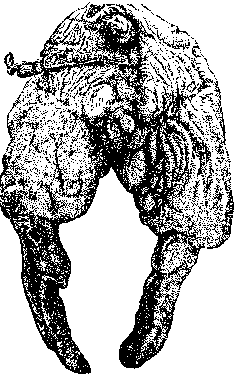
Holoacardius acephalus (after Aschoff).
In acardius, the twins are free and develop asymmetrically, with one fetus developing correctly while the other bears significant, usually highest degrees of malformations. Hemiacardius and Holoacardius are distinguished. In the first case, with the presence of major anomalies in the development of various parts of the body and in particular the heart, the general human forms are preserved; in the second case, which is much more frequent, there is a complete absence of the heart and a number of other drastic developmental anomalies, sometimes transforming the fetus into something formless. Dissection or X-ray examination reveals the degree and nature of the malformation of organs and systems, depending on which all Holoacardii are divided into Holoacardius ace
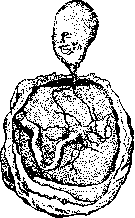
Holoacardius acormus (after Aschoff). phalus, the most frequent form of acardius (absence of the head and upper part of the trunk, absence or negligible rudiments of chest organs, absence of the liver, almost all intestines; kidneys and external genitalia are usually well developed), Holoacardius acormus (extremities and sometimes the trunk are absent, only the head may be present) and Holoacardius amorphus (a formless formation in which parts or rudiments of various systems and organs of the body can be discovered only with difficulty). Numerous transitions exist between Holoacardius and Hemiacardius. In all acardii, edema of the tissues, especially the skin and subcutaneous tissue, is observed. The development of vessels in acardius is irregular. The motor center of blood circulation is the heart of the normal twin: from the common placenta as part of a special umbilical cord, usually only two vessels (artery and vein) depart to the acardius, and inside the body of the acardius the blood flow is inverted, so that its inflow goes through the artery, and the outflow through the vein; thus, the circulation and nutrition of the acardius are served through the mediation of the normal twin. The conditions of development and the essence of acardius are unclear; some point to the primary inadequacy of organ primordia, while others, conversely, see in acardius the consequence of deep damage to a normally laid embryo (see Malformations). Practically, an acardius can present a serious obstacle to the birth process. Acardius belongs to fairly rare malformations. It occurs in mammals.
Related articles
Mentioned in
Cite this page
“Acardius.” Soviet Medical Encyclopedia. English translation of Bolshaya Meditsinskaya Entsiklopediya, 1st ed. (Moscow, 1928–1936), ed. N. A. Semashko. https://sovietmedicalencyclopedia.pages.dev/article/acardius/