Hermaphroditism
Historical document, translated for reference. It reflects medical knowledge of the 1920s–30s and is not medical advice.
Summary
A detailed 1930s medical article on hermaphroditism, covering its classification in humans and animals, including true and pseudo-hermaphroditism, with discussion of various physiological and developmental aspects.
Encyclopedia article (1928–1936)
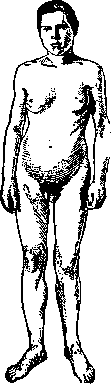
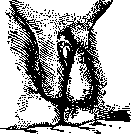
HERMAPHRODITISM. (from Greek Hermes and Aphrodite), bisexuality, bisexuality, bisexual development, the presence in an individual of characteristics of both sexes. Classification of hermaphroditism. Two main types of H. are distinguished: H. true (hermaphroditismus verus) and H. false, or pseudo-H. (pseudohermaphroditismus). True H. is understood as such a deviation in development when sexual glands of both sexes are present; pseudo-H. includes those cases where there is a discrepancy between the sexual glands and the other sexual characteristics (for example, in the presence of testes, the external sexual organs resemble rather a woman than a man, the sex consciousness is also female; conversely, in the presence of ovaries there is such hypertrophy of the clitoris that it becomes similar to a penis). In psychosexual relation, as well as in relation to such sexual characteristics as, for example, peculiarities of the skeleton, a shift to a greater or lesser degree toward heterosexuality may also be observed. In application to the animal kingdom, Goldschmidt divides all cases of true H. first of all into two main groups: 1) H. active (functional) and 2) H. inactive (afunctional). In the first group, the germ cells of both sexes, produced in the same organism, are really intended for their natural function - fertilization, while in the second group - we are dealing with bisexual animals in which generative elements of both sexes are constantly or temporarily produced in the same way, but only one kind is used. The first group, in turn, Goldschmidt divides into three subgroups: a) Unisexual monoecy, which consists in the fact that genetically the organism belongs for a long time to only one sex, but from time to time the female, for example, despite her female organization, begins to secrete sperm (so-called gynoecy) or vice versa (androecy). This is the case, for example, in one of the nematodes - Angiostomum nigrovenosum: in this worm freely moving unisexual generation alternates with a hermaphroditic one, parasitic in the frog's lungs, and anatomically the hermaphroditic individuals are females, but in their ovaries they alternately produce eggs and sperm, and their sexual gland is thus hermaphroditic. b) The individual is first male, then female; genetically, however, it is probably male (sequential, or consecutive monoecy). The essence of the phenomenon is that the individual in the form of a freely living larva is male and fertilizes the parasitic female, and then itself passes to parasitism and turns into a female. c) For a long time and simultaneously the animal possesses sexual glands of both sexes with all their accessory organs (spatial monoecy, H. in the narrowest sense of the word).-To the group of inactive H., according to Goldschmidt, belong the following, diverse in their physiological essence cases: 1) some (extreme) types of intersexuality (see below); 2) gynandromorphism [mosaic H.: on one side a gland of one sex, on the other - of the other sex, and each half of the body has a corresponding appearance to that sex. Such cases are observed, for example, in butterflies, more rarely - in birds (bullfinches, pheasants)]; 3) accessory, or accessional H., when in males along with the testis there is also an ovary, but rudimentary and non-functioning: such, for example, is the so-called Bidder's organ in toads (a round formation with the structure of a rudimentary ovary at the front end of both testes); 4) accidental (accidental) hermaphroditism: accidentally, as an anomaly, eggs are found in the testis, and spermatogenic tissue in the ovary; this kind of hermaphroditism is known among the most diverse groups of the animal kingdom, but it is found especially often in crustaceans. Hermaphroditism in humans. Specifically in application to humans, the existence of true H., in the sense of the simultaneous presence of separate sexual glands of both sexes, is subject to doubt. Cases of herm. bilateralis (the presence in the same subject on each side of the body simultaneously sexual glands characteristic of both sexes) are not only definitely unknown, but the very possibility of them seems unlikely from a theoretical-embryological point of view. The possibility of such H. was long admitted under the influence, mainly, of Pfliiger and Waldeyer, according to whom the Graafian follicles with the eggs contained in them and the tubuli seminiferi of the testes originate, allegedly, from different sources: the former - from the germinal epithelium covering the surface of the ovary and then growing into it, the latter - from the outgrowths of the Wolffian ducts. In application to tubuli seminiferi, however, the view of Pfliiger and Waldeyer is subject to doubt: the sexual products of both sexes can be considered a derivative of the same embryonic tissue, and moreover of the same locality. On the contrary, lateral true H., in the sense of the presence in the subject on one side of one kind of gland, and on the other - of another kind, i.e., in the form as it occurs in gynandromorphism in butterflies, bullfinches and pheasants, theoretically, as a teratological phenomenon in humans, is conceivable. However, such cases are unknown, just as their existence has not been proven in mammals in general. In the literature, however, there is a number of cases treated by their authors as true unilateral or bilateral H. in humans. These are those cases in which on one side, more rarely on both sides, a mixed sexual gland was found, containing elements of both testis and ovary (the so-called ovo-testis, or, more correctly, ovariotestis). Such cases have been described in all 15, but not all of them are equivalent in the sense of recognizing in the sexual glands undoubted elements of both sexes; while in some cases mature germ cells of both or only one sex were observed, in other cases there were only glandular elements characteristic of the ovary and testis, but without mature germ cells. Depending on one or another approach to understanding the essence of true H., the attitude of authors to such cases is very different. However, the question of what can and cannot be recognized as true H. loses much of its acuteness with the recently emerging tendency not to draw a sharp line between true and false H. (Siegenbeck van Henkelom, Hirschfeld, Keussler, Zucker), but to divide somatic H. into terminal (presence of germ cells of both sexes), glandular (presence of tissue of sexual glands of both sexes), genital with division into tubular and copulative (indeterminate form of internal and external sexual organs) and extragenital (perversion of somatic secondary sexual characteristics). Cases with ovariotestis were described by Guderatsch, Pick-Salen and Simon (see Figure 1). In relation to pseudo-H., male (see Figures 2-4) and female (see Figures 5, 6) are distinguished, depending on the nature of the sexual glands, and these two types of false H., in turn, are subdivided into internal and external - and finally, pseudoherm. completus, when in the presence of sexual glands of a certain type both external sexual organs and excretory ducts show bisexuality. In Fig. 3 is depicted a 22-year-old girl. The external appearance (as well as clothing, gait) - feminine, mammary glands are well developed, pubes, pelvis - feminine. External sexual organs (see Figure 4) of male type. In Fig. 5 is depicted an individual 39 years old, with normal external female sexual organs and sexual glands (case of Zondek). Since the age of 13 she menstruated and had a healthy child from a marriage against her will. The internal sexual apparatus is completely female, mammary glands are female; hair growth is of female type, voice and pelvis are male. Recognition of the nature of pseudo-H. is for the most part very difficult and becomes possible only upon microscopic examination of the sexual glands. There are many pseudohermaphrodites who felt themselves to be women and entered into marriage with men, and only accidentally, usually due to tumors that appeared in them at a certain moment in the inguinal region, which suggested inguinal hernias, their true nature was established: the tumors turned out to be testes that had descended late into the inguinal region or labia majora (compare Figs. 2, 3 and 4). Such, for example, is the case of Muhsam-Benda. The problem of H., when attempts are made to interpret it, encounters considerable difficulties.
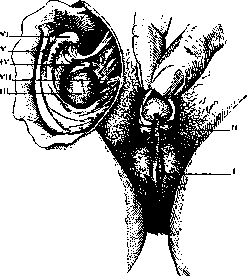
Figure 1. Ovotestis (H. verus); case of Simon (according to Hirschfeld): I - sexual cleft; II - clitoris; III - testes; IV - ovary; V - Fallopian tube; VI - epoophoron; VII - epididymis.
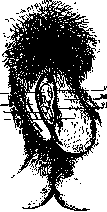
Figure 2. Pseudohermaphroditismus masculinus: I - clitoris (in this case penis); II - labium majus dextrum; III - labium majus sin.; IV - palpable testis in the left lip; V - labia minora; VI - external opening of urethra; VII - vaginal or scrotal cleft (according to Hirschfeld).
Two circumstances must be taken into account here: first, the laws governing normal sex determination (in the sense of the formation of one or another gonad), and second, the factors influencing the development of all other sexual characteristics; in the second respect, in turn, one must keep in mind: on the one hand, the sequence of embryological development of the internal and external excretory sexual pathways, and on the other hand, the recent works of Goldschmidt on the question of intersexuality (see). The latter, however, are not without significance for understanding true Hermaphroditism. Sex, according to modern views, is inherited, according to Mendel, just like many other traits, and this process is regulated by a special chromosomal mechanism (see Sex). Deviations from the latter could explain some cases of Hermaphroditism. But, besides zygotic intersexuality, Goldschmidt also distinguishes hormonal intersexuality. Such cases have been described in cows: sometimes twin calves are born; the latter, in the case of their origin from different eggs, can be of the same sex, but can also be of different sexes; sometimes it happens that one calf is of the male sex, and the other is intersexual (a mixture of both characteristics). The latter, as established by Lillie (1911), as well as by Keller and Tandler (Keller, Tandler), is essentially of the female sex, but the testicle of the first calf develops earlier than the ovary of the second, and since the fetuses establish a common blood supply (common chorion), the hormones produced by the testicle begin to suppress differentiation in the female direction. The embryological data on the development of both internal (except for the gonads) and external sexual organs are as follows. Both types of organs are initially indifferent, but in the further development of the sexual organs proceeds selectively: in differentiation toward the male sex, some of the organs of the embryonic system develop, while in differentiation toward the female sex, others develop, and in both cases, the organs that do not receive further development (according to Hirschfeld) subsequently either disappear or remain in a rudimentary state: in the first case, for example, the genital tubercle located at the anterior edge of the sinus urogenitalis grows rapidly, and from it the corpora cavernosa penis are formed; the genital folds fuse along their edges throughout their entire length, except for the end of the penis, as a result of which the embryonic sinus urogenitalis is transformed into the urethra, and in the thickness of the fused folds there appears the corpus cavernosum urethrae and glans penis. Finally, the genital ridge, also fusing along the midline, forms the labia majora; testes; the clitoris is similar to the penis in u. navicularis, the glans penis, etc. In the case of development of the female sex, the changes in the embryonic organs proceed in this way: the genital tubercle grows little and transforms into the clitoris. The genital folds and genital ridge grow, but no fusion occurs between them, as a result of which the sinus urogenitalis remains open downward along its entire length, transforming into the vestibulum vaginae. The genital folds, growing, form the small, and the two halves of the ridge form the large labia (see Figure 7). Correspondingly, the internal sexual organs also differentiate, which is evidenced, among other things, by the presence of rudiments of the opposite sex—uterus masculinus and remnants of the tubes in men, and hydatids and epoophoron parts of the Wolffian duct in women. Under such conditions, as is easy to understand, a delay in differentiation in the male direction at a certain stage of embryonic development can easily give the individual, from the side of its external and internal genitalia, characteristics of the opposite sex. One could associate pseudo-Hermaphroditism with intersexuality, seeking for the explanation of the latter similar moments, and even such phenomena, attributed by some authors to true Hermaphroditism, as cases of ovariotestis, could with good reason also be interpreted as higher forms of the same intersexuality. In analogy to the phenomena in the genus gynandromorphism, one could place the cases of so-called mosaic bastards, when in crossing traits one does not dominate over the other, and both as if retain their autonomy. 'Manliness' in women (virago) in a number of cases could be explained by the manifestation of male traits that were in a latent state on the basis of suppression of ovarian function, for which sometimes, as in hirsutism, there are special reasons. The cases of so-called 'bearded women' (see Hairiness, Figure 2, and Hirsutism, Figure 1), while maintaining menstruation, etc., perhaps admit interpretation in the sense of the absence of complete centralization of sex hormones in the sex glands, similar to what occurs in insects.
G. Sakharov. Medico-legal significance of hermaphroditism. Hermaphroditism has great medico-legal interest from the point of view of determining reproductive capacity, as well as in social and legal respects. One usually has to deal with false Hermaphroditism, when only the external sexual organs take on the appearance of the other sex, or when the internal sexual organs have also developed incorrectly simultaneously with malformation of the external ones. In such hermaphroditic individuals, it is important from childhood, aside from purely medico-legal inquiries, to determine the sex (connected with many social relations of a person). Expert examination in such cases has, if not a decisive role, then enormous significance, but presents particular difficulties, especially in children, when examination is possible almost only of the external sexual parts, which usually have an indeterminate appearance; internal examination of the sexual organs in children does not lead to a result due to the frequent combination of malformation of the external parts with cryptorchidism, descent of the ovaries into the inguinal canal, hernial formations, bulbous thickening of the round ligaments, enlargement of lymph glands, etc.
Upon reaching sexual maturity, a more correct diagnosis of Hermaphroditism can be made based on the manifestation of sexual characteristics; among them, the appearance of semen or menstruation is considered the most important, then the general appearance of the subject, its sexual inclinations, voice properties, and larynx shape. But, unfortunately, these signs do not have absolute significance and can lead to various errors. Klebs (Klebs) considers the presence of small lips as an important sign for determining sex, since they cannot form with simple underdevelopment of the penis and perineum. Casper (Casper) proposed to use the location of hair on the pubis to distinguish sex, but others (Schulte, Hofmann) refuted the significance of this sign through their research. The general appearance of the subject has great importance in determining sex; but this sign, as experience shows, has led to various errors: habitus in normally developed individuals is extremely varied; it is not uncommon to find women (virago, viraginitas) with a sturdy skeleton, muscular, and even bearded, just as it is not uncommon to find beardless, effeminate men; by analogy with eunuchs and castrates, one should expect that male hermaphrodites should be beardless and effeminate, and conversely, in female hermaphrodites a developed male appearance is encountered, and in particular a beard, as in Marie Magdalene Lefort (see Hairiness, Figure 2, and Hirsutism, Figure 1). The shape of the pelvis, according to Schroeder (Schroeder), is determined by the development in women of the sexual parts located in the small pelvis, which apparently is confirmed by cases of women in whom there is a combination of general narrowing of the pelvis with underdeveloped sexual organs; also in castrated Indian women the pubic arch appears very narrow; conversely, according to Kolisko (Kolisko), the shape of the pelvis does not depend on the development of the sexual organs and is an independent sign of male or female differentiation. Also far from fully reliable signs for differential diagnosis are the properties of the larynx, since although the protrusion of the 'Adam's apple' and a rough voice are undoubtedly characteristic of a man, under ordinary conditions there is great diversity in this respect, namely, a rough voice in women and, conversely, a high thin voice in men.
The presence or absence of breasts also does not have absolute significance for distinguishing sex in Hermaphroditism; for example, they were absent in some cases of undoubtedly female Hermaphroditism, and conversely, in Ekaterina Goman (Klebs' case) they were present, despite the proven discharge of semen. More or less developed
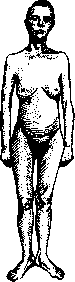
Figure 4. External sexual organs (for Figure 3):
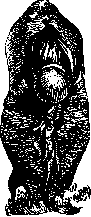
Figure 5. Pseudo-hermaphroditism femininus (according to Zondek).
Figure 6. Pseudo-hermaphrodit. femininus: sexual organs of a five-year-old child. Was considered a boy, since the genitalia resemble a penis and the genital folds are so closely adjacent to each other that a resemblance to a scrotum is obtained. On autopsy—uterus, tubes, ovaries (according to Hirschfeld).
The sexual organs of a five-year-old child. Was considered a boy, since the genitalia resemble a penis and the genital folds are so closely adjacent to each other that a resemblance to a scrotum is obtained. On autopsy—uterus, tubes, ovaries (according to Hirschfeld).
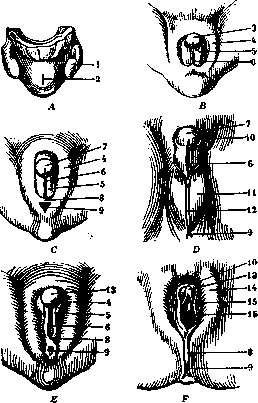
Figure 7. Development of the external genitalia of males and females (from a preparation by Zigler according to Zernov): A - external genitalia not yet visible, embryo of the 6th week; B - indifferent form of external genitalia in an 8-week embryo; C and D - changes in the external genitalia during the development of the male sex (C - embryo 2½ months; D - 3 months); E and F - changes in the external genitalia during the development of the female sex (E - 2½ months; F - 4½ months): 1 - lower limb; 2 - cloacal opening; 3 - genital tubercle; 4 - genital ridge; 5 - genital folds; 6 - sinus urogenitalis; 7 - penis; 8 - bridge of skin separating the sinus urogenitalis from the anus, future perineum; 9 - anal opening; 10 - prepuce; 11 - scrotum; 12 - raphe perinei et scroti; 13 - clitoris; 14 - labia majora; 15 - labia minora; 16 - vestibulum vaginae (according to Zernov).
breasts, furthermore, have been repeatedly observed in ordinary men, and swelling of the mammary glands and secretion of milk often occurs in newborn girls and boys. Since ancient times, inclinations, habits, and sexual attraction have been noted for determining sex in hermaphroditism, but this can have only conditional significance; habits in both childhood and later age are determined mainly by upbringing and environment and depend little on sex. Temperament does not fully depend on sex. Attraction to the opposite sex could generally characterize the sex of a given subject, but in individual cases gross errors are possible (compare, for example, sexual perversion in the mentally ill). The discovery of semen formation could be strong evidence of a subject's belonging to a particular sex, but unfortunately, in hermaphroditism, the testicle rarely reaches normal development, and the vas deferens is either absent or has no lumen or ends blindly; in these cases, the formation and secretion of semen containing spermatozoa can rarely be encountered. The appearance of menstrual bleeding would seem to leave no doubt in determining sex, however, errors are even possible in this respect, since bleeding similar to menstrual bleeding does not yet indicate the absence of testicles. In general, the literature describes many cases where men lived for several years in marriage with male hermaphrodites, and both were happy; from this it follows, on the one hand, that sexual feeling can exist with atrophy or underdevelopment of the corresponding sex glands, and on the other hand, only supposed femininity can cause sexual excitement. From what has been said, it is clear that determining the sex of adult hermaphrodites is often no less difficult than in children: there are known hermaphrodites who were exhibited at medical faculties, examined by higher representatives of science, and yet during their lifetime were considered sometimes men, sometimes women (example - Ekaterina Goman); therefore, it must be admitted that for an accurate diagnosis of the sex of a hermaphrodite, in most cases, a medico-legal autopsy and proper patho-anatomical examination of the sex glands are necessary, which is especially important when the determination of sex in hermaphroditism affects the rights of other persons. Hermaphroditism presents medico-legal interest in that such persons can be accused of unnatural sexual intercourse and of corrupting and raping minors entrusted to their care. In criminal literature, these cases are numerous. The modern significance of determining the sex of hermaphrodites may arise in civil cases in connection with the question of alimony. When assessing male capacity in hermaphroditism, it should be borne in mind that wrinkling and shortening of the penis with simultaneous hypospadias cannot yet prevent coitus, and with normal development of one testicle and its duct, the possibility of fertilization cannot be denied. The state of the psyche in hermaphroditism has not yet been sufficiently studied, but by analogy with eunuchs and castrates in early childhood, it must be assumed that they should also have significant deviations in this respect - lack of mental strength and energy and especially lack of moral feeling. Hermaphroditism is sometimes combined with feeble-mindedness and a depressed state of mind. The latter is understandable in view of the deformity, which hermaphrodites try to hide. The peculiarities of the psyche of hermaphrodites, sometimes associated with the desire to hide their deformity or relating to more complex psychopathies, should be taken into account when deciding on the responsibility of a hermaphrodite accused of any crime. a. Kryukov. Psychic hermaphroditism (hermapb.ro-disia psychica Krafft-Ebing), preservation in homosexuals of inclination and ability for sexual intercourse with persons of the opposite sex (a somewhat outdated term, now more often referred to as bisexuality). According to Hirschfeld, this phenomenon occurs significantly more often than pure homosexuality and is rarely accompanied by any abnormalities in the structure of the sexual apparatus. Sometimes both types of sexual attraction exist simultaneously, sometimes they periodically replace each other. Most often, the attraction to the opposite sex is most strongly expressed in the period of greatest sexual vigor, i.e., between 20 and 30 years, after which it gradually dies out. Much more rarely is it the case that both tendencies exist constantly in the personality, manifesting in one way or another depending on the subject's accidental disposition at a given moment, one or another encounter, etc. Opponents of the theory of congenital sexual anomalies (Kraepelin, Freudians) use the fact of the existence of bisexual personalities as an argument in their favor: it seems to them that psychic hermaphroditism best illustrates both the polymorphism of sexual attraction and its ability to undergo all sorts of changes under the influence of environmental and life conditions. However, such a fine connoisseur of the psychology of homosexuals as the German writer Hermann Bang decisively denies such considerations with respect to bisexuality and believes that bisexual personalities are latent homosexuals, differing from pure types of this anomaly by their excessive sensuality, which reacts to irritations from persons of the opposite sex, but always and regardless of the life situation returns to its basic inclination (see also Homosexuality and Intersexuality).P. Zinoviev. Hermaphroditism in animals. Hermaphroditism for some animal species is a natural state (natural hermaphroditism), while for others (including the vast majority of vertebrates and humans) hermaphroditism appears as an exception, as an anomaly, as a result of a perverted, pathological course of development in one or another individual among normally unisexual individuals (pathological hermaphroditism). Natural hermaphroditism is characteristic of many groups, especially parasitic worms (flukes, tapeworms, some roundworms), ciliated worms, annelid worms (leeches, earthworms), many mollusks, ascidians, etc. In the case of natural hermaphroditism, the male and female sex glands can function simultaneously throughout the life of the individual (flukes, tapeworms, etc.), or the individual functions in the first part of its life as a male, and in the second part of its life as a female (many isopod crustaceans, some mollusks from Prosobranchia), or the hermaphroditic individual functions alternately, periodically, sometimes as a male, sometimes as a female, i.e., in the sex gland, either sperm or eggs are produced (the hermaphroditic generation of the frog's lung roundworm - Angio-stomum nigrovenosum, many gastropod mollusks). Since in natural hermaphroditism the sex glands function normally, i.e., they produce germ cells capable of fertilization, natural hermaphroditism is called functional. Pathological hermaphroditism manifests in extremely diverse forms and can be analyzed on the basis of modern concepts of the mechanics of sex trait development, according to which two groups of animals should be distinguished. Representatives of one group are vertebrates. In them, the development of secondary sexual characteristics is strictly dependent on the secretions of the sex gland (see Sexual characteristics). Such development of sexual characteristics can be called centralized. Representatives of the second group are insects, in which it has not yet been possible to establish a dependence in the development of secondary sexual characteristics on the sex glands - such development should be called decentralized. In the case of the decentralized type of development of sexual characteristics (in insects), two types of mixing of male and female traits are observed in hermaphroditic individuals. In one case, certain secondary sexual characteristics, for example, antennae, copulatory organs, etc., specifically constructed in a normal male and normal female, have an intermediate (intersexual) form in the hermaphroditic individual. In another case, in one or another individual, there is as it were a mosaic of correctly constructed male and female traits; for example, there are known cases of mulberry silkworm butterflies, bees, and other insects in which on one side of the body there is a normally developed ovary with well-developed sexual ducts, and on the other side a normally constructed testis with male ducts. Corresponding to the sex glands, the external sexual characteristics, expressed in the form of antennae, coloration of the coverings, in the form of bristles or scales, etc., can be, on the one hand, of the male type, and on the other, of the female type. Not always, however, do the external sexual characteristics develop in accordance with the sex glands. Cases are observed where, despite the fact that a male sex gland lies on the right side, the external sexual characteristics of this side have female traits.
There are known cases when the anterior part of the body has male characteristics, while the posterior part has female ones, without any connection to the gonads, or when male and female characteristics are mixed on the surface of the body in a disorderly mosaic form. Individuals whose secondary sexual characteristics represent an intermediate form between the characteristics of the male and female are called intersexual (see Intersexuality); individuals whose properly developed male and female characteristics alternate in a mosaic form are called gynandromorphs (see Gynandromorphism). The mechanics of development of intersexual and gynandromorphic individuals within species with decentralized development of sexual characteristics is not entirely clear. There are, however, reasons to believe that the development of male or female characteristics is connected with the chromosomal complex of cells, and that in the case of gynandromorphs, the mosaic of secondary sexual characteristics is connected with the mosaic distribution of cells, some of which have a male and others a female chromosomal complex. The formation in one individual, along with cells that have a male chromosomal complex, of cells with a female chromosomal complex, is possibly connected with the abnormal distribution of chromosomes during division during individual development. The development of intersexual forms from the point of view just developed is connected with the fact that such individuals in all their cells, although they have the same chromosomal sex complex, this chromosomal complex has intermediate characteristics between the complex of a normal male and a normal female (Goldschmidt). The question of the nature of hermaphrodites can be more fully illuminated from the point of view of the mechanics of development in animals with centralized development of sexual characteristics, for example, in vertebrates. The external expression of H. within individuals of the same species can be extremely diverse. H. can be expressed in the form of a combination in one individual of only external (so-called somatic) secondary sexual characteristics of the male and female (for example, a beard in an otherwise almost normal woman), or in the form of a combination not only of somatic secondary sexual characteristics, but also of characteristics of the conducting sexual pathways (strong development of the clitoris in a woman or underdevelopment of the penis in a man), or in the form of the simultaneous presence in the organism of testicular and ovarian tissue (in the form of one mixed gland-ovotestis or in the form of separately existing testes and ovaria). The presence in the organism of ovotestis or anatomically separate testis and ovary is usually associated with a simultaneous mixing in such an individual of male and female characteristics in the conducting sexual pathways and in somatic characteristics. The numerous experiments at present on castration and transplantation of gonads (Steinach, Tandler, Sand, Lipschiitz, M. Zavadovsky, etc.-on mammals; Goodall, Pesar, M. Zavadovsky, etc.-on birds; Nussbaum, Breska, Champy, etc.-on frogs) allow for a closer analysis of the conditions for the manifestation of H. From the point of view of the dependence in the development of sexual characteristics on the gonads, the entire complex of sexual characteristics in vertebrates should be divided into four groups (see Sexual characteristics, Secondary sexual characteristics). 1. Sexual endocrine glands-primary sexual characteristics. 2. Characteristics dependent on the testis-M-eusexual. 3. Characteristics dependent on the ovary-F-eusexual. 4. Characteristics independent of the gonads-pseudosexual. 5. Characteristics independent of the gonads-somosexual. a) I' Among the dependent M-eusexual characteristics, which develop only in the presence of a testis, are: the comb, beard, and wattles of the rooster, the singing and instinct of the rooster, the horns of deer and roe deer, the typical hair covering on the pubis and body, including the mustache and beard of a man, the low voice of a man, the full development of the seminal vesicles and prostate of male mammals, etc. Among the dependent F-eusexual characteristics, which develop only in the presence of an ovary, are: the feather dress of the hen, the hen instinct, the full development of the mammary glands in women and female mammals, the oviduct and other conducting sexual pathways of the female, etc. Among the pseudosexual characteristics, which develop in the absence of gonads equally in males and females, are the male plumage of birds, the spurs of gallinaceous birds, the plumage of female mammals in form and color, etc. Somosexual characteristics, which develop independently of the gonads differently in males and females, are represented in vertebrates very weakly; to them perhaps belongs such a characteristic as the color of the beak in the drake and duck, and a few others. Hermaphroditic individuals may carry within themselves: 1. A combination of somosexual, pseudosexual, and M-eusexual characteristics (in various degrees of their development). 2. A combination of somosexual, pseudosexual, and F-eusexual characteristics (in various degrees of their development). 3. A combination of somosexual, pseudosexual, M- and F-eusexual characteristics. 4. A combination of somosexual, M- and F-eusexual characteristics. From the presence of M-eusexual or F-eusexual characteristics in a hermaphrodite, one can conclude about the presence in the organism of testicular or ovarian endocrine function. Even in the recent past, when it was assumed that any secondary sexual characteristic in vertebrates requires for its development one or another sexual internal secretion, an incorrect conclusion was often drawn from the presence of a pseudosexual characteristic, for example, the rooster's feather in a hen or the female hair covering in a man, about the presence in the organism of glandular sexual tissue of the other sex. The relative degree of development of pseudosexual, M- and F-sexual characteristics depends on the age of the individual and the beginning of function or the time of fading of the male or female internal secretion. In some cases, a mosaic of male and female sexual characteristics is obtained. Experiments on the artificial creation of hermaphrodites by transplanting the male gonad to females and the female gonad to males were carried out by Steinach and Sand on guinea pigs, M. Zavadovsky on chickens. The artificial hermaphrodites of Steinach alternately manifested either the male or the female instinct, the hermaphroditic chickens of Zavadovsky had the plumage of the female but trampled on hens and crowed like roosters. It is of interest that the testis of a rooster, transplanted to a normal hen, took root so well in some cases that spermatozoa developed excellently in the transplanted gland while the ovary was normally ovulating. It has been experimentally established that any female bird (at least a hen) is potentially hermaphroditic, or more precisely, bisexual (see Bisexuality). The latter is evident from the fact that any hen after complete, and sometimes partial, removal of her single left ovary soon develops on the right side a gland that is structurally close to a testis. Along with the development of the testis-like gland in a castrated hen, the rooster's head ornament, voice, male instinct, and along with this, female feather develop. In connection with the potential H. of hens (bisexuality), in them often (especially in old age) the crowing voice and manifestation of the male instinct are observed. The crowing voice and rooster plumage of hens, pheasants, and other birds, the drake plumage of ducks, etc., is a phenomenon well known in poultry farms. In some birds, for example, in bullfinches and chaffinches, very rare cases are observed of such a distribution of characteristics of the male and female as is described in insects under the name of gynandromorphism. On one side was an ovary, on the other a testis; that half of the body that carried the ovary had an oviduct and was colored the same as in the female; that same half of the body that carried the testis had a vas deferens and male plumage. Whether a parallel can be drawn with the gynandromorphism of insects is not entirely clear. The conclusions firmly established on birds about the potential bisexuality of any female individual cannot, at least at present, be extended to mammals. There are some reasons to believe that, while in birds the female is potentially bisexual, in mammals the male is potentially bisexual. This point of view is not shared by all, however. Many researchers think that in birds and mammals both males and females are potentially bisexual, i.e., both sexes (see Sexual characteristics). In general form, it can be said that the development of H. in vertebrates stands in complete and clear dependence on the endocrine function of the gonad in the present or past. The gonads possess functions through which in vertebrates the development of the overwhelming majority of other sexual characteristics is carried out. The endocrine function of the gonad is, however, not completely autonomous; it in turn depends on the endocrine function of other glands of internal secretion (especially the pituitary, thyroid, and cortical layer of the adrenal gland) and other internal and partly external factors. Among the most responsible internal factors determining the development in the organism of gonads of one or another type, the chromosomal complex of the zygote should be kept in mind (see Sexual characteristics).
Abnormal hermaphroditic development of an individual often originates from disorders in the chromosomal complex of the zygote, but in some cases, hermaphroditic development is associated with conditions of embryonic development. As an illustration of the latter point, one can mention the cases of free-martin described by English authors. Free-martin refers to twins of different sexes, often observed in cows and goats, characterized by the fact that one individual of the pair develops as a normal male, while the other develops as a hermaphrodite. Keller and Lillie showed that free-martins are born when a common fetal blood circulation is established between the developing male and female fetuses located side by side. The internal secretion of the male fetus enters the vascular system of the female fetus and distorts the development of the latter's sexual characteristics. If there is no vascular connection between the fetuses of different sexes, then the development of both individuals (male and female) proceeds normally.
M. Zavadovsky.
Related articles
Mentioned in
Cite this page
“Hermaphroditism.” Soviet Medical Encyclopedia. English translation of Bolshaya Meditsinskaya Entsiklopediya, 1st ed. (Moscow, 1928–1936), ed. N. A. Semashko. https://sovietmedicalencyclopedia.pages.dev/article/hermaphroditism/