Sanitary Physician
Historical document, translated for reference. It reflects medical knowledge of the 1920s–30s and is not medical advice.
Summary
A practical physician specializing in sanitary affairs who typically no longer works in clinical medicine. This role emerged with the development of preventive healthcare methods, focusing on environmental observation and preventive measures.
Encyclopedia article (1928–1936)
SANITARY PHYSICIAN, a practical physician who specialized in sanitary affairs and usually no longer worked in clinical fields. With the gradual development of preventive healthcare methods, separate groups began to emerge among medical doctors, to which various collectives or the state as a whole began to entrust the functions of monitoring the environment to prevent diseases, as well as carrying out corresponding preventive measures. In its initial outlines, this activity had primarily an administrative-prohibitive character and operated within the narrow framework of primitive sanitary supervision, mainly in the direction of its simplest form - current supervision (see Sanitary Supervision). In this initial stage
~*U-
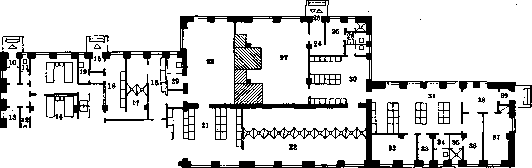
Figure 2. Sanitary pass-through station of II category: 1-entrance; 2-barbershop; 3-household room; 4-registration desk; 5-waiting room for those washing; 6-wardrobe; 7-shower; 8-personal changing room; 9-toilets for those washing; 10-entrance to isolation ward; 11-toilet for isolated persons; 12-toilet; 13-household room; 14-isolation wards (2 rooms); 15-exit from individual shower; 16-dirty changing room for individual shower; 17-individual shower; 18-dressing room for individual shower; 19-toilet for individual shower; 20-examination room; 21-changing room for group sanitary processing; 22-shower; 23-entrance and exit from clean department of disinfection section; 24-vestibule; 25-personal for clean chamber section; 26-toilet for clean chamber section; 27-clean chamber department; 28-dirty chamber department; 29-toilet at dirty department; 30-waiting-dressing room; 31-dressing room; 32-vaccination room; 33-household room; 34-toilet; 35-shower for staff; 36-personal; 37-head's office; 38-antechamber-cooling room; 39-exit from clean half of sanitary pass-through station.
In the early development of sanitary affairs, these functions could be performed by individuals without medical training due to the simplicity of prohibitive practices as the main method of work during that period. Such were the sanitary officials (aediles and curators) in Rome for supervising food products and for urban improvements; such were various administrative and police agencies that managed and, to some extent, still manage in many countries the current sanitary supervision. The complication of sanitary work and the expansion of the fields of sanitary affairs, primarily in the area of combating infectious diseases, increased the requirements for sanitary personnel, and the development of hygiene as an experimental science, as well as bacteriology with their laboratory methods, served as the moment that determined the final separation of a group of doctors specializing in these areas for corresponding practical activities. For quite a long time, it was considered possible to combine sanitary and therapeutic functions in one person. This was particularly emphasized in a number of different administrative medical positions, which began to be created by the state at the end of the 18th century as organs of government supervision in medical affairs. The combination of various functions in one person (treatment of patients, forensic medical duties, and finally the tasks of sanitary supervision) is characteristic of the institutions of government physicians in Germany, former Austria-Hungary ('district physicians'), and old Russia ('urban and county physicians'). However, this situation can be considered only a transitional stage, and, as sanitary tasks and the state significance of health measures were precisely identified, the separation of a separate institution of sanitary physicians became a universal fact. Among the first groups of sanitary physicians were physicians at sanitary councils in England, who received the name 'Medical officer of health' (medical official for health care), with their staff of sanitary inspector assistants (Sanitary inspectors). In France, the term 'Medicin inspecteur d'Hygiene' is common, under which sanitary physicians working at hygiene bureaus in departments and cities fall. In old Russia, the term 'sanitary physician' was adopted in zemstvo practice, and then in urban practice; from 1917/18 it became generally accepted in the work of Soviet health agencies. In accordance with the complex requirements now imposed on a physician in carrying out sanitary measures, especially in the field of preventive sanitary supervision and sanitary inspections, the scope of knowledge that a sanitary physician must possess has also expanded. Here, first of all, the diversity of objects subject to sanitary supervision has been identified (the external environment, socio-economic and living conditions, professional groups). Then comes the variety of methods and techniques used in sanitary work—sanitary-statistical studies, sanitary-topographical surveys and descriptions, anthropometric studies, bacteriological and hygienic laboratory methods, sanitary-technical aspects—ability to understand plans and drawings, etc. This nature of the sanitary physician's work also emphasizes a new feature—the need for the closest connection with the mass of the population, with various public organizations and departments; public methods of work—ability to give reports, lectures, conduct various sanitary campaigns, organize health education—all these are common techniques in the activities of sanitary agencies. Thus, life has more or less everywhere outlined the general contours of tasks set for sanitary physicians in their work, specializing these contours for various fields of sanitary affairs. In the conditions of the USSR, where health care particularly sharply emphasizes its preventive functions and its sanitary direction, the question of the so-called 'profiles' of sanitary physicians was subjected to special development. In accordance with the division that already exists in the practice of sanitary affairs in the form of separate special fields, sanitary physicians in the USSR, as established by the legislation on sanitary agencies (1927), are divided into several groups—general sanitary physicians, sanitary physicians for housing and communal supervision, for food supervision, for industrial supervision, for epidemiology (epidemiologists). Within these specialties, more detailed groupings are also identified—physicians for public catering, physicians for water sanitation, for planning populated areas, for disinfection, etc. However, both according to the law and according to the most accepted practice, the main types of sanitary specialties (excluding the so-called general sanitary physician) are the four groups mentioned above: housing and communal, food, industrial, and for epidemiology (see Sanitary Organization). The profiles developed for these main types of sanitary supervision are as follows. 1. Profile of the general sanitary physician (district and area sanitary physician in the city and in rural areas). From a physician of this specialty is required: a) to be politically prepared for broad work in organizing sanitary affairs and socialist health care as part of the general socialist reorganization of the country; b) to be theoretically prepared in hygiene and epidemiology in full; c) to be familiar with the main laboratory techniques and methods and with the production of corresponding analyses for sanitary and bacteriological investigation of the external environment; d) to be able to understand projects and drawings of sanitary-technical structures and buildings, to be able to compile the necessary sanitary assignments for these projects, to give the necessary sanitary expert opinions and consultations; e) to have information on the general organization of sanitary affairs in the USSR and in other countries and to be familiar with questions of sanitary legislation, state and local; f) to be knowledgeable in questions of legislation and practice in the fields of communal economy, labor protection and nutrition; g) to be able to independently process materials on general sanitary statistics, on the compilation of mandatory sanitary rules and regulations, to prepare necessary reports, reports, etc.; h) to master the general methods of sanitary education and the organization of public initiative. 2. Profile of the housing and communal sanitary physician: points a, b, d, e, f, g, and h—the same as above; in addition, this sanitary physician must: c) be fully prepared and possess the ability to produce sanitary analyses for hygienic and bacteriological investigation of the external environment (air, water, soil, housing, etc.); d) to be familiar with the basic techniques of drawing and surveying plans, to be able to freely read the corresponding projects and plans, to give expert opinions and conclusions on them, to compile assignments; e) to be informed on the main questions of sanitary engineering in the field of urban improvements and housing construction, new construction, state farms and collective farms (heating, ventilation, sanitation, water supply, sewerage, construction); f) to be informed on sanitary-technical questions in the construction of special purpose buildings (schools, clubs, baths and laundries, factory kitchens, medical and resort construction, nurseries); g) to be familiar with the general problems of communal economy and industrial construction in the USSR and abroad. 3. Profile of the sanitary-food physician: points a, b, d, e, f, g, h—the same; in addition: c) to be knowledgeable in the basic techniques of laboratory-food analysis (sanitary and bacteriological investigation) of food products—animal and vegetable raw materials, semi-finished products and food supplies, ready-made dishes; to be able to give corresponding conclusions and expert opinions; d) to be prepared in the field of food product inspection; e) to be prepared in the field of commodity science and technology of production of the main groups of food products (dairy, meat and fish, canning, fruit and vegetable, bread and confectionery production), as well as in questions of their storage and transportation; f) to be familiar with the basic questions of physiology and pathology of nutrition (food poisoning), dietetics and cookery; g) to be well acquainted with the organization and tasks of public catering. 4. Profile of the sanitary physician for industrial supervision: points a, b, d, e, f, g, h—the same; c) to be prepared in the field of hygiene and physiology of labor, as well as hygiene of individual productions; d) to be familiar with the main production processes in the leading branches of industry (chemical, metallurgical, mining, textile), as well as socialist agricultural industry; e) to master laboratory methods for investigating the industrial environment (meteorological factors, radiant energy, dust content, lighting, gases); f) to be informed on the general tasks of industrial construction in the USSR, on legislation for labor protection and safety engineering, on the organization of health posts at enterprises, and on the material of occupational morbidity; g) to be familiar with questions of communal improvements at enterprises and in particular with questions of neutralization and purification of industrial wastewater. 5.
Profile of the epidemiologist physician: a) the same point; b) to be theoretically familiar in full with epidemiology, bacteriology, and hygiene in their main sections; c) to master laboratory methods of bacteriological analysis, in particular to be prepared in the methodology of sanitary-bacteriological studies of the external environment; d) to be fully prepared in the theory and practice of disinfection work, both in the field of disinfection and disinsection and deratization, as well as in all matters of sanitary processing of human contingencies and vaccination; e) to be informed on general questions of the clinic of infectious diseases and the main methods of diagnosis of the main groups of the latter; f) to be practically prepared in carrying out measures to combat contagious diseases, informed in the field of anti-epidemic and general sanitary legislation, as well as with the practice of international sanitary conventions in this matter; g) to master general methods of sanitary statistics and sanitary education, as well as the organization of public self-activity. - In addition to these basic profiles, S. v. may have (and in practice in the USSR have been compiled) profiles of S. v. for railway transport, S. v.-administrators (senior sanitary inspectors, etc.). Finally, sanitary functions of physicians at health points are particularly highlighted; who according to the 'Regulations on Health Points' (RSFSR, 1931) are given certain tasks in this regard. The compilation of profiles of S. v. should of course, giving general outlines, also have sufficient flexibility to timely include new demands of life and accordingly supplement the equipment of Sv. It should be noted that in some countries the term 'sanitary physician' is also applied to those preventive physicians who work in the corresponding areas of combating social diseases, protection of infancy, etc. Such are in England so-called S. v. for tbc, for venereal diseases. Preparation of S. v. In various countries at present, different methods of preparation (and improvement) of S. v. have been established. In most European countries, a certain diploma or certificate of completion of a preliminary training period is usually required for S. v. Thus, in England, completion of a one-year training course (6 months - studies in hygiene and bacteriology, 3 months - infectious disease hospital, 3 months - practice in sanitary affairs) is required; in Germany, where the functions of Sv. on site are usually performed by district government physicians, the latter also study hygiene on preparatory courses. In addition, in Germany several special courses for the preparation of physicians in the field of prevention have now been created. In France, by a special circular of 1906, rules for the admission of physicians to local hygiene bureaus were established; according to these rules, physicians are required to submit documents about their work in the field of public hygiene (see corresponding articles on individual countries). - In old Russia, the first courses for the preparation of Sv. were organized in the Bacteriological Institute of Prof. P. N. Diatropov in Moscow (1909/10). Then by order of the government, three-month courses for S. v. were organized in Leningrad (former Eleninglin clinical institute-laboratory of Prof. G. V. Khlopin) and in Moscow at the medical faculty of Moscow University (Prof. S. S. Orlov). These courses mainly provided acquaintance with the methodology of hygienic research. In general, through these courses in the pre-war period, a small number of physicians passed, usually seconded by zemstvos and cities. Courses for the preparation and improvement of Sv. developed widely after the revolution. Under the NKZdr. of the RSFSR (as well as in Ukraine), from the very first years of Soviet power, annually repeating courses for Sv. began to be organized. The organization of these was under the jurisdiction of the sanitary-epidemic management of NKZdrav; the academic part was then entrusted in Moscow to the State Institute of Public Health (GINZ), organized in 1922, through its Sanitary-Hygiene Institute, and in Leningrad - to the State Institute for the Improvement of Physicians. The courses were initially 4-month, with an enrollment of 50 students each. The main task was to supplement the knowledge of local S. v. With the development of sanitary affairs and the need for rapid increase in 6(51 personnel, the issues of preparation and retraining of Sv. came to the forefront. This role is now performed by the V.RSFSR Central Institute for the Improvement of Physicians (TUI) in Moscow, the Institute for the Improvement of Physicians in Leningrad. In addition, similar courses exist in Ukraine in Kharkov (Ukrainian Institute). In accordance with the demands of life, these courses for Sv. are divided into 1) courses for general sanitary physicians, 2) courses in the main specialties of sanitary affairs (food, communal, industrial, epidemiological) and finally in narrower specialties (physicians for water sanitation, for malaria, etc.). In recent years, the annual number of these courses already amounts to several dozen, and the number of students to several hundred (in Moscow in TUI in 1932, over 400 students). The term is now set at 3 months [physicians seconded by local health departments are accepted to courses (according to the allocation of NKZdr.)]. The repeatedly worked-out programs and curricula of these courses are now more or less stabilized. In the general sanitary course, the curriculum consists of 570-600 hours, of which communal hygiene takes 200-240 hours, nutrition hygiene 80-100; industrial hygiene 80 hours, epidemiology with disinfection 120-140; organization of health care and sanitary affairs with sanitary statistics 40 hours. In addition, military sanitary affairs and social sciences (dialectical materialism) are studied. In courses for specialties, the main part of time is spent on in-depth study of the corresponding special disciplines, as well as related ones (drawing, meteorology, hydrogeology, courses in sanitary engineering-heating, ventilation, etc.). In addition to theoretical classes, laboratory classes and so-called practical training are widely used, i.e. internship of students in the area under the guidance of peripheral S. v. in their current work. The ratio of theoretical and practical classes (work in production) is 60 and 40%. The method of excursions or independent study of individual topics at specific sites is also widely used. Special courses for the retraining of S. v. are now also conducted, i.e. switching physicians of other specialties to work as S. v.; here well-organized practical training is of particular importance. - The shortage of S. v. gave impetus in the USSR to the organization of special departments for their preparation in medical institutes, i.e. the creation of so-called 'sanitary-preventive faculties'. They were first organized in the RSFSR in 1930 and now exist in a number of medical institutes of the USSR (their organization and programs - see Medical education). Methodology of work of S. v. Having received one or another preparation (on courses or at the sanitary-preventive faculty), S. v., starting his activity on the periphery (in the area, in the district), must carry out a certain preparatory work to familiarize himself with the territory of his area or district and the general living conditions of the latter, as well as to familiarize himself with the corresponding literary and other materials. In general, these preparatory works are as follows: 1) familiarization with materials on the economic and state of the district and its development plans; 2) familiarization with sanitary-statistical materials of the district (demography and morbidity) according to the data of statistical institutions, health departments and insurance funds; 3) familiarization with literature on the sanitary study of the district (previous reviews, medical-topographical surveys, reports), published in the local medical press in previous years or available in the form of separate monographs; 4) familiarization with the organization of health care in the district and personal tour and inspection of all medical-sanitary institutions of the district or area; 5) similar familiarization with local objects (on-site inspection) of communal economy, food industry and public catering and other structures of public character (baths, hostels, clubs); 6) familiarization with large industrial enterprises; 7) compilation of detailed lists of all objects mentioned in items 4, 5 and 6 for the subsequent proper conduct of current sanitary supervision; 8) familiarization with existing local mandatory sanitary regulations; 9) establishment of organizational ties with bodies of communal economy, labor protection, public catering, etc.; 10) establishment of close contact with public organizations related to sanitary affairs (ROKK, Ossoaviakhim, etc.). This preliminary work, carried out systematically, gives S. v. a firm support and knowledge of local conditions and forces and connects him with all those bodies and persons whose participation in sanitary construction plays a major role. Along with this organizational part of the work of Sv., it is also incumbent upon the latter to establish the conduct of sanitary surveys and current analyses. In the field of the first, one of the usual methods is the keeping of sanitary journals, the systematic filling of which for individual objects provides valuable material for subsequent conclusions and comparisons.
In the second area, all measures must be taken to organize a local sanitary laboratory or to obtain corresponding sanitary-laboratory and other equipment, with the help of which the sanitary study of the conditions of various natural environments is carried out on site. The so-called instrumentation of the Sanitary Physician constitutes an essential necessary part of his work, unfortunately often too weakly applied in practice. Approximate instrumentation of the Sanitary Physician. I. Determination of distance and direction: *1) tape measure and *2) compass.- II. Meteorological instruments: *1) room Celsius thermometer, *2) maximum-minimum Six thermometer, 3) aneroid barometer, 4) Coppe hygrometer, *5) portable hygrometer, 6) August psychrometer, 7) Füss anemometer and 8) Kata thermometer.- III. Air research: chemical methods-1) glass bottles with rubber stoppers, calibrated for taking air samples for CO2, 2) pump with rubber tube for taking air samples, 3) apparatus for microdetermination of CO2 by the Reberg-Vinokurov and Golden method; bacteriological methods-1) sterile Petri dishes (from the laboratory), 2) test tubes with nutrient gelatin (from the laboratory), 3) enameled cup, 4) tripod, 5) alcohol lamp, 6) Wolf-Lügel counter, 7) magnifying glass on legs; airborne dust- 1) glass cubic salt cells with cover glasses, with black sticky mass for catching and counting dust (from the laboratory).--IV. Water research: a) taking samples: *1) apparatus for taking water for chemical analysis with spare utensils, *2) same for bacteriological research, *3) boxes and baskets for sending water samples to the laboratory; b) physical and chemical research (on site): *1) water thermometer, 2) disk for determining transparency, 3) Pettenkofer cup apparatus, 4) Marbutene fluoroscope with fluorescein (for determining contamination); *5) field laboratory for chemical research; c) bacteriological research (colony count)- in addition to the above in section III - 1) measuring pipettes 1: 0.1 cm3 sterile (from the laboratory), 2) test tubes with sterile water for dilution (from the laboratory).-- V. Soil research: 1) Frenkel soil auger, 2) utensils for soil samples.- VI. Research on food products (simplest): a) milk-1) Kevenn lactodensimeter with thermometer, 2) cylinder for it, 3) Herber lactobutyrometers, 4) pipettes for them, 5) hand centrifuge; b) flour- *1) Rakovich apparatus; c) meat (for rot)- 1) Ebert apparatus.-VII. Lighting research: 1) Kon light tester, 2) Wing-Krüss photometer, 3) Turner photometer. VIII. Epidemiological research: 1) typhus diagnosticum by Park-Davis, 2) tuberculosis diagnosticum by Pirquet, 3) set for Schick reaction, *4) Frank needle, *5) slides and cover glasses for smears, 6) devices for their shipment, 7) apparatus for taking and shipping: *a) mucus for diphtheria, *b) excreta for cholera and typhoid fever, *c) urine, *d) blood for agglutination and Wassermann and for malaria and *e) sputum.- IX. Anthropometric research: 1) measuring stand for height, 2) fat caliper, *3) measuring tape, 4) scales, 5) spirometer, 6) audiometer, *7) test type, 8) Martié-Colley dynamometer.- X. Blood research: 1) Sahli hemoglobinometer or Talqviet hemoglobin scale, 2) apparatus for counting blood cells.-XI. Photography: 1) photographic apparatus (9x12) with movable ground glass for focusing-in a bag, 2) tripod, 3) photographic accessories.- XII. Drawing accessories: 1) drawing board, 2) T-square, *3) triangle, *4) protractor, *5) drawing set, 6) curvimeter, Whatman paper, ink, pencils, watercolors, pins, rubber, etc.-XIII. Reference books and dictionaries. This list is more or less complete; a number of analyses can of course be carried out only in the laboratory. For this, the sanitary physician must be in contact with the latter. From this list, the most necessary instrumentation (for the first time) can be selected, marked above with *. The legal status of the Sanitary Physician is determined by the tasks of protecting and strengthening the health of the population that the state power and the collective of a particular country set for themselves, depending on the socio-economic basis of the structure of that country. Therefore, the rights of the Sanitary Physician in their work will be formulated most fully and broadly when the state fully and unconditionally implements the policy of decisive provision of the population with all sanitary measures and elimination of all factors hindering this (private ownership of the means of production, old way of life, sanitary illiteracy, etc.). Therefore, in the current legislation of the USSR, the rights of the Sanitary Physician are defined much more broadly than in the corresponding laws of other countries (capitalist). The right to enter dwellings and enterprises (all without exception), the right to seize objects for examination, the right to demand from responsible persons all necessary materials and information, the right to bring to trial, impose fines, the right to judicial investigation, the right to compulsory hospitalization of contagious patients, etc. - this list of rights of the Sanitary Physician, given in the legislation of the USSR, sufficiently characterizes the fundamental difference in the approaches and tasks of the activities of the Sanitary Physician in the USSR and in other countries (see Sanitary Legislation).
A. Sisin. Material and domestic benefits for sanitary physicians. Taking into account the particularly important significance of the work of the Sanitary Physician in the conditions of the socialist reconstruction of the national economy and the radical improvement of labor and living conditions, the Soviet government has established for them a number of special benefits in the material-domestic sphere, in addition to the general benefits provided to workers in general and medical personnel in particular. On 10/1 1930, a resolution of the All-Russian Central Executive Committee and the Council of People's Commissars of the RSFSR (Collection of Laws 1930, No. 4, p. 44) "On improving the position of sanitary physicians" was issued, which established: 1) periodic additions to the received salary for length of service, starting from 1/X 1929, by 20% for every three years of continuous work as a Sanitary Physician. The maximum addition--60% (for three three-year periods); 2) scientific business trip not less than once every 5 years, for a duration of at least 3 months; 3) children of Sanitary Physicians who have worked for at least 3 years in the position of Sanitary Physician are equated upon admission to educational institutions to children of workers and 4) the next vacation is provided annually for a term of at least 1 month. For Sanitary Physicians serving rural areas and workers' settlements, the benefits established for qualified workers in rural areas according to the law of 10/VI 1930 also apply in full, namely: 1) transfer to another job can take place only with the consent of the worker (§ 6); 2) in case of dismissal for unsuitability-the right to demand the appointment of an expert commission (§ 7); 3) preservation of living space in the former place of residence if the family remained there, regardless of the duration of the Sanitary Physician's absence from the family (§ 9); 4) provision of a free apartment with heating and lighting (§ 10); 5) provision of free transport for official trips (§ 12); 6) the right to combine regular vacations for three years (all other workers have the right-only for 2 years); 7) scientific business trip not less than once every three years (Sanitary Physicians in cities-1 time in 5 years). In addition, for Sanitary Physicians serving rural areas and workers' settlements, the above-mentioned benefits established by the law of 10/1 1930 for all Sanitary Physicians in general also apply. Special benefits are established for Sanitary Physicians working to combat epidemics. By the resolution of the Council of People's Commissars of the RSFSR of 31/III 1926 (SU 1926, No. 20, art. 158) and the instruction issued to develop this law by the People's Commissariat of Health, the People's Commissariat of Labor, the People's Commissariat of Finance of the RSFSR and the All-Union Central Council of Trade Unions, it is established: 1) in case of business trip for temporary work to combat cholera, typhus or relapsing fever, the worker receives daily expenses in the amount of VIa ok~ lada, and when on business trip to combat other infections [scarlet fever, anthrax, smallpox, malaria (in heavily affected areas)]-VIe of the salary; persons who, by the nature of their service, carry out constant anti-epidemic work, may be established, by agreement with the relevant health authority, instead of daily expenses, a constant solid supplement to the main salary (§ 4 of the instruction). This includes Sanitary Physicians - epidemiologists, constantly traveling through the district to carry out measures to combat epidemics or sent for this purpose for a more or less long period outside their permanent place of residence. By the law of 30/III 1926, the right is also provided for a medical worker whose permanent disability resulted from work to combat epidemics, and in case of his death in this work-the right of his family to receive benefits according to the standards established for workers and their family members, if a worker was injured as a result of an industrial injury. Regarding the salary of the Sanitary Physician, it is stipulated in the resolution of the Council of People's Commissars of the USSR of 16/XII 1931 (Collection of Laws of the USSR No. 73, art. 489) that when establishing differential rates for physicians, a higher increase in salary must be ensured FOR sanitary physicians.
Related articles
Mentioned in
- Alexander Petrov
- Alfred Blaschko
- Arnol'dov
- Avksenty Vasilyevich Korchak-Chepurkovsky
- Bekarkhov
- Bogoslovsky, Sergey Mikhailovich
- Chistovich
- Czechoslovakia
- Dembo
- Dementiev
- DESYATOV
- DIATROPTOV
- Disinfectors
- Dyakonov, Pyotr Ivanovich
- Ersiman
- Food Legislation
- Gorokhov
- Gretchishchev
- Health Protection of Children and Adolescents
- House Fungus
Cite this page
“Sanitary Physician.” Soviet Medical Encyclopedia. English translation of Bolshaya Meditsinskaya Entsiklopediya, 1st ed. (Moscow, 1928–1936), ed. N. A. Semashko. https://sovietmedicalencyclopedia.pages.dev/article/sanitary-physician/